That's not a hypothetical. It's exactly what mass SMS makes possible on modern construction sites.
The challenge is real: construction teams are mobile, spread across multiple zones, often working in areas with no reliable internet, and rarely sitting in front of email. According to the JBKnowledge 2020 ConTech Report, 92% of the construction industry uses a smartphone daily for work — meaning the device to reach every worker is already in their pocket. SMS just needs to be pointed at it.
This guide covers how construction companies are using text messaging for safety alerts, crew coordination, schedule changes, and emergency broadcasts — and what to look for when building a communication system that actually works.
Key Takeaways
- Manual WIP reporting takes 10–20 days; automated construction analytics deliver the same data in under 2 minutes
- Construction CFOs and controllers using purpose-built BI replace spreadsheet grind with real-time dashboards across job costing, cash flow, and margin tracking
- Pre-built dashboards covering 12+ financial and operational KPIs are available on day one — no custom development required
- Flat annual pricing with unlimited users eliminates per-seat cost barriers that make most BI tools impractical for construction teams
- Direct ERP sync with Procore, Sage, Viewpoint, Acumatica, and 8+ other systems ensures 100% data integrity without manual exports
The Real Cost of Poor Communication on Construction Sites
Construction sites are structurally difficult to communicate across. Crews split into zones by trade, shifts start and end at different times, language barriers exist across many teams, and nobody's checking email from a scaffold.
Phone trees take too long. Bulletin boards go unread. Group calls require everyone to stop what they're doing.
Those breakdowns add up fast. Research from PlanGrid and FMI found that poor data and miscommunication caused 48% of U.S. construction rework, totaling $31.3 billion annually. The same study found construction teams lose 5.5 hours per week just tracking down project information.
Why SMS Fits Construction
Text messaging solves the communication problem without requiring behavioral change from workers:
- No app download required — SMS works on any phone, any carrier
- No reliable internet needed — messages deliver over cellular networks
- Read quickly — CTIA reports a 98% open rate for text messages, compared to 21% for email
- Works at scale — one broadcast reaches 500 workers as easily as five
Workers already carry phones on site. SMS puts a direct line to those phones in the hands of site managers — no new hardware, no training required.
How Text Messaging Improves Construction Site Safety
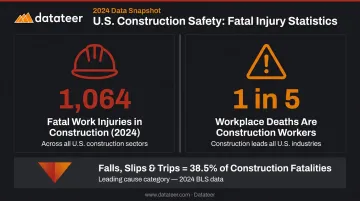
Construction is among the most hazardous industries in the U.S. BLS data for 2024 recorded 1,064 fatal work injuries in construction — roughly one in five workplace deaths across all industries. Falls, slips, and trips alone accounted for 38.5% of construction fatalities.
When hazards emerge, warning speed determines outcomes. SMS addresses that gap through instant, documented, site-wide communication — covering everything from daily reminders to full-scale evacuations.
Instant Hazard Alerts
When a worker spots exposed wiring, unstable scaffolding, or a chemical spill, a single text broadcast can warn the entire site before anyone else reaches that area. No waiting for a safety meeting. No hoping someone checks the board. The warning goes out in seconds.
This is particularly valuable on large sites where hazards in one zone may not be visible to workers in another.
Daily Pre-Shift Safety Reminders
Automated morning texts — PPE requirements for specific zones, restricted areas, weather-related precautions — create consistent safety culture without adding to supervisors' workloads. Unlike paper memos or posted notices, texts arrive directly and get read. With SMS open rates at 98%, pre-shift reminders via text reach their audience far more reliably than any other channel.
Two-Way Safety Reporting
Two-way texting gives workers a direct channel to contribute to site safety, not just receive it:
- Reply to confirm they've received a hazard warning
- Report near-misses without having to find a supervisor
- Ask questions about zone restrictions or PPE requirements
- Flag when a reported hazard has been resolved
Every exchange is logged, creating a documented safety record that supports compliance reviews and incident investigations.
Emergency Broadcasts
Pre-scripted emergency messages cover the scenarios that matter most:
- Severe weather and evacuation orders
- Medical emergencies requiring site-wide awareness
- Equipment failures affecting adjacent work areas
- Utility strikes or structural concerns
Supervisors can send with a single tap and request confirmation replies to verify headcount in real time — replacing the chaos of a verbal roll call during an actual emergency.
How SMS Drives Efficiency Across Construction Projects
Safety is the highest-stakes use case, but SMS delivers daily operational value across the entire project lifecycle.
Delivery and Equipment Alerts
Discovering that a concrete pour was cancelled at 4 PM — after crews have been staged and waiting — is an expensive way to learn about a delivery failure. Automated texts when shipments leave the warehouse give site managers time to prepare or reschedule before the gap becomes a work stoppage.
The same logic applies to equipment: when a critical machine breaks down or fuel levels drop below threshold, an instant text to the maintenance or procurement team triggers faster response than a voicemail that might not be heard until after lunch.
Schedule Change Management
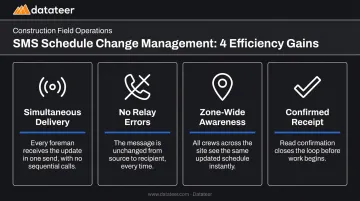
Mid-day plan changes happen constantly — weather delays, inspection requirements, trade conflicts. One group text redistributes the updated schedule to all relevant workers instantly, replacing hours of phone tag with a 30-second exchange.
Key efficiency gains from schedule SMS:
- Changes reach all affected workers simultaneously, not sequentially
- No relay errors from word-of-mouth communication
- Workers in other zones learn about changes before they're impacted
- Managers can confirm receipt rather than assuming everyone heard
Inspection Workflow Acceleration
Text alerts can pause work site-wide the moment an inspector flags a non-compliance issue, and resume operations the instant it's cleared. Without SMS, this coordination requires a supervisor physically moving between zones — slow, error-prone, and easy to miss.
The Financial Visibility Gap SMS Can't Fix
SMS closes the communication gap between field workers and supervisors. But there's a parallel gap between the field and the finance office — one that text messaging alone doesn't solve.
Datateer's construction financial dashboards bring that same immediacy to financial data. While crews receive real-time schedule updates via text, CFOs and project managers can see live WIP reporting, cost variance, and job-level cash flow. The typical 10-20 day lag for manual WIP reports gets replaced with automated overnight data pulls from connected ERPs like Procore, Sage, and Viewpoint Vista. When field communication and financial visibility both run in near real time, problems surface while there's still time to act on them — not after the damage shows up in a month-end report.
Crew and Subcontractor Coordination via Text
Tracking down an electrician, a concrete crew, and a mechanical subcontractor through separate calls and voicemails can easily burn two hours. A targeted group text with a confirmed reply compresses that same exchange to under a minute.
Segmented Group Messaging
Purpose-built construction texting platforms let managers create contact groups by:
- Trade (concrete, electrical, framing, mechanical)
- Shift (day crew, night crew, weekend)
- Location (Zone A, Building 2, Parking Structure)
- Project phase (foundation, structure, MEP rough-in, finishing)
This prevents alert fatigue. Workers only receive messages relevant to their work — not every broadcast across a 20-trade project.
Using SMS for Team Input
Segmented groups also open a channel for input — not just instructions. Quick poll texts cut through the friction of scheduling meetings or chasing replies:
- "Reply 1 for Monday or 2 for Tuesday for safety training" gets faster, more honest responses than an open meeting
- Post-milestone broadcasts ("Phase 1 complete — solid work this week") reinforce shared progress on a project most workers only see a piece of
- Simple check-ins after scope changes ("Any conflicts with the revised Phase 2 timeline?") surface problems before they become delays
On sites where workers from different companies rarely interact, these brief exchanges build enough connection to keep coordination from breaking down.
One-Way vs. Two-Way Texting: What Construction Sites Actually Need
The Difference
One-way SMS sends broadcasts outbound. Workers receive alerts, reminders, and updates — but cannot reply. The communication flow runs in a single direction.
Two-way SMS enables real conversations. Workers can confirm receipt, report hazards, ask questions, and respond to scheduling requests. The platform receives and logs all replies.
For construction, one-way SMS alone is insufficient. Safety communication that can't receive acknowledgment leaves supervisors with no way to verify that a hazard warning was actually read. A worker who tries to reply to a one-way system and gets silence learns fast that their input doesn't matter — the opposite of the safety culture most sites are working to build.
Multilingual Crew Support
Two-way platforms that support message translation remove one of the most persistent barriers in construction communication. The same safety alert can reach English, Spanish, and other language speakers simultaneously — in their preferred language — without requiring separate broadcasts or bilingual supervisors to relay information.
This is directly relevant on most U.S. construction sites, where multi-language crews are the norm rather than the exception.
Getting Started: Implementing SMS on Your Construction Site
Setup Fundamentals
- Add mobile number capture to worker registration forms during onboarding — not as an afterthought
- Segment workers by trade, shift, language preference, and project zone before the first message goes out
- Document which message types go to which groups, and assign broadcast authority before you need it
Platform Selection Criteria
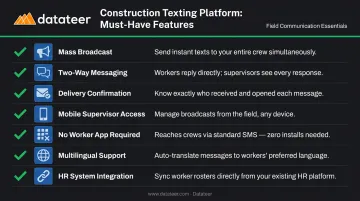
Look for these capabilities when evaluating construction texting platforms:
- Mass broadcast to hundreds of recipients simultaneously
- Two-way messaging with reply management
- Delivery confirmation and read receipts
- Mobile-accessible for supervisors in the field
- No app download required for message recipients
- Multilingual message support
- Integration with HR or workforce management systems to keep contact lists current
TCPA Compliance
TCPA consent rules apply to employer-to-employee texting. FCC guidance covers automated texts under consent requirements, and CTIA's 2023 Messaging Principles require businesses to obtain consent before sending messages and provide clear opt-out instructions.
For non-marketing, job-related messages, legal analysis indicates consent is established when employees provide their number to an employer as part of the hiring process. That said, capturing explicit written consent during onboarding removes any gray area — pair that with a platform that handles opt-out management automatically.
TCPA violations can reach $500 to $1,500 per message in penalties. With mass broadcasts, that exposure multiplies fast.
Frequently Asked Questions
What is a two-way texting platform for business?
A two-way texting platform allows businesses to both send and receive text messages, enabling real back-and-forth conversations rather than one-directional broadcasts. For construction sites, this means workers can confirm hazard alerts, report near-misses, and respond to scheduling requests — not just receive information.
What are the two different types of text messaging?
One-way SMS sends outbound alerts with no reply capability — useful for bulk notifications where no response is needed. Two-way SMS enables full conversation, with the platform receiving and logging replies. Construction sites typically need two-way capability for safety acknowledgment and crew coordination.
How can text messaging improve safety on construction sites?
SMS gives construction teams several direct safety advantages:
- Instant hazard alerts that reach the entire workforce in seconds
- Daily pre-shift safety reminders with near-certain open rates
- Two-way near-miss reporting so workers can flag issues in real time
- Emergency broadcasts with confirmation replies for headcount verification
Can construction teams use regular consumer SMS apps instead of dedicated software?
Personal SMS apps lack group segmentation, delivery tracking, broadcast capability, and TCPA compliance tools. For any crew beyond a handful of people, purpose-built business texting platforms are necessary.
What features should construction companies look for in a text messaging platform?
Prioritize mass broadcast capability, two-way messaging, contact segmentation by trade or role, delivery confirmation, multilingual support, and built-in consent and opt-out management. Mobile accessibility for supervisors, without requiring workers to download anything, is also non-negotiable on active job sites.