Introduction
A withheld pay application. An unsigned change order sitting in someone's inbox. A project running four months late with three competing explanations for why. Construction disputes rarely announce themselves — they build up in silence until one party stops paying and the other stops working.
The financial exposure extends well beyond whatever dollar amount is in dispute. Legal fees, management attention pulled from active projects, cash flow frozen while receivables age, and the relationship damage that affects future work all compound the original problem. According to Arcadis' 2025 Construction Disputes Report, North American construction disputes averaged $60.1 million in value and took 12.5 months to resolve in 2024.
That's over a year of carrying a dispute on your balance sheet, your bonding conversations, and your management team's calendar.
The contractors who navigate this cleanly aren't necessarily better litigants. They're better record-keepers. What separates a defensible claim from an expensive reconstruction exercise is almost always the state of financial documentation on the day the conflict starts. Legal counsel matters — but it can only work with the records your team kept.
This guide covers the most common sources of construction disputes — change orders and schedule delays — and the documentation and financial tracking practices that keep conflicts manageable before they become claims.
Key Takeaways
- Disputes are won or lost on documentation quality before conflict begins, not legal strategy after
- The three highest-exposure dispute categories — unapproved change orders, payment withholding, and delay claims — each require different documentation to resolve
- Missing a contract notice deadline can forfeit the right to recover specific damage categories entirely
- Real-time job cost tracking and WIP discipline are dispute prevention infrastructure — built into how the firm operates financially
Why Construction Disputes Carry Outsized Financial Risk
The $60.1M average dispute value from Arcadis sets a useful scale, but most contractors aren't facing eight-figure claims. At any scale, the true cost of a dispute extends well beyond the disputed amount — it's the cash pressure, relationship damage, and management distraction running alongside it.
The Full Exposure Picture
When a receivable is frozen in dispute, that cost sits on the contractor's balance sheet as a contract asset or aging receivable. The withholding party, meanwhile, is using the contractor's money interest-free.
That asymmetry creates real pressure to settle for less than what's owed — not because the claim lacks merit, but because the contractor is effectively financing the dispute.
The downstream effects compound this pressure:
- Cash flow strain — Levelset's 2021 Construction Cash Flow Report found that only 9% of construction businesses always get paid on time, with cash flow problems reducing profits for 47% and forcing loans for 30%
- Bonding capacity risk — for mid-sized contractors operating across multiple concurrent projects, a 12–18 month dispute can damage bonding limits and lender relationships even if the contractor ultimately prevails
- Management diversion — every hour a CFO or project executive spends on dispute documentation is an hour not spent managing active work
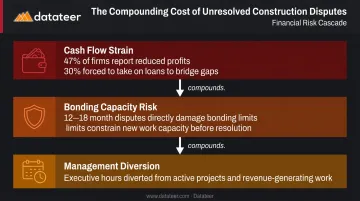
Each of those effects plays out across the 12.5-month average resolution timeline — long enough to span multiple WIP cycles, fiscal year-ends, and audit periods. A dispute that starts in Q2 will appear in financial statements, bonding reviews, and bank covenant calculations before it closes.
The Three Most Common Categories of Construction Disputes
While disputes arise from dozens of triggers, three categories account for the majority of financially significant construction conflicts — each with distinct documentation requirements and financial exposures.
Change Order and Scope Disputes
This is the most frequent source of construction conflict. HKA's 2025 CRUX Insight Report, covering 2,200+ projects globally, identifies scope change as the leading dispute cause at 28% of all claims analyzed.
The financial trigger is almost always an unsigned or unapproved change order: costs have been incurred, but no formal written agreement on price exists. Two problems follow immediately:
- Cash flow exposure — the contractor has paid for work that hasn't been billed or approved
- Accounting-estimate risk — under ASC 606, unapproved change order amounts are variable consideration requiring probable-reversal assessment before revenue recognition
Carrying large unapproved change order balances as contract assets compounds both problems simultaneously.
Scope ambiguity compounds the problem. Vague contract language about what constitutes a "change" versus what falls within original scope allows both parties to reach genuinely different conclusions in good faith. Contract precision at signing and field documentation during execution are equally important — one without the other leaves exposure on both ends.
Payment Withholding and Retainage Disputes
Owners and GCs sometimes withhold more than the contract allows — disputing pay applications, applying unauthorized backcharges, or holding retention past the contractual release deadline. When that happens, the contractor faces a receivables problem that compounds over time.
Retainage has become a legislative focus across multiple states. California SB 61, effective for private works contracts entered on or after January 1, 2026, caps retention at 5% of contract price. New York and Washington have enacted similar 5% caps for private projects. Contractors working across state lines need contract review processes that account for state-specific retainage rules — and tracking systems that surface when contractual release deadlines are approaching.
Delay and Disruption Claims
Delay and disruption claims are the most complex and expensive disputes to resolve. Establishing cause, responsibility, and financial impact requires schedule analysis, cost documentation, and often expert testimony. The damage categories a contractor may claim include:
- Extended general conditions costs (superintendent time, trailers, equipment standing by)
- Labor inefficiency from disrupted sequences or stacking of trades
- Acceleration costs if directed to recover schedule
- Lost profits on subsequent work that couldn't begin on time
The distinguishing factor in these claims is whether the contractor has contemporaneous records — daily field reports, updated schedules, RFI logs — or must reconstruct the timeline months after the fact. Reconstructed records are expensive to prepare and far less persuasive in mediation or arbitration than records generated in real time.
Understanding the Dispute Resolution Hierarchy in Your Contract
Most commercial construction contracts — AIA, ConsensusDocs, and owner or GC-drafted forms — specify a tiered dispute resolution process that must be followed before either party can pursue formal legal action. Contractors who understand this hierarchy before a conflict arises are in a considerably stronger position than those reading it for the first time after the relationship breaks down.
How the Typical Tier Structure Works
The AIA A201-2017 process illustrates the standard escalation path: disputes first go to the Initial Decision Maker, then to mediation if unresolved, then to binding arbitration or litigation as the final step. ConsensusDocs and EJCDC documents follow comparable tiered structures, though the specific triggers and timelines differ.
The provisions that matter most:
- Notice requirements — AIA-style contracts include 21-day claim notice language. Missing a deadline can jeopardize or bar specific claims depending on contract language and governing state law
- Mandatory mediation — in many contracts, mediation is a condition precedent to arbitration, meaning you can't skip to arbitration without attempting mediation first
- Arbitration clause specifics — the administering body (often AAA), the applicable track, and any claim thresholds that trigger different procedural rules
AAA's 2024 Construction Arbitration Rules provide multiple tracks: Fast Track applies where no claim or counterclaim exceeds $150,000; Large Complex applies at $1M and above. Fast Track closes the hearing within 45 calendar days after the preliminary conference, with the award due within 14 calendar days after closing.
The Three Resolution Mechanisms
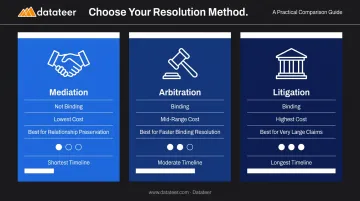
Each tier in your contract serves a distinct purpose. Understanding which tool fits which situation shapes how you respond when a dispute first surfaces:
| Method | Binding? | Relative Cost | Best For |
|---|---|---|---|
| Mediation | No | Lowest | Preserving relationships; forcing realistic settlement discussion |
| Arbitration | Yes | Mid-range | Binding resolution faster than litigation; limited appeal rights |
| Litigation | Yes | Highest | Very large claims; situations where arbitration isn't contractually required |
Review your contract's dispute resolution clauses with construction legal counsel before signing. Notice deadlines, mandatory mediation requirements, and arbitration specifications lock in your procedural rights from day one — before any dispute surfaces.
Why Financial Documentation Determines Dispute Outcomes
A contractor with clean, contemporaneous records of what was directed, when it was directed, what it cost, and how it affected the schedule occupies a far stronger position than one forced to reconstruct this information under dispute.
The Society of Construction Law's Delay and Disruption Protocol directs that progress and delay records be generated contemporaneously as work proceeds — not assembled retroactively. The same principle applies to cost records, RFI logs, and change order documentation. Records created in real time carry evidentiary weight that reconstructed records simply cannot match.
What Contemporaneous Documentation Looks Like
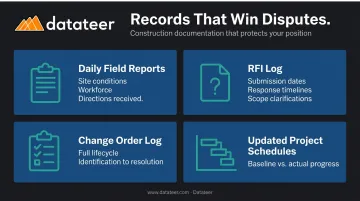
The specific records that carry the most weight in mediation and arbitration:
- Daily field reports capturing site conditions, workforce deployed, work performed, and any directions from owner or GC
- RFI log with submission dates, response timelines, and documentation of scope clarifications
- Change order log tracking every potential extra from identification through pricing, submission, and resolution
- Updated project schedules showing baseline versus actual progress at regular intervals
Cost Coding Granularity and WIP Discipline
Job costs must be coded granularly enough to separate costs by change order or claim category if needed. General ledger entries that lump all project costs together make it nearly impossible to isolate the incremental cost of a specific change or delay — which is precisely what forensic accountants and opposing experts will scrutinize.
WIP schedule discipline matters for identical reasons. A WIP schedule updated monthly establishes a running baseline against which cost overruns, overbillings, and underbillings can be measured. In a dispute, a well-maintained WIP history demonstrates that cost growth was tracked in real time, not identified retroactively.
Datateer's platform syncs directly with 12+ construction ERPs — including Procore, Sage, Viewpoint Vista, Acumatica, CMiC, and Foundation — and delivers cost variance reporting at the job, phase, cost code, and resource type level. When a finance manager sees a cost code running over budget with no approved change order attached, that's a potential dispute in formation. Catching it on day 30 is very different from catching it on day 180.
The Change Order Impact & Aging Analytics module tracks change orders across their full lifecycle — pending, approved, denied, and executed — with aging by days since submission and margin impact tied to specific cost codes.
Stalled change orders where work has been performed but the CO hasn't been approved are surfaced directly, creating accountability in the approval chain before the gap becomes a claim.
For finance teams carrying disputed receivables, the ASC 606 Revenue Recognition module handles variable consideration estimation and contract modification accounting directly from ERP data — producing revenue recognition schedules with audit-ready documentation that applies appropriate constraint on unapproved change order amounts.
Change Order Best Practices That Reduce Dispute Exposure
The first line of defense is contract language, not field documentation. Before a project starts, contracts must address:
- What constitutes a change and the deadline for submitting a Change Order Request
- Required supporting documentation and markup limitations
- Dispute resolution procedures for cost disagreements
Negotiating markup caps happens at contract execution. Challenging a 10% cap after the change arises is too late.
The Rule That Cannot Be Violated
Never perform work without a signed change order. Verbal authorizations and informal emails are the most common reason contractors lose payment claims that were otherwise legitimate. Courts consistently enforce written change order requirements even when the work was clearly directed and the owner benefited from it.
The one exception: a Construction Change Directive (CCD) allows work to proceed before cost agreement in urgent situations. Even then, the CCD must be in writing, signed by the owner, and pricing must be resolved promptly.
What a Defensible Change Order Actually Includes
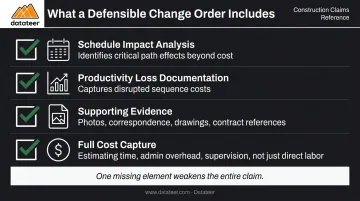
Beyond the basics of description and price, a well-documented change order needs:
- A schedule impact analysis — even a cost-neutral change can push the critical path
- Productivity loss documentation when applicable — disrupted sequences create inefficiency costs beyond direct labor and materials
- Supporting evidence: photos, correspondence, revised drawings, and the contract provision that puts this work outside original scope
- Full cost capture: estimating time, administrative overhead, schedule coordination, and supervision — not just direct labor and materials
Early Warning: Budget-to-Actual Variance Monitoring
Cost codes running over budget without corresponding approved change orders are signals worth acting on immediately. Real-time budget-versus-actual visibility by job and cost code is the finance team's mechanism for catching emerging change order disputes before they escalate into formal claims.
Datateer's Cost Variance Reporting dashboard provides this visibility at the cost code level with drill-down to source transactions in the ERP. When a variance appears, the investigation stays within the dashboard — no separate accounting system audit required. That shifts variance reporting from a month-end retrospective into an ongoing early-warning system, giving finance teams time to act before a cost overrun becomes a formal dispute.
Frequently Asked Questions
What are the most common causes of construction disputes related to change orders?
The primary triggers are unsigned or unapproved change orders, vague contract language about what constitutes a "change" versus original scope, work performed under verbal authorization without written approval, and communication failures between field and office over cost and schedule impacts.
How do unapproved change orders affect WIP reporting and financial statements?
Under ASC 606, unapproved change order amounts are variable consideration that must be assessed for probable reversal risk before inclusion in recognized revenue. Until the change order is approved, those amounts should receive conservative treatment as contract assets on the balance sheet, creating simultaneous cash flow exposure and accounting-estimate risk.
What types of damages can a contractor claim in a construction delay dispute?
The main recoverable categories include:
- Extended general conditions costs
- Labor inefficiency from disrupted work sequences
- Acceleration costs if directed to recover schedule
- Lost profits on subsequent work that couldn't start as planned
All require contemporaneous cost records and schedule documentation to quantify credibly in mediation or arbitration.
What is the standard dispute resolution process in commercial construction contracts?
Most contracts specify a tiered hierarchy: a required negotiation or Initial Decision Maker period, followed by mandatory mediation if that fails, then binding arbitration or litigation as the final step. Specific notice requirements and timing deadlines govern each step — missing them can forfeit the right to pursue specific damage categories.
Can a contractor perform work before a change order is signed?
Generally, no. Performing work without a signed change order risks payment denial and is the most common trigger for payment disputes. The exception is a Construction Change Directive (CCD), which allows work to proceed before cost agreement in urgent situations — but even a CCD must be in writing and signed by the appropriate party.