Introduction
Overhead and profit markup are two of the most referenced financial concepts in construction pricing — and two of the most consistently miscalculated. Most contractors know they need to apply them. Far fewer can confirm they're applying them correctly.
The gap matters. A contractor who confuses markup with margin, or who applies a stale overhead rate to a growing bid volume, isn't just making a math error — they're systematically underpricing every project they win. That shortfall accumulates across an entire year of bids before it surfaces in the financials.
This article is written for construction CFOs, finance managers, and business owners who need a clear, practical understanding of how overhead and profit markup works, how to calculate it correctly, and what breaks when the calculation is wrong.
According to construction CPA guidance, inaccurate overhead allocation leads directly to underbidding, shrinking margins, and cash-flow surprises. The following sections cover the correct formulas, common miscalculations, and the process changes that prevent them.
Key Takeaways
- Overhead covers all indirect business costs not tied to a single project; profit is what remains after both direct costs and overhead are paid
- The overhead rate is calculated as total overhead ÷ total revenue, expressed as a percentage. Apply it consistently to every bid or your pricing will drift.
- Markup and margin are mathematically different numbers; confusing them is one of the most costly pricing errors in construction
- CFMA's 2025 Benchmarker puts the average net margin at 6.7% across all construction firms, and 12.0% for top-quartile performers
- Overhead rates must be recalculated at least annually; cost structure shifts compress margins faster than most firms catch them
What Is Construction Overhead and Profit Markup?
Overhead: The Costs That Run Whether or Not You're Building
Overhead covers every indirect cost required to keep the business operational — regardless of whether a specific project is active. These costs exist when the pipeline is full and when it's empty.
Common overhead categories include:
- Office rent and utilities
- Administrative and executive salaries
- Insurance premiums (general liability, workers' comp, professional)
- Vehicle expenses and fleet costs
- Software subscriptions and technology
- Marketing and business development spend
- Accounting, legal, and professional fees
One important classification note: owner compensation belongs in overhead when it represents executive or administrative work. If an owner is actively performing documented project-management or field supervision duties, that portion may properly belong in project-level costs instead.
The IRS Construction Industry Audit Technique Guide confirms this distinction — officer salaries should be classified based on the nature of the work performed, not the title on the org chart.
Profit: The Return on the Business Itself
Profit is the revenue remaining after both direct project costs and overhead have been paid. It is not the owner's salary, which belongs in overhead. Profit is what the business earns for taking on risk, deploying capital, and executing work.
Without profit, a construction firm cannot reinvest in equipment, absorb cost overruns, or sustain operations through slow periods. A project that covers labor and materials but not overhead isn't breaking even — it's losing money.
Markup: The Percentage That Covers Both Hurdles
Markup is the percentage added on top of direct project costs (COGS) to cover overhead and generate net profit. It must clear two distinct financial hurdles simultaneously:
- Recoup the firm's allocated share of overhead
- Deliver a defined net return above all costs
Setting markup by feel rather than calculation is where most pricing errors begin, and where they tend to compound before anyone notices.
COGS vs. Overhead: Keeping the Categories Straight
| Cost Type | Examples | Varies by Project? |
|---|---|---|
| COGS (Direct) | Labor, materials, equipment, subs, permits | Yes — job to job |
| Overhead (Indirect) | Rent, admin salaries, insurance, software | No — fixed and ongoing |
COGS are project-specific. Overhead exists independently of any single contract and must be distributed across the entire revenue base. This distinction drives the entire OH&P calculation.
How to Calculate Construction OH&P Markup
The end-to-end flow: identify overhead costs → calculate overhead rate → set profit target → combine into a markup factor → apply to every bid.
Step 1: Identify and Total Your Overhead Costs
Compile all indirect business costs over a defined 12-month period. Include every cost the business incurs regardless of project activity:
- Office rent and facility costs
- Administrative payroll (non-project staff)
- Owner/executive compensation (administrative portion)
- Insurance premiums
- Vehicle and fleet expenses
- Software subscriptions
- Marketing spend
- Accounting and legal fees
Use actual figures from your accounting system, not estimates. The accuracy of everything downstream depends on this number.
Step 2: Calculate Your Overhead Rate
Formula: Overhead Rate (%) = (Total Overhead Costs ÷ Total Revenue) × 100
Worked example:
- Total annual overhead: $400,000
- Total annual revenue: $2,000,000
- Overhead Rate: ($400,000 ÷ $2,000,000) × 100 = 20%
This percentage represents what portion of every revenue dollar is consumed by overhead. A 20% overhead rate means $0.20 of every dollar earned goes to keeping the lights on — before any profit is generated. This rate must be incorporated into every future bid.
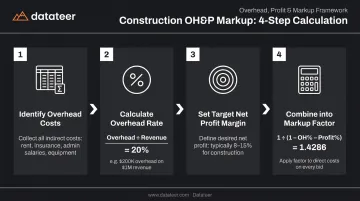
Step 3: Determine Your Target Net Profit Margin
The profit margin is the percentage of revenue retained as profit after all costs — both COGS and overhead — are covered.
CFMA's 2025 Benchmarker (based on fiscal 2024 results from 1,558 firms) provides the most reliable published benchmarks by trade:
| Segment | Average Net Margin | Top Quartile |
|---|---|---|
| All respondents | 6.7% | 12.0% |
| Industrial & Nonresidential | 4.4% | 7.9% |
| Heavy Construction | 8.3% | 15.1% |
| Specialty Trades | 7.7% | 14.2% |
Margins below 5% leave very little room to absorb cost overruns, unpriced change orders, or material price swings. Set your target based on your trade segment and firm size — not a generic heuristic.
Step 4: Combine OH&P Into a Markup Factor and Apply It
Markup Factor Formula: Markup Factor = 1 ÷ (1 − (Overhead % + Profit %))
Worked example:
- Overhead rate: 20%
- Target net profit margin: 10%
- Combined OH&P: 30%
- Markup Factor: 1 ÷ (1 − 0.30) = 1.4286
Apply to job costs:
- Direct project costs (COGS): $500,000
- Selling price: $500,000 × 1.4286 = $714,300
- Overhead recovered: $142,860
- Net profit: $71,430 (10% of revenue)
This step is also where markup vs. margin confusion causes the most damage — covered in the next section.
For firms running multiple concurrent projects, manually tracking overhead in spreadsheets introduces compounding error as project mix shifts and overhead rates change mid-year. Datateer integrates directly with ERPs including Procore, Sage, Vista, and Acumatica, automatically calculating real-time overhead absorption and margin data across all active projects — so your markup rates reflect current actuals, not last quarter's estimates.
Markup vs. Margin — Understanding the Difference
Why the Confusion Exists
A 20% markup does not produce a 20% profit margin. This is the single most consequential math error in construction pricing.
Here's why they diverge:
- Markup = profit ÷ cost (smaller denominator)
- Margin = profit ÷ selling price (larger denominator)
The same dollar amount of profit appears as a larger percentage of cost than of revenue. A contractor applying a 20% markup while believing they're earning a 20% margin is underperforming their profit target on every project they price.
The Correct Conversion
Formula: Required Markup = Desired Margin ÷ (1 − Desired Margin)
| Target Net Margin | Required Markup |
|---|---|
| 10% | 11.1% |
| 20% | 25.0% |
| 30% | 42.9% |
| 40% | 66.7% |
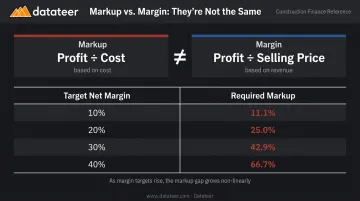
The gap widens sharply at higher targets. A contractor aiming for 30% margin who applies a 30% markup is actually earning closer to 23% — a difference that compounds across a full year of bids.
The Margin Method as an Alternative
Some finance teams prefer working directly in margin terms:
Formula: Selling Price = Job Costs ÷ (1 − Total OH&P Margin %)
Example comparison on identical $500,000 job costs:
| Method | Calculation | Selling Price |
|---|---|---|
| Markup (30%) | $500,000 × 1.30 | $650,000 |
| Margin (30%) | $500,000 ÷ 0.70 | $714,286 |
The margin method produces a higher — and correct — selling price when a 30% margin is the actual target.
Markup is operationally simpler for estimators building bids. CFOs and finance managers, though, need to know the margin equivalent behind every markup rate — otherwise there's no reliable way to confirm whether completed projects actually delivered the returns the bid model projected.
Key Factors That Affect OH&P in Construction
Business size and project volume. Larger firms distribute fixed overhead across a broader revenue base, which can lower the effective overhead rate per project. Smaller firms carry a proportionally higher overhead burden per job and should set markup targets accordingly — not benchmark against larger competitors with fundamentally different cost structures.
Project type and risk profile. Higher-complexity projects warrant higher profit margins to compensate for unpredictability in scope, labor costs, and materials. CFMA's data confirms this: Heavy Construction top-quartile firms earn 15.1% net margins, a margin that reflects what high-risk work demands. Specialty trades and industrial/nonresidential work carry different risk profiles and corresponding margin expectations.
Market conditions and bid competitiveness. In competitive bidding environments, contractors face consistent pressure to reduce margins to win work. The compounding risk is direct: thin margins leave no room to absorb cost overruns, material price swings, or unpriced scope gaps — and can turn nominally profitable backlogs into cash-flow problems mid-cycle.
BLS tracking of OH&P markup indexes shows that in May 2020, 15.3% of contractors decreased markup to secure backlog — often pushing projects from marginal to unprofitable before the first invoice cleared.

Common OH&P Mistakes and Misconceptions
Mistake 1: Confusing Markup With Margin at Bid Time
A contractor consistently applying a 20% markup while believing they're earning a 20% margin will underperform their profit target on every project. Over a full year of bids, this gap compounds into a material shortfall — one that only becomes visible in the annual review, by which point recovery is impossible.
Know the margin equivalent of every markup rate you apply, and verify that your bid model is solving for the right number — before the bid goes out, not after the job closes.
Mistake 2: Using a Stale Overhead Rate
Overhead creep is common — and nearly invisible until it's too late. Rising insurance costs, new hires, expanded office space, and additional software subscriptions push the true overhead rate above the figure being applied to bids — without triggering any obvious alert.
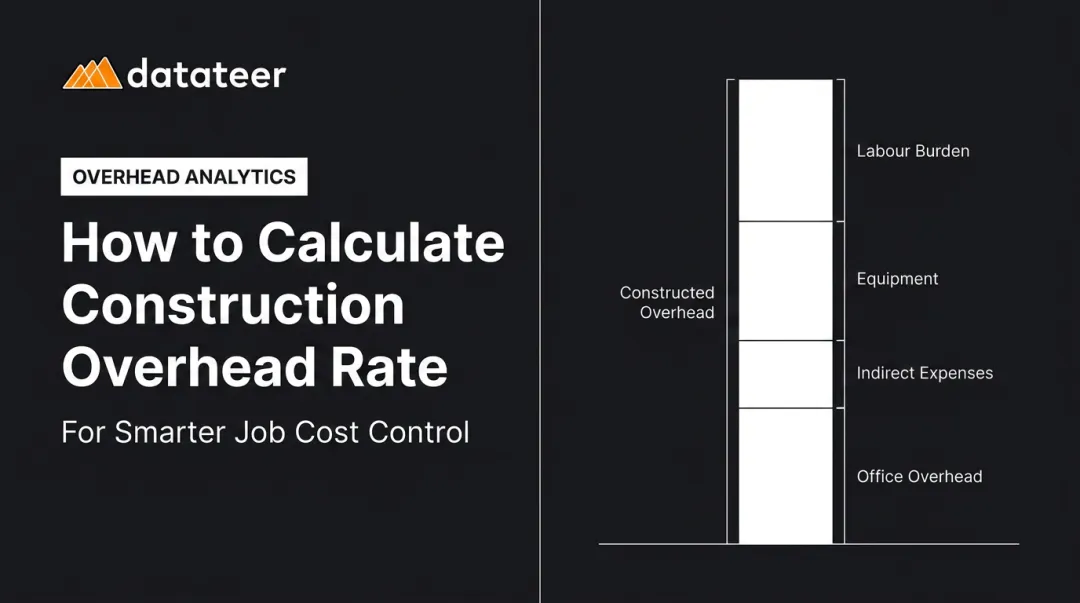
The result is margin fade: projects that appear profitable at bid time underperform because the overhead allocation was understated. Best practice is to review overhead rates at least quarterly — not just at year-end. Datateer's Overhead & Burden Rate analytics continuously compare actual overhead accumulation against bid assumptions, surfacing rate drift within 24 hours of a data refresh rather than weeks later when a manual WIP report finally closes.
Mistake 3: Treating OH&P as a One-Time Bid Calculation
Firms that set markup at bid time but never monitor actual overhead spend and profit-to-date during execution cannot intervene when costs deviate. By the time month-end accounting reveals the problem, the project has moved forward and options have narrowed.
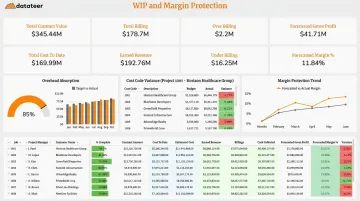
The standard to target is proactive financial management — not forensic accounting. Datateer's Margin Protection and WIP dashboards flag variance drivers — labor overruns, material escalation, unapproved change orders — at the cost code level while there's still time to act. What users call "autopsy reporting" gets replaced with live, forward-looking oversight.
Frequently Asked Questions
What is normal profit and overhead in construction?
The "10-10 rule" (10% overhead, 10% net profit) is a common heuristic, but no authoritative source establishes it as an industry standard. CFMA's 2025 Benchmarker reports an average net margin of 6.7% across all firms, with top-quartile performers reaching 12.0%. Set targets based on your specific trade segment, not a generic rule of thumb.
Is a 50% profit margin too much in construction?
A 50% net profit margin is extremely rare in construction. CFMA's highest-reported top-quartile figure is 15.1% for Heavy Construction. Contractors sometimes believe they're achieving very high margins because they're confusing a markup percentage with a margin percentage — a 100% markup corresponds mathematically to a 50% margin, but that doesn't make 50% a realistic net-margin target for most contractors.
What is the difference between markup and margin in construction?
Markup is expressed as a percentage of cost; margin is expressed as a percentage of selling price. They use different denominators, so they produce different numbers. A 25% markup on $100 of cost produces a $125 selling price — but that $25 profit represents a 20% margin (profit ÷ selling price), not 25%.
What costs are included in construction overhead?
Overhead includes all indirect costs the business incurs whether or not a specific project is active: office rent, administrative salaries, insurance premiums, vehicle expenses, software subscriptions, marketing spend, and professional fees. Direct project costs — labor, materials, equipment, subcontractors, permits — are not overhead.
How do you calculate the overhead rate for a construction project?
Divide total overhead costs by total revenue, then multiply by 100. If your firm carries $400,000 in overhead against $2,000,000 in revenue, your overhead rate is 20%. Recalculate at least annually — or immediately after any material change in cost structure, such as new hires or a significant insurance increase.
How often should contractors review their overhead and profit markup?
At minimum, review both the overhead rate and profit targets annually. Add a mid-year check whenever significant cost changes occur — new hires, facility expansions, rising insurance premiums, or shifts in project volume — since stale rates are a primary driver of margin fade.