Key Takeaways
- AIA billing documents (G702, G703) govern payment applications on 70–80% of commercial construction loans
- The G-Series forms are the primary billing instruments; A201 governs the rules under which they operate
- Retainage (typically 5–10%) must be tracked cumulatively across every application to avoid costly errors
- Missing a billing cutoff date pushes payment to the next cycle — a direct 30-day cash flow penalty
- The AIA Architecture Billings Index is a completely separate economic indicator, not a billing form
What Are AIA Billing Documents and Why They Matter
AIA billing documents are standardized contract administration forms published by the American Institute of Architects. They are not proprietary to any single firm — they are widely accepted legal instruments used across the construction industry to govern payment applications between owners, contractors, and architects.
These forms matter because they create structured, documented requests for payment that tie work completed to contract values. Contractors get a defensible right to payment. Owners get verified progress documentation. Lenders get a standardized draw package they can actually process.
That structured documentation matters more than most firms realize. According to the 2024 Construction Payments Report by Rabbet, slow payments cost the U.S. construction industry $280 billion annually, with 82% of contractors now waiting more than 30 days to get paid — up from 49% just two years earlier. Standardized, error-free AIA billing is one of the few levers firms can pull to reduce that friction.
The numbers reinforce this:
- AIA G702/G703 are used on an estimated 70–80% of commercial construction loans as the standard draw-package format
- AIA Contract Documents have been the industry standard for 135+ years, backed by case law and carrying the official AIA seal
- Most lenders, sureties, and project owners require AIA-format billing for loan draws and contract compliance
Improper or incomplete AIA billing documents are a leading cause of payment disputes, delayed draws, and retainage disagreements. Understanding each form — what it captures, when it's used, and where errors creep in — is where most billing disputes are won or lost.
Essential AIA Document Code Reference
AIA documents are organized into lettered series, each covering a different contractual relationship. The letter prefix tells you which relationship the document governs; the number tells you its specific function.
For billing purposes, the G-Series contains the documents you'll use on every pay application.
G-Series: Contract Administration Forms
These are the core billing documents. Every construction finance professional should have these memorized:
| Document | Edition | Purpose |
|---|---|---|
| G702 | 1992 | Application and Certificate for Payment — the cover sheet of every pay app |
| G702S | 2017 | Subcontractor variation of G702 |
| G703 | 1992 | Continuation Sheet — the line-item Schedule of Values backup |
| G704 | 2017 | Certificate of Substantial Completion — triggers retainage release |
| G706 | 1994 | Contractor's Affidavit of Payment of Debts and Claims |
| G707 | 1994 | Consent of Surety to Final Payment |
Note the edition years: the base G702 and G703 are 1992 documents. G702S (subcontractor variation) was updated in 2017. Cost-of-work variants (G702CW, G702GMP) came in 2021. Using the wrong edition for your contract is a rejection risk.
A-Series: Owner-Contractor Agreements
A-series documents establish the contractual framework within which billing occurs. The contracts below set the rules that govern how those G-Series forms are submitted and certified. The most relevant for billing purposes:
- A101-2017 — Stipulated sum (lump sum) owner-contractor agreement
- A102-2017 — Cost-plus-fee with GMP agreement
- A201-2017 — General Conditions of the Contract for Construction
A201-2017 is the document that actually governs how billing works. Its key billing provisions include:
- Sets the architect's 7-day review window for payment applications
- Defines the contractor's right to include stored materials in pay apps
- Establishes retainage release at substantial completion (Section 9.8.5)
- Gives the architect authority to withhold certification for defective work or unpaid subcontractors (Section 9.4.1)
B-Series: Owner-Architect Agreements
The B-series is relevant to billing because it defines the architect's role in certifying G702 payment applications. Under B101-2017, the architect's certification is a representation that work has progressed to the point indicated — but explicitly does not constitute exhaustive on-site inspection. This distinction matters in disputes: the architect's signature is a qualified certification, not a guarantee of performance.
AIA G702 and G703: The Foundation of Construction Payment Applications
How G702 Works
G702 is the cover sheet of every payment application. It summarizes the full financial picture in a single page. The key line items:
- Original Contract Sum — the base contract value
- Net Change by Change Orders — approved changes to date
- Contract Sum to Date — line 1 plus line 2
- Total Completed and Stored to Date — pulled from G703
- Retainage — split between completed work and stored materials
- Total Earned Less Retainage — what's been earned net of holdback
- Less Previous Certificates for Payment — cumulative payments already made
- Current Payment Due — the net amount owed this period
- Balance to Finish, Including Retainage — remaining contract exposure
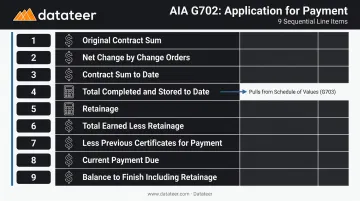
Every number on G702 must reconcile to the G703 line items below it. When they don't match, architects reject the entire application — pushing payment to the next billing cycle.
How G703 Works
G703 is the itemized Schedule of Values breakdown that supports G702's summary figures. Each line item in G703 represents a discrete scope of work, with columns tracking:
- Scheduled Value — the agreed value of that work scope
- Work Completed from Previous Applications — cumulative prior billings
- Work Completed This Period — new work billed this application
- Materials Stored — on-site materials not yet incorporated
- Total Completed and Stored — sum of the three prior columns
- Balance to Finish — scheduled value minus total completed and stored
- Retainage — amount withheld from this line item
The G703 grand total must equal G702 Line 4 exactly. No exceptions.
Stored Materials and Why They Matter
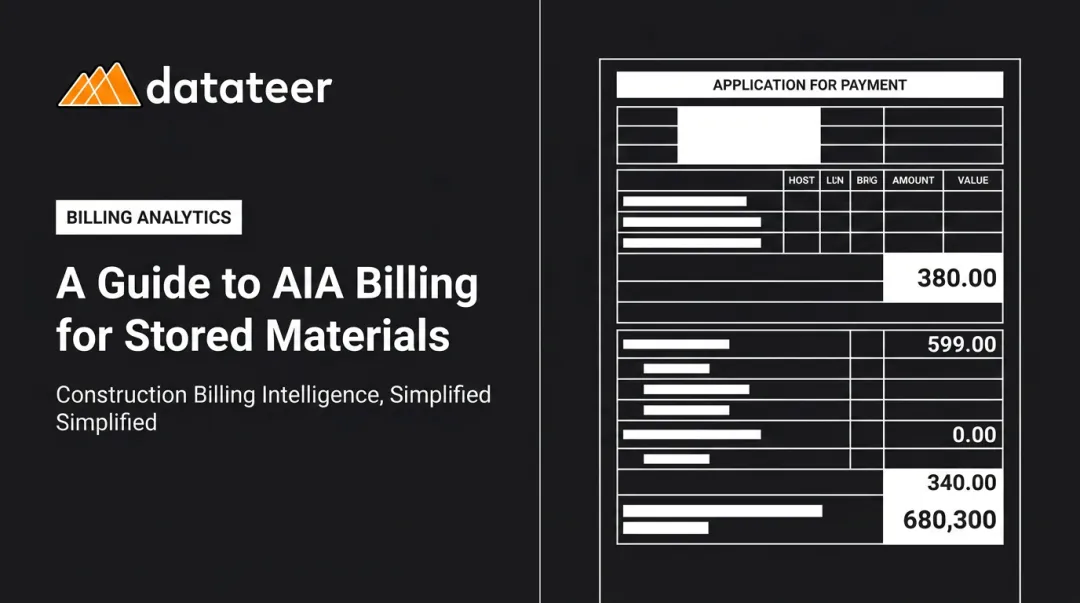
Stored materials — items purchased and on-site but not yet installed — can be included in a payment application if the contract permits. A201-2017 Section 9.3.2 requires the contractor to provide evidence of insurance, proper storage conditions, and title transfer before stored materials can be billed.
This distinction matters for cash flow. A contractor who purchased $500,000 in steel that's sitting in a staging area has a legitimate billing claim for that amount if the contract allows it — but they need the documentation to support it.
Retainage Tracking Across Applications
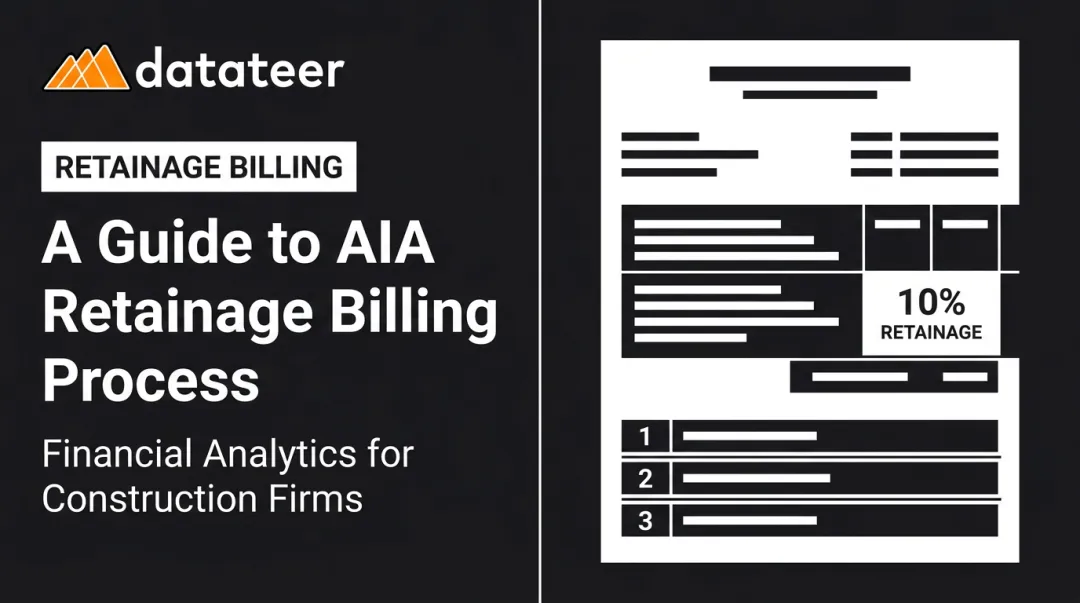
Retainage typically runs 5–10% of each payment application, withheld by the owner until substantial or final completion. Finance teams must track cumulative retainage carefully across every application. The math compounds across a project's life: on a $10 million project with 10% retainage, $1 million is locked up until closeout.
Manually tracking retainage across a portfolio of active projects in spreadsheets creates serious exposure. Platforms like Datateer address this by integrating directly with ERPs (Sage, Viewpoint Vista, Procore, CMiC) to automatically track A/R retainage held by owners, A/P retainage held on subcontractors, release schedules, and overdue releases that tie up working capital without obvious visibility. That data feeds into 13-week cash flow forecasting, making retainage timing a live input to liquidity planning rather than a manual estimate.
Schedule of Values, Retainage, and Common Billing Mistakes
The Schedule of Values: Set It Right From Day One
The Schedule of Values (SOV) is the backbone of every AIA billing cycle. It's the agreed-upon breakdown of the full contract price into individual line items, submitted before the first payment application (A201-2017 Section 9.2), and referenced in every G703 that follows.
Front-loading is the most common SOV manipulation: inflating early-stage line items (mobilization, site prep) to accelerate cash receipts beyond actual earned value. AIA's own counsel identifies this as a recognized risk, and Section 9.2 gives the architect explicit authority to reject a front-loaded SOV.
Finance managers reviewing incoming SOVs from subcontractors — or their own before submission — should audit line items against actual cost distributions. CFMA research confirms overbilling can trigger breach of contract claims, surety exposure, and on public projects, False Claims Act liability.
Retainage Release at Completion
Full retainage release requires:
- G704 (Certificate of Substantial Completion) to establish the substantial completion date
- G706 (Contractor's Affidavit of Payment of Debts and Claims) confirming all obligations are satisfied
- G707 (Consent of Surety to Final Payment) on bonded projects
Partial retainage reduction mid-project — reducing the holdback percentage at 50% completion, for example — is a common negotiated term in A101 or A102. It doesn't happen automatically; it requires explicit contract language.
The Most Common AIA Billing Errors
These mistakes account for the majority of rejected pay apps and delayed payments:
- Math discrepancies between G702 and G703 — grand total mismatch triggers automatic rejection
- SOV line items that don't align with contract scope — makes architect certification difficult
- Incorrect or missing retainage percentages — especially when partial reduction clauses apply
- Missing supporting documentation — lien waivers, stored materials invoices, change order backup
- Using outdated form editions — contracts specify which version is required; G702-1992 and G702S-2017 are different instruments
- Missing the billing cutoff date — if the contract says the 25th and you submit on the 26th, you wait another 30 days
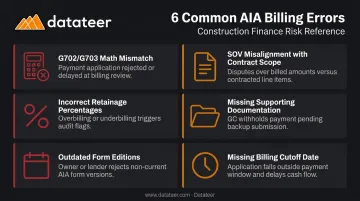
The cutoff date issue catches more teams off guard than it should. A201-2017 establishes the architect's 7-day review window and the owner's payment obligation, but the submission cutoff date is set in the owner-contractor agreement. Miss it, and the cash flow impact is immediate.
AIA Architecture Billings Index: What It Is and How It Differs
Some readers searching "AIA billing" are actually looking for the AIA Architecture Billings Index (ABI) — a completely different concept from AIA payment application documents.
The ABI is a monthly economic indicator published by the AIA that tracks whether billings at U.S. architecture firms increased, decreased, or held stable versus the prior month. It functions as a leading indicator of nonresidential construction activity approximately 9–12 months ahead.
The ABI uses a diffusion-index methodology:
- Above 50 — architecture firm billings are growing
- Below 50 — billings are contracting
The most recent published score (May 2026) was 44.5 — well below the growth threshold, indicating continued softening in architecture firm billings. Given the 9–12 month lead time, this signals potential softening in nonresidential construction spending into early-to-mid 2027.
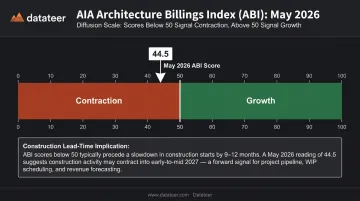
For construction CFOs and finance leaders, the ABI is worth tracking as an early pipeline signal. In contracting markets, owners tighten payment practices and lenders scrutinize draw packages more carefully — which is exactly when disciplined AIA billing compliance matters most.
Frequently Asked Questions
What is the AIA Billings Index?
The AIA Architecture Billings Index (ABI) is a monthly survey-based economic indicator published by the American Institute of Architects. It measures whether billings at U.S. architecture firms increased, decreased, or held stable compared to the prior month, and serves as a leading indicator of nonresidential construction activity approximately 9–12 months ahead.
How is the AIA Billings Index calculated?
The ABI uses a diffusion-index methodology: each month, firms report whether billings increased, held steady, or decreased. The score equals the percentage reporting an increase plus half the percentage reporting no change. A score above 50 signals growth; below 50 signals contraction.
What is the current AIA Billings Index score?
The May 2026 ABI score was 44.5, indicating continued contraction in architecture firm billings. For the most current monthly figures, check the AIA's official ABI resource page, which publishes updates monthly.
What is the difference between AIA G702 and G703?
G702 is the one-page cover summary showing totals for contract value, work completed, retainage, and the amount due. G703 is the continuation sheet that breaks those totals down line by line per the Schedule of Values. They are always submitted together — G703 feeds G702.
What is retainage in AIA billing?
Retainage is a percentage of each payment application — typically 5–10% — withheld by the owner as a completion guarantee. It accumulates across all G702/G703 submissions and is released at substantial or final completion, typically alongside G704, G706, and G707 closeout documents.
How often are AIA billing documents updated?
AIA does not follow a fixed update schedule. Major revision cycles occurred in 2007 and 2017 for core A-series and B-series documents. The base G702 and G703 remain at 1992 editions; G702S was updated in 2017. Always confirm which version your contract specifies before submitting a pay application.