
Introduction
Construction projects rarely fit neatly into a single pricing model. When scope is uncertain — or when work is highly repetitive and measurable — project owners and contractors turn to time and materials (T&M) or unit price contracts instead of a fixed lump sum.
Choosing the wrong contract structure — or failing to track costs properly under the chosen type — produces budget overruns, billing disputes, and margin erosion that often surfaces weeks after the damage is done. According to Arcadis's 2025 Construction Disputes Report, the average North American construction dispute value rose 40% — from $43M in 2023 to $60.1M in 2024 — with errors and omissions in contract documents ranking as the top cause.
Understanding how these contract types work is the first step toward avoiding that exposure.
This guide covers:
- Definitions and mechanics of T&M and unit price contracts
- When to use each, with a practical decision framework
- Trade-offs for owners and contractors
- How to maintain financial visibility across both contract types
Key Takeaways
- T&M contracts bill actual labor hours at a loaded rate plus materials at cost with a markup — the right fit when scope can't be defined upfront
- Unit price contracts set a fixed rate per measurable unit (per linear foot, cubic yard, square foot), with final cost determined by actual quantities completed
- Both types shift financial risk toward the owner and require rigorous cost tracking
- NTE clauses (T&M) and accurate quantity estimates (unit price) are the primary tools for controlling owner-side exposure
- Finance managers need current visibility into labor hours, material spend, and unit quantities — not data that's two weeks old
What Are T&M and Unit Price Contracts?
Time and Materials (T&M) Contracts
A T&M contract is a legally binding construction agreement where the owner pays the contractor for:
- Actual labor hours worked, billed at a predetermined loaded hourly rate
- Actual materials used, billed at cost plus a negotiated markup
The final project cost isn't fixed — it depends entirely on how much labor and material the work actually requires. Per FAR 16.601, which governs federal T&M contracts, the fixed hourly rate includes wages, indirect costs, general and administrative expense, and profit.
Unit Price Contracts
A unit price contract establishes fixed prices for specific, measurable units of work — such as per linear foot of trench excavation, per cubic yard of concrete poured, or per square foot of paving. The contractor and owner agree on these unit rates before work begins. Final contract value is only determined after actual quantities are measured and verified in the field.
What They Have in Common
Both contract types share three defining characteristics:
- Used when full scope or final quantities can't be determined before construction begins
- Require detailed tracking of labor, materials, or measured quantities throughout the project
- Shift more financial risk toward the owner than a fixed-price or lump sum contract
How They Differ From Other Contract Types
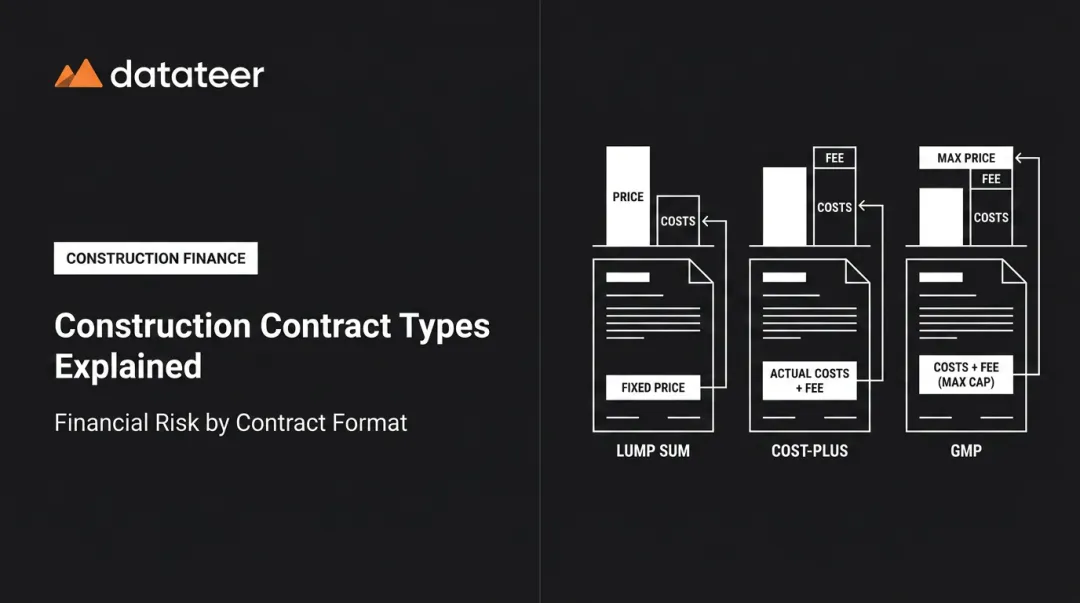
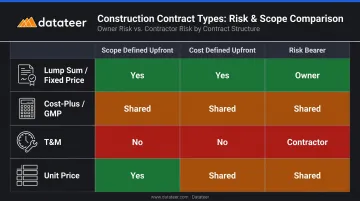
| Contract Type | Scope Defined Upfront? | Cost Defined Upfront? | Risk Bearer |
|---|---|---|---|
| Lump Sum / Fixed Price | Yes | Yes | Contractor |
| Cost-Plus / GMP | Partial | No (cost + fee) | Owner |
| T&M | No | No (pay as you go) | Owner |
| Unit Price | Partial (type, not quantity) | Per unit only | Shared |
How T&M Contracts Work
Mechanics and Key Components
T&M billing rests on two core elements:
- Labor: Billed at a loaded labor rate bundling base wages, benefits, overhead, and profit markup into a single hourly or daily figure. Rates are negotiated per labor category (foreman, journeyman, apprentice) before work begins.
- Materials: Billed at actual cost — including freight and applicable taxes — plus an agreed contractor markup. Subcontractor costs follow the same structure, with the general contractor adding a separate markup on top. Contract terms should explicitly address how subcontractor costs are handled.
Together, these billing elements create flexibility — but without a ceiling, that flexibility becomes owner risk. The not-to-exceed (NTE) clause is the primary risk control tool: it sets a contractual cap on the total amount the owner is obligated to pay.
Under FAR requirements for federal contracts, the contractor must notify the government when expected costs will reach 85% of the ceiling within the next 60 days. That safeguard is worth incorporating into private-sector T&M agreements as well.
Critically, FAR identifies a structural weakness in T&M that applies just as clearly on private projects: T&M provides no positive profit incentive for cost control or labor efficiency. This is why the NTE clause matters, and why a trusted contractor relationship is often cited as a prerequisite for T&M work.
What a T&M Contract Should Include
Every T&M contract should address:
- Labor categories with corresponding loaded hourly rates
- Materials markup percentage
- Subcontractor billing terms and markup
- Invoicing frequency and documentation requirements (timesheets, receipts)
- Change order procedures
- NTE clause (if applicable)
- Termination and dispute resolution provisions
Change orders under T&M are handled by updating the estimate or issuing an amended NTE limit. Because T&M is inherently flexible, changes in scope don't require full contract renegotiation — but every change should still be documented in writing.
How Unit Price Contracts Work
Mechanics and Key Components
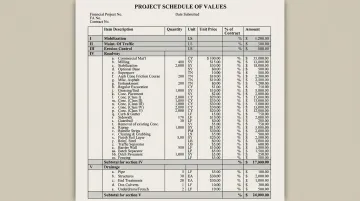
Before work begins, the contractor and owner agree on a schedule of values — a list of work items, each assigned a fixed price per measurable unit. Quantities are estimated upfront (via a bill of quantities or engineer's estimate), but the final contract value is determined only after actual quantities are measured and verified.
Common applications include:
- Underground utility installation (priced per linear foot)
- Earthwork and excavation (priced per cubic yard)
- Pavement and surface work (priced per square foot)
- Structural concrete pours (priced per cubic yard)
- Highway and road base preparation (priced per ton or cubic yard)
Work is periodically measured in the field — often by the owner's engineer or project manager. The engineer certifies quantities, and the contractor invoices based on certified quantities multiplied by agreed unit rates.
Caltrans's construction manual, for example, requires measurement accuracy tight enough to keep calculated payment within roughly 0.2%–0.5%, with adjustment procedures triggered when a bid item varies more than 25% from its original quantity.
The Quantity Risk Problem
The Emerson Construction Company case (ASBCA No. 55165) illustrates what happens when estimated quantities diverge sharply from actuals. Emerson alleged that actual orders on a Fort Hood unit-priced roads and site improvement contract reached only 33% of estimated quantities — producing a claimed shortfall of $1,628,287. While the Board didn't decide the claim's merits, the case demonstrates that quantity risk is real and can produce material financial consequences for either party.
Key Difference From T&M
That quantity risk is what most sharply separates unit price from T&M. The two contract types distribute risk in nearly opposite directions:
| Risk Type | Unit Price | T&M |
|---|---|---|
| Labor efficiency & material waste | Contractor | Owner |
| Quantity uncertainty | Owner | Minimal — all legitimate costs reimbursed |
In unit price, the contractor's rate is fixed regardless of productivity. In T&M, the owner absorbs efficiency risk but is largely insulated from quantity surprises.
T&M vs. Unit Price: When to Use Each
When T&M Makes Sense
T&M is appropriate when:
- Scope is genuinely unknown — renovation projects where hidden conditions are likely (structural repairs, storm damage remediation, historic renovations)
- Time pressure removes pre-planning — emergency or rapid-response work where there's no opportunity for detailed scope definition
- The work is investigative — early-phase feasibility work, subsurface exploration, or assessment work where scope will evolve as findings emerge
FAR 16.601 permits T&M only when the extent or duration of work cannot be estimated with reasonable confidence and no other contract type is suitable — a standard that maps well to private-sector judgment calls.
When Unit Price Makes Sense
Unit price contracts work best when:
- The type of work is well understood but total quantities are not
- The project involves large volumes of repetitive, measurable tasks — highway construction, pipeline installation, large grading contracts, utility work
- Public agency procurement rules apply — unit price contracts are especially common in civil, infrastructure, and public works projects
FAR 36.207 specifically identifies unit pricing as appropriate where work includes large quantities of grading, paving, or site preparation, and where lump-sum bidding would require contractors to carry a substantial contingency for quantity uncertainty.
A Practical Decision Framework
Use this table to match contract type to project conditions:
| Situation | Recommended Contract Type |
|---|---|
| Work type known, quantity unknown | Unit price |
| Neither work type nor quantity defined | T&M |
| Both work type and quantity defined | Lump sum or GMP |
| Mixed project (e.g., earthwork + unforeseen remediation) | Hybrid — unit price for repetitive scope, T&M for unknown elements |
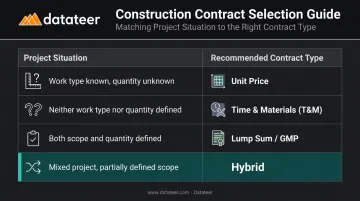
Hybrid contracts are permitted under FAR and common in practice. On a highway project, for example, earthwork and paving carry unit prices while unforeseen soil remediation runs on T&M — each contract type covering the work it's actually suited for, which also simplifies cost tracking and owner reporting.
Pros, Cons, and Key Considerations
T&M Trade-Offs
For owners:
- ✅ Flexibility to redirect scope without renegotiating the entire contract
- ✅ Transparent cost visibility through detailed invoices
- ❌ No budget certainty without an NTE clause
- ❌ Incentive misalignment — contractors paid by the hour may lack pressure to work efficiently
For contractors:
- ✅ Reduced risk of underestimating a complex, unpredictable project
- ✅ All legitimate costs are reimbursed
- ❌ Heavy administrative burden — detailed timesheets and receipts required for every invoice
- ❌ Cash flow pressure if owners delay invoice approval
Unit Price Trade-Offs
For contractors:
- ✅ Unit rates are agreed upfront — no scope creep disputes on covered items
- ✅ Quantity verification is straightforward when measurement methods are defined in the contract
- ❌ Productivity assumptions must be right; material waste and labor inefficiency eat margin directly
For owners:
- ✅ Price per unit is fixed and predictable
- ✅ Competitive unit pricing is easy to compare across bidders
- ❌ Total cost stays uncertain until quantities are finalized — significant overruns can blow past the original budget
Disputes most often arise when the contract is vague about what a unit price actually covers. A common flashpoint: whether a per-linear-foot pipe installation rate includes or excludes trench backfill. Clear unit definitions in the schedule of values prevent that argument before it starts.
Tracking and Financial Oversight for T&M and Unit Price Contracts
Tracking and Financial Oversight for T&M and Unit Price Contracts
Both contract types place a higher tracking burden on construction finance managers than fixed-price work. T&M requires continuous reconciliation of actual hours and material spend against estimates. Unit price contracts require current visibility into quantities installed versus quantities billed. Without accurate, timely data, billing disputes and margin erosion are almost inevitable.
The Common Failure Mode
Manual spreadsheet workflows create a significant lag between field activity and financial reporting. By the time labor hours are compiled, cost codes reconciled, and materials receipts matched, project conditions have often already shifted. A Double L Management business analyst described the pre-automation experience simply: "That one click replaced two weeks worth of prior work."
That lag — approximately 10–20 business days in many construction finance teams — is long enough for a T&M contract to blow past its NTE without warning, or for a unit price job to bill against quantities that haven't been field-verified.
Eliminating the Lag
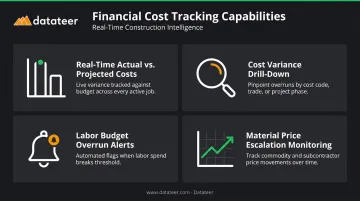
Construction finance managers can close this gap by connecting ERP data directly to dashboards that refresh automatically rather than relying on manual exports and spreadsheet assembly. For T&M and unit price contracts specifically, the most relevant capabilities are:
- Track real-time actual vs. projected costs at the job, phase, and cost-code level.
- Pinpoint cost variances for labor, materials, and equipment with drill-downs to source ERP transactions.
- Surface labor budget overruns instantly instead of weeks after payroll closes.
- Monitor material price escalation by comparing purchased costs against bid estimates.
Platforms like Datateer solve this by integrating with construction ERPs like Procore, Sage, and Viewpoint. This connection pulls labor hours, material costs, and other actuals directly from your existing payroll, procurement, and project modules.
These dashboards refresh overnight, replacing manual reporting cycles with current financial intelligence. A typical implementation is complete in 2–4 weeks, ensuring data is flowing before the annual subscription even activates.
For firms managing T&M contracts with NTE exposure or unit price contracts with significant quantity risk, the gap between "data from two weeks ago" and "data from last night" can be the difference between catching a problem and discovering a loss.
Frequently Asked Questions
What is a time and materials contract?
A T&M contract is a construction agreement where the owner pays the contractor for actual labor hours at a predetermined loaded rate plus materials at cost with an agreed markup. It's used when the full scope or duration of a project cannot be determined before work begins.
What is a unit price contract in construction?
A unit price contract sets fixed prices per measurable unit of work — such as per linear foot, cubic yard, or square foot — with the final contract value determined by multiplying those rates by actual quantities completed. It's common in civil, infrastructure, and repetitive-task construction work.
What is the difference between fixed-price and time and materials contracts?
Fixed-price contracts establish a single total cost before work begins, with the contractor absorbing the risk of overruns. T&M contracts bill for actual hours and materials used, shifting more financial risk to the owner in exchange for flexibility when scope is uncertain.
When should you use a unit price contract vs. a T&M contract?
Unit price contracts work best when the type of work is well defined but total quantities are unknown. T&M is better suited to projects where both the work type and quantity are uncertain — renovations, emergency repairs, or investigative work.
What is an example of a time and materials contract?
A contractor hired to renovate storm-damaged commercial space — where the full extent of damage can't be assessed until demolition begins — bills the owner weekly for verified labor hours and documented material receipts plus agreed markups. The NTE clause caps total owner exposure until the scope becomes clearer.
How do you track costs effectively on T&M and unit price contracts?
Effective tracking requires daily reconciliation of labor hours, cost codes, materials receipts, and quantities against contract estimates. Manual spreadsheet methods introduce days-long lag between field activity and financial visibility. Construction finance teams get the most reliable results through direct ERP integration that syncs data automatically — so cost codes, quantities, and labor hours are current before the morning review.