The term "integrated construction software" gets used constantly, but its actual value only becomes clear when you look at which teams are absorbing the cost of disconnection every single day — and what that's costing the business.
This article breaks down exactly which teams gain the most from software integration, why the benefits are different for each group, and what the absence of integration is actually costing construction firms in practice.
Key Takeaways
- Integrated construction software connects ERPs, field tools, and financial systems into a single source of truth, so every team works from the same clean data instead of re-keying it across systems
- Finance and accounting teams see the most immediate relief: automated WIP reporting, real-time job cost visibility, and faster close cycles
- Current budget data reaches project managers fast enough to catch overruns in week 3, not week 12
- Executive leadership gets portfolio-wide visibility to catch margin fade, cash flow risk, and underperforming jobs before they become crises
- Without integration, every team makes decisions on stale data, and that lag compounds as the firm takes on more work
What Is Integrated Construction Software?
Integrated construction software is a connected system where data flows automatically to the people who need it — no manual re-entry required. That means field operations, project management, payroll, procurement, and accounting all drawing from the same source.
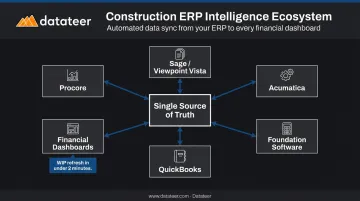
This doesn't always mean a single platform. More often, it means connected systems: an ERP like Sage or Viewpoint Vista linked to financial dashboards, scheduling tools, and field apps, where an update in one place is reflected everywhere else.
The real value is eliminating the time, cost, and errors that accumulate when teams work from different versions of the same data.
Which Teams Benefit Most from Integrated Construction Software?
Three functional teams consistently see the most measurable, day-to-day impact: finance and accounting, project managers and field operations, and executive leadership. Each benefits for different reasons.
Finance and Accounting Teams
Finance teams in construction are typically the hardest hit by disconnected systems. Controllers and project accountants spend the bulk of their time pulling cost data from ERPs, reconciling spreadsheets, and assembling WIP reports that are already outdated the moment they're distributed.
When ERP data syncs automatically to financial dashboards, that cycle breaks. Job costs, committed costs, and billing data update in near real-time — replacing what previously took 10–20 days of manual effort with a near-instant refresh.
That lag matters more than most firms realize. Slow financial reporting means:
- Decisions made on stale margin data
- Overbilling and underbilling positions that go undetected until month-end
- An accounting team too buried in data preparation to function as a strategic partner
The operational cost of that grind is real. Research from PlanGrid and FMI found construction professionals spend 35% of their time on non-optimal activities, with data collection and management consuming 13% of that time — and that's across the entire firm, not just the finance function.
Datateer's automated financial analytics platform connects directly to 12+ leading construction ERPs — including Procore, Sage, Viewpoint Vista, Viewpoint Spectrum, Acumatica, Foundation Software, CMiC, Jonas, QuickBooks, and NetSuite — and refreshes WIP reports in under two minutes. One client put it plainly: "That one click replaced two weeks worth of prior work."
KPIs impacted: WIP report cycle time, gross margin accuracy, accounts receivable aging, overbilling/underbilling ratios, monthly close duration
When this matters most: Firms managing multiple simultaneous jobs, those approaching bonding limits, and any organization where the controller is still running financial close on spreadsheets
Project Managers and Field Operations Teams
Project managers are responsible for keeping jobs on budget and on schedule — but in most construction firms, they're doing it without real-time cost data. The numbers they're working from are days or weeks old, delivered by accounting after a manual reporting cycle.
When field data flows directly into the project cost system — labor hours, purchase orders, daily reports, equipment usage — PMs can see actual-versus-budgeted costs as jobs progress, not after the fact.
That timing gap is expensive to ignore. According to McKinsey's analysis of large capital projects, 98% of megaprojects incur cost overruns or delays, with an average cost increase of 80% over original value. Labor slippage and material overruns caught in week 3 cost a fraction of what they cost when discovered in week 12.
Integration also closes the field-office gap — the persistent problem where the site team and the accounting team are operating on entirely different sets of numbers. The 2025 AGC/Sage survey of 1,109 US commercial construction firms found that 32% of firms cited field-office communication as a top IT challenge, while 28% cited integration between internal software systems. That's not a technology inconvenience — it's a structural driver of change order friction, rework, and eroded client trust.
Datateer's Project Excellence & Field Operations suite gives PMs role-specific dashboards — Budget vs. Actuals, Project Cost Performance, and PM Scorecards — all pulling live data from connected ERPs. PMs can see cost variance at the job, phase, and cost code level without waiting for accounting to run a report.
KPIs impacted: Cost-to-complete accuracy, schedule variance, change order cycle time, rework rates, subcontractor payment accuracy
When this matters most: Multi-phase projects, jobs with multiple subcontractors, and any work running at tight margins where small variances have outsized financial impact
Executive Leadership (CFO and CEO)
Construction executives make high-stakes decisions daily — bonding capacity, cash deployment, new bids, resource allocation. Most are making those calls based on reports that are weeks old, manually assembled, and inconsistent across projects.
Integrated software gives CFOs and CEOs a consolidated view of the entire portfolio: which jobs are performing, which are at risk, where liquidity is tightening, and whether the firm has capacity for new work.
The difference between a firm that scales and one that hits cash flow crises often isn't bid volume — it's how fast leadership spots and responds to financial signals across the portfolio. CFMA identifies cash flow pressure as a primary driver of contractor failure, and Travelers lists it among the top four reasons contractors go under.
The 2026 AGC survey found 63% of contractors reported project postponements or cancellations in a six-month period, with 62% citing economic slowdown as a primary concern. In that environment, financial visibility is a protection mechanism.
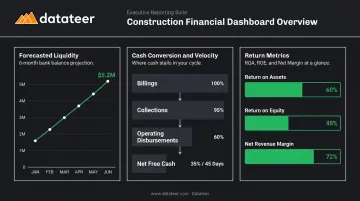
Datateer's Executive Strategy & Solvency suite delivers this visibility through three dashboards: Forecasted Liquidity (projecting bank balance six months out), Cash Conversion & Velocity (identifying where cash is getting stuck), and Return on Assets/Equity/Revenue (executive financial health at a glance). Executives move from forensic accounting — reconstructing what happened — to forward-looking strategy, steering what comes next.
KPIs impacted: EBITDA by project and division, cash flow forecast accuracy, portfolio margin trends, overhead absorption rates
When this matters most: During rapid growth, when pursuing large or complex bids, and during economic uncertainty when protecting margin becomes the top priority
What Happens When Integration Is Missing
The consequences of siloed construction software aren't dramatic failures — they're slow, compounding inefficiencies that rarely get attributed to the right cause:
- Finance teams spend the majority of their time gathering and formatting data rather than analyzing it — and the reports they produce are already stale before anyone reads them
- Project managers make budget decisions on information that's days or weeks old, leading to overruns that could have been caught and corrected earlier
- Executive leadership receives inconsistent data from different departments, making cross-project comparisons unreliable and strategic planning a best-guess exercise
- Operations teams at growing firms face compounding disconnection — more jobs mean more spreadsheets, more manual reconciliation, and more undetected errors accumulating across the portfolio
These gaps carry a measurable price tag. PlanGrid and FMI found that data and miscommunication issues caused 48% of rework in the US, costing $31.3 billion in 2018 alone. When teams operate on different versions of the same data, rework isn't a risk — it's a predictable result.
How to Get the Most Value from Integrated Construction Software
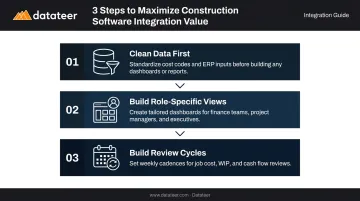
Firms seeing the biggest returns from integration share one trait: they treat it as an ongoing operational practice, not a setup-and-forget IT project. The pattern looks like this:
Clean data before building on top of it. Make sure the ERP is capturing standardized cost code data first — bad source data propagates through every downstream dashboard. Datateer handles automated data cleaning and cost code standardization during implementation, so firms don't need to prep data manually before going live.
Build role-specific views, not one-size-fits-all reports. Finance teams, PMs, and executives pull different insights from the same underlying data. The most effective setups surface what each team needs without requiring them to dig through irrelevant metrics.
Build review cycles into the workflow. Integration creates visibility, but value compounds when teams use it consistently. Set a regular interval for reviewing job cost reports, WIP accuracy, and cash flow forecasts — weekly beats monthly for catching problems while they're still fixable.
Conclusion
Integrated construction software isn't a single-team solution. Finance, field operations, and executive leadership all benefit in distinct and measurable ways — and the value compounds when all three teams are working from the same live data simultaneously.
The firms gaining the most from integration aren't necessarily the largest. They're the ones that have eliminated the manual data grind, closed the field-office gap, and given their decision-makers financial visibility that is current, accurate, and actionable.
In an industry where margins average 2–5%, real-time visibility into every active job isn't a luxury reserved for $500M firms. A mid-size GC running 15 concurrent projects can catch a margin fade event on Job 7 before it wipes out the profit on Jobs 1 through 6 — but only if the data is current when the decision gets made.
If you're not sure where your firm stands on that front, Datateer's 15-Minute Workflow Audit is a fast, no-pitch way to find out exactly where the gaps are.
Frequently Asked Questions
What is an advantage to companies that use integrated software programs?
Integrated software eliminates duplicate data entry and manual reconciliation, giving all teams access to the same accurate, real-time information. This reduces errors, speeds up decision-making, and lowers operational costs across the entire business, not just within a single department.
What is the most widely used construction software?
Widely adopted platforms include Procore (project management), Sage, Viewpoint Vista, and Acumatica (ERP/accounting). Most firms use a combination of these tools, which is why integration between them matters so much for avoiding data silos and manual re-entry.
Which team in a construction company benefits most from integrated software?
Finance and accounting teams typically see the most immediate operational relief. Integration eliminates the manual WIP report cycle, reduces close time, and delivers real-time job cost visibility that was previously unavailable. That shift lets the team focus on analysis instead of spending the week chasing numbers.
How does integrated construction software improve financial reporting?
By syncing ERP data directly to financial dashboards, integration removes the manual data-pull step entirely. WIP reports, job cost summaries, and cash flow forecasts update automatically. Work that once took days or weeks of spreadsheet effort now refreshes in minutes.
What happens when construction teams use disconnected, siloed software?
Teams make decisions on outdated data, reconciliation errors accumulate between field and office, and accounting spends most of its time gathering data rather than analyzing it. The problem worsens as the firm grows: more jobs mean more manual work and greater exposure to undetected errors.
How long does it take to implement integrated construction software?
Platforms purpose-built for construction, such as Datateer, can have data flowing in as little as 2–4 weeks. Setup is fast because the platform connects directly to your existing ERP — no system replacement needed. Data extraction, cleaning, and field mapping are handled as part of standard onboarding.