Introduction
Contractors complete the work, recognize the revenue, and then wait — sometimes for months — to collect a meaningful chunk of what they've earned. That gap is retainage, and for many firms, it's one of the most poorly managed items on the balance sheet.
The problem isn't just operational. Retainage is a genuine accounting and receivables challenge that touches balance sheet classification, cash flow reporting, and collection strategy. A firm can show strong net income while its finance team watches liquidity tighten because $2M in retainage sits uncollected across a dozen completed jobs.
This guide covers what contractors need to know about retainage from a finance and accounting perspective: correct balance sheet classification under ASC 606, building an AR aging and collection process that actually surfaces overdue balances, and the practices that keep retainage from quietly draining liquidity before release dates arrive.
Key Takeaways
- Retainage is either a contract asset or a receivable under ASC 606 — the distinction hinges on whether additional performance is still required
- The FASB's April 2025 staff paper adds disclosure expectations — no accounting change required, but your footnotes need to reflect it
- Retainage aging must be tracked separately from standard AR — milestone-based, not invoice-date-based
- Lien rights in many states expire before retainage becomes legally due, making proactive collection critical
- Real-time retainage visibility across active jobs is the difference between managing cash flow and chasing it
What Is Construction Retainage?
Retainage is the contractual practice of withholding a percentage — typically 5% to 10% — of each progress payment until a project reaches substantial completion. It functions as financial assurance for the project owner: if the contractor fails to complete the work or correct deficiencies, the owner has withheld funds to cover those costs.
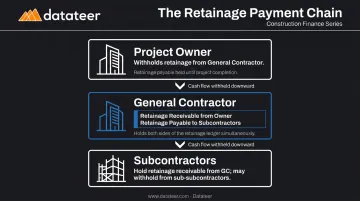
The withholding cascades down the payment chain:
- Owner withholds from the GC — creating a retainage receivable on the GC's books
- GC withholds from subcontractors — creating both a retainage receivable (what the owner owes them) and a retainage payable (what they owe subs)
- Subcontractors may withhold from sub-subs — each layer adds another retainage receivable or payable balance
On federal construction contracts, FAR 32.103 caps progress payment retainage at 10%. State rules vary considerably:
- New York: private construction retainage capped at 5%
- California: private construction retention cap drops to 5% effective January 1, 2026
- Illinois: step-down rules reduce retainage at the 50% completion milestone
Prompt payment laws, escrow requirements, and release timelines differ by state. Verify the rules for each project location using the AGC/ABA State Law Matrix before assuming a standard rate applies.
How retainage is tracked — and whether those balances are aging on schedule — directly affects cash flow and financial reporting.
How Retainage Impacts Cash Flow and Liquidity
The "Earned but Inaccessible" Problem
Under the percentage-of-completion method, revenue is recognized as work progresses. A GC who is 70% complete on a $5M project has recognized roughly $3.5M in revenue — but if 10% retainage has been withheld on every billing, nearly $350,000 of that recognized revenue sits as uncollected cash on the balance sheet. The income statement looks fine; the bank account tells a different story.
This structural gap between recognized revenue and collected cash shows up directly on the cash flow statement. Even when net income is healthy, uncollected retainage reduces operating cash flow — which is why construction firms can appear profitable on paper while simultaneously struggling to fund payroll and materials on large concurrent projects.
Compounding Pressure Across the Payment Chain
The liquidity strain compounds depending on where a firm sits in the project hierarchy:
- GCs with large portfolios carrying retainage across 10–15 simultaneous jobs often find cumulative withheld amounts represent a material share of total AR — capital they're financing out of operating cash with no near-term access
- Specialty subcontractors face the sharpest asymmetry: a sub finishing scope in month two of a 14-month project waits until final completion to collect retainage, despite finishing their work months earlier
According to a 2019 survey of 503 construction professionals by Levelset, 66% of respondents waited more than 30 days to collect retainage, and average payment time across the industry reached 83 days. For subcontractors finishing work early in long project timelines, the wait is substantially longer.
Strong net income paired with large, aging retainage receivables means liquidity is under pressure that the P&L won't show — which is precisely why retainage requires its own tracking discipline, separate from standard AR aging.
Recording Retainage Under GAAP: ASC 606 Classification
Contract Asset vs. Receivable — the Core Question
Under ASC 606, whether retainage sits on the balance sheet as a contract asset or a receivable comes down to one question: is the contractor's right to payment unconditional?
- Receivable (unconditional): The right to payment depends solely on the passage of time — the work is done, the retainage will be released when the contractual period expires, with no additional performance required
- Contract asset (conditional): The right to payment depends on completing something else — finishing a punch list, obtaining final sign-off, passing an inspection — before the retainage is released
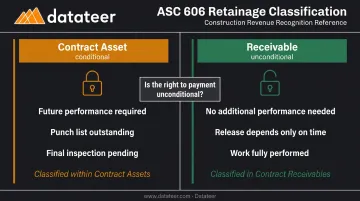
This distinction matters for balance sheet presentation. Retainage on jobs where the contractor has fully performed belongs in Contract Receivables; retainage tied to outstanding performance obligations sits within Contract Assets. The analysis runs contract by contract, not as a portfolio-level judgment.
The FASB's April 2025 Clarification
The FASB released a Staff Educational Paper in April 2025 clarifying how construction contractors should present and disclose retainage under existing GAAP. The paper does not change the standards — it explains how to apply them.
Key takeaways from the paper:
- Voluntary supplemental disclosures are encouraged, including parenthetical retainage amounts within contract asset line items
- Note disclosures showing retainage expected to be collected beyond one year are specifically highlighted as decision-useful for financial statement readers
- The total retainage balance, the portion due after 12 months, and expected collection timing should be disclosed when retainage is classified as an unconditional receivable
These disclosures go beyond accounting hygiene. Sureties and lenders want to know how much of your receivables balance is genuinely liquid versus tied up in long-dated retainage — and that distinction directly affects bonding capacity and lender covenant compliance.
Managing Retainage Receivables: Tracking, Aging, and Collection
Why Retainage Needs Its Own Aging Schedule
Standard AR aging sorts balances by invoice date. Retainage aging doesn't work that way. A retainage balance that is 90 days old might be perfectly current if the project just reached substantial completion last week — or it might be seriously overdue if the punch list was signed off three months ago and the owner still hasn't released funds.
Retainage aging must be tied to project milestones, not invoice dates. An effective retainage aging schedule includes:
- Project name and contract value
- Retainage withheld to date
- Expected release date or triggering milestone
- Current punch list or final approval status
- Days past expected release date
- Responsible contact on the owner or GC side
This visibility is what allows finance teams to catch problems before a 60-day delay becomes a dispute.
The Collection Process — and the Lien Deadline Problem
The retainage collection process follows a defined sequence:
- **Submit a formal retainage release request** tied to substantial completion documentation — photos, daily reports, change order logs, and inspection sign-offs
- Follow up systematically on client delays; the owner's subjective sense that the punch list isn't done is easier to push back on when documentation is airtight
- Escalate through contractual dispute resolution if the owner stalls without valid cause
- File a mechanic's lien if necessary — but this must happen before the lien window closes
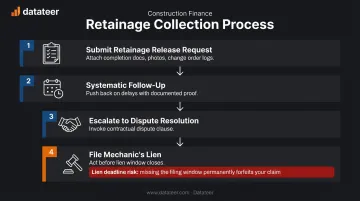
That last point is where many contractors get caught. Construction Executive notes that mechanics liens typically cover amounts that are owing and due — meaning lien rights may expire before retainage is legally due under the contract. In states like Texas, Chapter 53 of the Property Code includes separate lien provisions for retainage claims with their own deadlines. Missing those windows can eliminate your legal recourse entirely, leaving a formal demand letter as your only option.
The Silent Risk: Stale Retainage on Completed Jobs
For multi-project firms, the most common source of retainage write-offs is simple: retainage on completed jobs ages past expected release dates while finance teams are focused on active projects. Firms relying on monthly ERP exports or spreadsheet-based tracking often discover these balances only at year-end close, by which point disputes have calcified and lien rights have expired.
Datateer's construction financial dashboards connect directly to ERPs including Sage, Vista, Procore, and Acumatica. They surface retainage A/R aging, overdue release flags, and release schedule projections on an automated daily basis — replacing the manual spreadsheet process with real-time visibility that identifies stale retainage before it becomes a write-off.
Best Practices for Managing Construction Retainage
Strong retainage management starts before the contract is signed.
Negotiate Terms Proactively
- Request 5% rather than 10% as the baseline withholding rate
- Propose milestone-based step-down schedules rather than holding everything to final completion
- Note that ConsensusDocs 500 Section 10.2.4 explicitly allows retention bonds as an alternative to cash withholding
- Consider retention bonds where available — Miller Nash reports bond premiums typically run 1%–2% of the bond amount, often less than the carrying cost of withheld cash
How you structure these terms at signing directly determines how retainage will behave in your cash flow model throughout the job.
Build Retainage Into Cash Flow Forecasting From Day One
- Treat retainage release dates as discrete cash inflow milestones in your 13-week or monthly model
- Maintain a retainage reserve to cover operational shortfalls during periods of high accumulation on large jobs
- Map every expected release to a date on the calendar — retainage is a known schedule, so treat it like one
Once your forecasting accounts for retainage timing, the next priority is building the documentation record that gets it released on schedule.
Maintain Documentation That Accelerates Release
- Keep organized records of work completion by phase, with photos and daily reports
- Log all change orders contemporaneously — delays here create disputes at closeout
- Submit retainage release requests with documentation complete enough that the owner has no basis to dispute what was finished
How Real-Time Financial Data Improves Retainage Visibility
A construction finance team managing retainage across 20, 50, or 100+ active jobs cannot effectively track outstanding balances, aging, and expected release dates using static ERP reports or monthly spreadsheet exports. By the time those reports are compiled, they're already stale — meaning overdue balances go unnoticed until close.
What changes with real-time visibility:
- CFOs and controllers can see total retainage receivable by project, aging bucket, and expected collection date at any point — not just at month-end
- Overdue retainage is flagged automatically, not discovered during close
- Cash flow forecasts reflect actual retainage release schedules, not assumptions based on last month's data
- Finance teams shift from compiling data to acting on it — engaging project managers early about punch list completion, modeling the cash impact of delayed releases before the shortfall hits
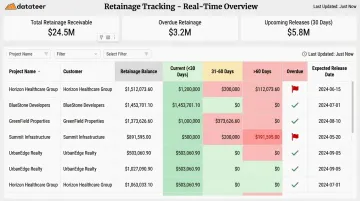
Datateer's construction financial dashboards integrate directly with 20+ construction ERPs and refresh daily. The Retainage Tracking module covers both A/R retainage (what owners owe you) and A/P retainage (what you owe subs), retainage release schedules, and overdue flags.
It links directly to 13-week cash flow forecasting within a flat annual subscription starting at $10,000/year per data source with unlimited users.
Instead of spending hours assembling a retainage schedule for the monthly close, a CFO can walk into that meeting with current data already visible. From there, it's straightforward to prioritize the three conversations that need to happen this week and model what a 45-day delay on a $400K retainage release does to next quarter's cash position.
Frequently Asked Questions
How do you account for retention in construction?
Retainage is recorded as either a contract asset (conditional on future performance) or a receivable (unconditional, depending only on time) under ASC 606, classified contract by contract. Revenue is recognized as earned under percentage-of-completion regardless of collection status. Uncollected retainage reduces operating cash flow on the cash flow statement even when net income is strong.
Should retainage be included in accounts receivable?
Retainage belongs in accounts receivable only when the contractor holds an unconditional right to payment and the release depends solely on the passage of time. If completion of a punch list or final approval is still required, it is a contract asset under ASC 606, not a receivable.
What is the typical retainage percentage in construction?
Retainage typically ranges from 5% to 10% of each progress payment. Federal contracts are capped at 10% under FAR 32.103. Several states have enacted lower caps — New York and California now limit private construction retainage to 5%. Many contracts include step-down provisions that reduce the withholding rate (often from 10% to 5%) once a project reaches 50% completion.
What is the difference between a contract asset and a retainage receivable?
A contract asset reflects earned revenue still conditioned on future performance: completing a punch list, passing an inspection, or meeting another milestone. A retainage receivable reflects an unconditional right to payment where only time separates the contractor from the cash. This distinction drives balance sheet presentation and ASC 606 disclosure requirements.
What happens if retainage is not released on time?
Contractors can submit a formal retainage demand, pursue dispute resolution per the contract's clause, or file a mechanic's lien. The critical timing issue: lien windows in many states expire before retainage is legally due, so proactive documentation and early escalation are essential — waiting until funds are officially late can leave limited legal recourse.
How does retainage appear on the WIP schedule?
Retainage balances are tracked separately from billed receivables on the WIP schedule. Unresolved retainage on completed jobs can distort the over/under-billing picture if not accurately classified and segregated. Disciplined retainage accounting is a prerequisite for a WIP schedule that reflects the firm's true financial position.