Overhead costs are the expenses that keep your business running whether projects are active or not. They're easy to underestimate, surprisingly easy to miscalculate, and when they go unmanaged, they quietly compress margins on every job you bid.
This article covers:
- What construction overhead costs actually include (and what gets misclassified)
- How to calculate your overhead rate — including the Eichleay Formula
- Industry benchmarks from CFMA's Financial Benchmarker
- How to allocate overhead across projects using a job costing system
- The most common mistakes and how to avoid them
- Practical strategies to manage and reduce overhead
Key Takeaways
- Overhead divides into indirect (company-wide) and direct (job-specific) — misclassifying one as the other distorts both your rate and project profitability
- Your overhead rate should be recalculated at least annually, with quarterly reviews when staffing or insurance costs shift
- CFMA data shows SG&A averaged 11.8% of revenue across all firms in FY2023
- Unabsorbed overhead drains cash directly; volume forecasting matters as much as the rate itself
- Real-time ERP-connected reporting eliminates the multi-week lag that pushes stale rates into live bids
What Are Construction Overhead Costs?
Overhead costs are all expenses required to keep the business running that cannot be directly traced to a single project. They're distinct from direct costs (materials, field labor, and subcontractor payments) which are tied to specific jobs.
The distinction matters for two reasons: accurate job costing and accurate bidding. Get the classification wrong and you'll either over-recover overhead on some jobs or quietly lose money on others.
Indirect (General) Overhead
Indirect overhead covers company-wide operating costs that exist regardless of project volume. These include:
- Office rent and utilities
- Administrative and executive salaries
- General liability insurance and workers' compensation premiums
- Marketing and advertising
- Legal and accounting fees
- Software subscriptions and IT infrastructure
- Depreciation of office equipment and vehicles
These costs don't disappear between projects. They run on whether you have two active jobs or twelve.
Direct (Job) Overhead
Direct overhead (also called "job overhead" or "general conditions") consists of costs tied to a specific project but not part of the physical construction. Examples include:
- Site superintendent and foreman salaries
- Temporary facilities (trailers, portable toilets, site fencing)
- Project-specific equipment rentals
- Temporary utilities at the job site
- Job-specific insurance riders
Misclassifying a direct overhead cost as general overhead (or vice versa) creates two problems: it inflates your company-wide overhead rate and understates the true cost of that specific job — both of which skew your bids in opposite directions on different jobs.
Labor Burden: The Hidden Overhead
Labor burden (payroll taxes, benefits, workers' compensation, and unemployment insurance) is one of the most commonly underestimated overhead components.
BLS Employer Costs for Employee Compensation data from Q1 2026 shows that for construction industry workers, benefits add approximately 44% on top of base wages — with total benefits costing $15.69 per hour against wages of $35.54 per hour.
That gap between what you pay someone and what they actually cost the company needs to be captured in your overhead rate. Firms that don't include labor burden in their cost structure end up underbidding every labor-intensive job.
How to Calculate Your Construction Overhead Rate
A predetermined overhead rate ensures every project bid carries its fair share of operating costs. Without one, individual jobs quietly absorb expenses like rent, insurance, and admin payroll — and by the time you spot the pattern, the margin damage is already done.
Method 1: Percentage of Direct Costs
This is the most common method for commercial contractors. The calculation has three steps:
- List and total all overhead expenses for a 12-month period (indirect overhead only — exclude direct job overhead)
- Determine total direct costs (labor + materials + equipment) for the same period
- Divide total overhead by total direct costs and multiply by 100
Example:
- Annual overhead: $300,000
- Total direct costs: $1,500,000
- Overhead rate: $300,000 ÷ $1,500,000 × 100 = 20%
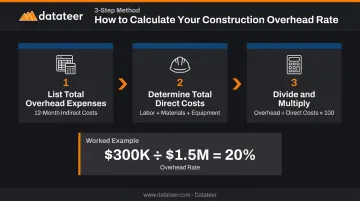
When building a bid, you'd apply that 20% on top of the direct costs for each project to ensure indirect overhead is recovered.
Method 2: The Eichleay Formula
The Eichleay Formula is used primarily in government contract disputes to calculate unabsorbed home office overhead (HOOH) caused by government-imposed delays. Per federal case law, it's a two-step calculation:
Step 1 — Allocable HOOH: (Contract Billings ÷ Total Company Billings) × Total HOOH During Contract Period
Step 2 — Daily HOOH Rate: Allocable HOOH ÷ Contract Days
Example:
- Contract billings: $2M | Total company billings: $10M | Total HOOH: $500,000
- Allocable HOOH: ($2M ÷ $10M) × $500,000 = $100,000
- If the contract ran 200 days: Daily HOOH = $100,000 ÷ 200 = $500/day
This formula is most appropriate when a government-caused delay extends the performance period and the contractor can demonstrate they were unable to take replacement work. It's not a general-purpose overhead allocation tool for everyday bidding.
How Often to Recalculate
Overhead rates should be recalculated at least annually — tied to budget planning — with quarterly reviews to catch material changes in staffing, insurance costs, or project volume. A rate set in January becomes unreliable by July if you've added two project managers or renewed an insurance policy at a higher premium.
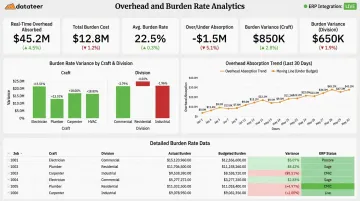
That lag is where stale rates cause the most damage. Firms using ERP-integrated analytics can pull current indirect cost data continuously, so rates reflect what's actually happening in the business today. Datateer's Overhead & Burden Rate Analytics dashboard, for instance, automatically calculates fully-burdened labor rates by craft, department, and division, and compares budgeted burden rates to actuals in real time — so bid teams are working from current figures rather than a number set during last year's planning cycle.
Industry Benchmarks: What Is a Typical Overhead Rate?
Benchmarking your overhead rate gives you a reality check on whether your cost structure is competitive. The most reliable public data comes from CFMA's Financial Benchmarker.
CFMA Benchmarker Data
CFMA's 2024 Financial Benchmarker reported that SG&A expense averaged 11.8% of revenue across all construction companies in FY2023, with Best in Class firms coming in slightly lower at 10.8%. For FY2024, Industrial & Nonresidential contractors specifically reported SG&A averaging 7.3% of revenue.
| Segment | SG&A as % of Revenue |
|---|---|
| All construction companies (FY2023) | 11.8% |
| Best in Class firms (FY2023) | 10.8% |
| Industrial & Nonresidential contractors (FY2024) | 7.3% |
These figures represent indirect overhead as a percentage of total revenue — a different calculation than the overhead-to-direct-cost rate used in bidding, but useful for benchmarking overall cost structure efficiency.
Overhead by Specialty
Overhead rates vary by construction type:
- General contractors typically carry lower overhead rates because much of their work flows through subcontractors (reducing the direct cost base)
- Specialty trade contractors tend to carry higher rates, driven by specialized equipment, skilled labor requirements, and tighter crew scheduling
- Heavy civil and highway contractors sit somewhere in between, with equipment-heavy operations creating distinct indirect cost structures
A "good" overhead rate for an electrical subcontractor looks very different from a good rate for a civil general contractor. Benchmark against your specific segment, not the industry average.
Unabsorbed Overhead
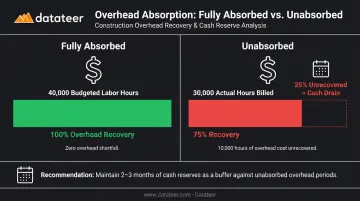
When project volume drops below projections, overhead that was supposed to be recovered through client billings instead comes out of company reserves. This is unabsorbed overhead — and it's a direct cash drain.
Volume forecasting matters as much as the rate calculation itself. If your overhead rate assumes 40,000 direct labor hours and you only bill 30,000, you recover 25% less overhead than planned. CFMA recommends keeping enough cash or credit to cover fixed payments and payroll for two to three months as a buffer against exactly this scenario.
How to Allocate Overhead Costs Across Projects
Allocation starts with choosing a cost driver — a measurable project input used to distribute indirect overhead proportionally across jobs.
Choosing an Allocation Base
The three most common options:
| Allocation Base | Best For |
|---|---|
| Direct labor hours | Labor-intensive firms where time on site drives most overhead |
| Direct labor cost | Firms with varied wage rates across project types |
| Equipment hours | Equipment-heavy contractors (civil, excavation, mechanical) |
A blended rate can improve accuracy when your project mix includes both labor-heavy and equipment-heavy work. Per CFMA guidance on job costing, equipment repairs and maintenance costs specifically should be allocated on equipment hours rather than labor hours when that better reflects actual cost drivers.
The Allocation Calculation
Once your rate is set, the math is straightforward:
Predetermined overhead rate × Allocation base quantity = Allocated overhead for that job
Example: $20/labor hour rate × 150 hours on a job = $3,000 allocated overhead
That $3,000 gets recorded as an indirect cost line in the job's cost report, ensuring it contributes to overhead recovery alongside every other active project.
Direct vs. Indirect: Why the Distinction Matters
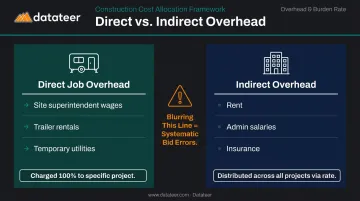
Direct job overhead (site superintendent wages, trailer rentals, temporary utilities) is charged entirely to that specific project with no allocation needed. Indirect overhead is distributed proportionally across all active jobs through the rate calculation.
Blurring this line creates systematic errors. Some projects get overcharged, others get undercharged, and neither problem surfaces until you close the job and compare projected margin to actual.
Common Overhead Cost Mistakes to Avoid
The most costly overhead mistakes in construction aren't dramatic failures — they're small misclassifications and stale assumptions that compound across every bid.
The three most common:
- Failing to separate direct and indirect overhead — lumping job-specific costs into the general overhead pool inflates the company-wide rate and makes individual job profitability impossible to read accurately
- Overlooking small recurring items — vehicle depreciation, small tools, software subscriptions, and cell phone allowances seem minor individually, but they compound into a meaningful gap between estimated and actual overhead
- Using stale rates — a rate set 12 months ago in a lower-insurance, lower-staffing environment will systematically underbid every job priced against it this year
Beyond misclassification, inconsistent treatment is its own problem. Once an allocation methodology is chosen, it must be applied the same way across all jobs and periods. Inconsistent application produces results that can't be compared across projects — rendering historical bid data unreliable for future estimates.
Manual spreadsheets amplify all of these problems. A broken formula, a copy-paste error, or a delayed update can corrupt the overhead rate being used for active bids without triggering any visible error flag. Research from FMI and Autodesk found that over 80% of construction and engineering leaders reported at least 25% of their project data was unusable — and bad data cost the industry an estimated $1.84 trillion in 2020.
ERP-connected reporting solves this by maintaining a single, continuously updated cost record. Datateer's platform, for example, automatically standardizes cost codes across systems, catches malformed entries, and reconciles Procore project commits to Sage invoices — removing the manual handoffs where miscalculations typically enter the overhead rate.
Strategies to Manage and Reduce Construction Overhead
Managing overhead isn't just about cutting costs. It's about knowing what you're spending, why, and whether the business is recovering it.
Run quarterly overhead audits. Review insurance policies, software subscriptions, staffing levels, and vendor contracts every 90 days. Overhead categories that grow incrementally often go unnoticed until annual budget season — when the rate adjustment is already overdue.
Tighten back-office operations. Digitizing documentation, automating invoice approvals, and standardizing cost codes cuts the labor hours required to run the administrative function. Fewer admin hours means a smaller indirect overhead pool.
Apply historical job data to the next bid. Firms that track job costing results at close can identify which cost categories consistently overrun estimates and adjust their overhead rate before the next bid cycle. CFMA notes that job-costing data compiled weeks or months after the fact diminishes the ability to react to changing conditions.
Close the reporting lag. Traditional monthly reporting cycles create a 10–20 day gap between when costs are incurred and when they're visible to finance managers. By that point, the project phase driving the overrun may already be complete. Datateer's dashboards sync directly with construction ERPs — including Procore, Sage, and Viewpoint Vista — and refresh overnight, replacing the manual close cycle with continuous visibility into overhead absorption, burden rate variances, and margin trends.
Know your fixed overhead floor. Fixed overhead (rent, core salaries) must be covered regardless of project volume. Understanding your firm's break-even revenue threshold helps leadership make better go/no-go decisions during slow periods.
Taking a job at thin margins to "keep the crew busy" makes sense if it covers fixed overhead. It doesn't if it also requires adding variable overhead that won't be recovered.
Frequently Asked Questions
What is a typical overhead rate in construction?
Based on CFMA benchmarker data, SG&A overhead averages around 11–12% of revenue for most construction firms, with Best in Class companies running slightly lower. The range varies by specialty, company size, and geography — specialty trade contractors typically carry higher rates than general contractors.
What are examples of overhead costs in construction?
Indirect overhead includes office rent, administrative salaries, general liability insurance, marketing, and accounting fees. Direct (job) overhead includes site superintendent wages, equipment rentals, temporary site facilities, and job-specific insurance riders.
What is the difference between direct and indirect overhead in construction?
Direct overhead ties to a specific project without touching the physical build; site trailers and superintendent wages are common examples. Indirect overhead supports overall company operations and gets distributed across all projects through a predetermined allocation rate.
How often should construction companies recalculate their overhead rate?
At least annually, aligned to the budget cycle. Quarterly reviews are advisable to catch material changes in staffing, insurance premiums, or project volume before actual overhead exceeds the estimated rate and distorts active bids.
What is unabsorbed overhead and why does it matter?
Unabsorbed overhead occurs when project volume falls short of projections, leaving a portion of fixed indirect costs uncovered by any client billing. That shortfall comes directly out of company cash reserves and can threaten business continuity if it persists across multiple periods.
How do overhead costs affect construction project bids?
The overhead rate is applied on top of direct project costs in every bid. Underestimate it and the company loses money on jobs; overestimate it and bids become uncompetitive.