Cost-to-complete (CTC) reports are one of the most direct tools available to prevent that scenario. But their value isn't theoretical — it shows up only when the reports are current, maintained consistently, and reviewed by the people who can actually do something about what they show.
This article covers what CTC reports are, why they matter operationally, what happens when firms skip them, and how to get the most out of them.
Key Takeaways
- A CTC report projects total cost at completion — not just what's been spent — giving teams a forward view of project health
- Maintained regularly, CTC reports protect margins, improve cash flow planning, and enable corrective action before problems compound
- Stale CTC reports are nearly as dangerous as none — decisions made on weeks-old data compound problems instead of preventing them
- CTC reporting is an ongoing financial discipline, not a one-time response to a troubled project
What Is a Cost-to-Complete Report in Construction?
A cost-to-complete report is a financial document that answers one question: Will this project finish within budget? It combines what has already been spent, what is contractually committed, and an estimate of remaining work to project the total cost at completion — measured against the original contract value.
That distinction separates it from a standard job cost report. A job cost report tells you what has been spent; a CTC report tells you where the project is actually headed — and whether the budget will hold.
Core Components of a CTC Report
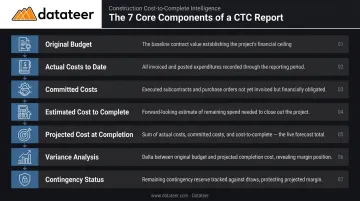
A CTC report includes:
- Original budget — the contracted value and approved scope baseline
- Actual costs to date — all costs posted against the job
- Committed costs — executed subcontracts and purchase orders not yet invoiced
- Estimated cost to complete (ETC) — the remaining spend needed to finish the work
- Projected cost at completion — actual costs + committed costs + ETC
- Variance analysis — projected cost at completion vs. original budget
- Contingency status — how much reserve has been consumed and what remains
Each component feeds the forward projection. Omitting even one — committed subcontract costs are a frequent gap — renders the ETC unreliable. AICPA-CIMA's guidance on WIP schedules confirms that effective construction financial reporting requires contract price, estimated total project cost, costs incurred to date, and billings to date as minimum components.
Key Advantages of Cost-to-Complete Reports
The value of CTC reports is operational and financial — showing up in margin protection, liquidity management, and the quality of decisions made daily across field and finance teams.
Proactive Margin Protection Before It's Too Late
CTC reports shift financial oversight from forensic to forward-looking. Instead of explaining what happened to margin, finance teams can detect erosion while options still exist.
Compare the projected cost at completion against the original contract value on a regular cadence. What emerges is visibility into margin fade — the gradual erosion of profit through small overruns across labor, materials, and subcontractor costs.
Why does this matter? KPMG's 2023 Global Construction Survey found that 37% of respondents missed budget and/or schedule performance targets. Margin fade is rarely a single event — it accumulates across cost codes, often invisibly until month-end close.
Timing is everything here. When a CTC report signals a problem at 40% completion, the team can renegotiate subcontracts, reduce scope, or accelerate productivity. At 80% completion, the same problem has far fewer solutions and most of the budget has already been spent.
Datateer's Margin Protection dashboard detects margin fade at the cost-code level — tracking labor overrun, material price escalation, subcontractor cost increases, and change order denial — with data refreshed overnight rather than at month-end close.
KPIs impacted:
- Gross margin per project
- Cost variance (CV)
- Estimate at completion (EAC)
- Contingency burn rate
- Projected over/under
When this matters most: Long-duration projects (12+ months), lump-sum contracts where overruns come directly off profit, and jobs with heavy labor content where productivity variances are difficult to predict.
Accurate Cash Flow Planning and Stronger Lender and Bonding Relationships
Because CTC reports show not just remaining costs but the timing and composition of those costs, they enable finance teams to build reliable cash flow projections — and to present those projections credibly to lenders, bonding companies, and investors.
CFMA data cites a U.S. Bank study finding 82% of failed businesses failed because of cash-flow problems, not demand or profitability issues. Construction firms managing multiple concurrent projects face compounding exposure: a draw delay or cost overrun on one job affects liquidity across all active work.
A well-maintained CTC report becomes the foundation for managing working capital at the portfolio level, not just the job level.
On the bonding side, NASBP confirms that timely and periodic financial information is key to increasing bonding capacity. Firms that can produce current, credible CTC data move through draw approvals and bonding reviews faster and with less friction than firms presenting month-old spreadsheets.
KPIs impacted:
- Working capital ratio
- Draw schedule accuracy
- Days cash on hand
- Bonding capacity utilization
- Accounts payable cycle time
Best suited for: Firms running three or more concurrent projects, firms seeking bonding increases mid-year, and firms with significant subcontractor payment obligations creating short-term liquidity pressure.
Faster, More Informed Decision-Making Across the Field-to-Finance Gap
CTC reports create a shared financial reference point between field operations and the finance office. When both teams work from the same current data, project managers can make scope, procurement, and resource decisions with an actual understanding of their remaining budget — not intuition or three-week-old exports.
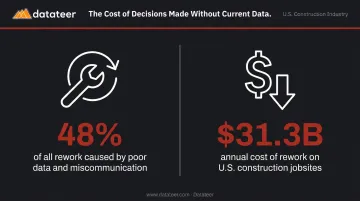
The cost of the alternative is well documented. A 2018 PlanGrid/FMI study found that poor project data and miscommunication account for 48% of all rework on U.S. construction jobsites, costing more than $31.3 billion annually. Decisions made without current cost-to-complete context frequently produce reactive spending — unnecessary acceleration, rework, or scope concessions that erode margin further.
CTC reports solve this differently than general budget summaries. By showing remaining budget by cost code — labor, materials, equipment, subcontractors — they enable targeted diagnosis.
A project manager can determine whether a problem stems from labor productivity, material cost escalation, or a subcontractor billing discrepancy — rather than receiving a generic "you're over budget" alarm.
Datateer's Project Excellence & Field Operations suite provides project managers with Budget vs. Actuals and Project Cost Performance dashboards, giving field teams real-time cost-code-level visibility without routing every question through the finance office. The result is what Datateer calls a shared "Single Source of Truth" — replacing office-vs-field data disputes with data-backed conversations.
KPIs impacted:
- Decision cycle time
- Change order approval speed
- Rework costs
- Labor cost variance by phase
- Subcontractor invoice accuracy
Larger firms benefit most from this dynamic — when superintendents and project managers are geographically distributed and finance operates from a central office, the CTC report becomes the common language bridging that operational gap.
What Happens When CTC Reports Are Missing or Ignored
The most common consequence is this: finance teams shift into reactive mode, learning about cost overruns too late to course-correct. End-of-project "surprise losses" that have been accumulating for months become the norm rather than the exception.
Three downstream risks compound when CTC reporting is inconsistent or absent:
- Estimating accuracy degrades — inconsistent cost coding and data entry make historical job comparisons unreliable, eroding the data quality that future bids depend on
- External relationships suffer — lenders and bonding companies may slow draw approvals or restrict bonding capacity when firms cannot produce credible forward-looking cost data on request; NASBP is explicit that timely financial information is critical to bonding capacity increases
- Field execution suffers — project managers without current budget visibility over-order materials, absorb subcontractor overcharges without pushback, or slow crew productivity out of financial uncertainty
These consequences are manageable on a single small project. Across a portfolio of five to fifteen active jobs, they compound quickly.
The firms most exposed are typically the ones who assume their ERP provides cost-to-complete visibility — when it's only showing cost-to-date data. Cost-to-date tells you what's been spent; cost-to-complete tells you where the project is headed. Most ERP job cost screens show the former, not the latter.
How to Get the Most Value from Cost-to-Complete Reports
CTC reports deliver their greatest value when updated in line with job cost postings, not just at monthly close. That cadence only works if every stakeholder — from project manager to CFO — is working from the same version of the numbers.
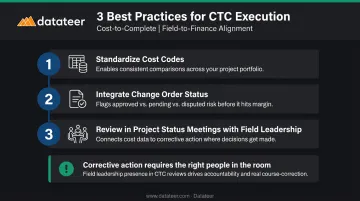
Three practices define consistent CTC execution:
Standardize cost codes across all jobs so CTC data is comparable across the portfolio, not just interpretable job-by-job. Benchmarking margin performance or spotting systemic overruns requires consistent structure. Datateer's automated data extraction engine handles this normalization directly, mapping cost codes across ERPs and jobs into a unified structure.
Integrate change order status directly into the CTC calculation : approved, pending, and disputed change orders each carry different risk to the projected cost at completion. Work performed without an approved change order is a real cost; treating it the same as contracted scope distorts the forward projection.
Review CTC data in project status meetings with field leadership, not just in finance-only close reviews. The report only drives corrective action when the people with authority to act are in the room. A CFO reviewing CTC data alone cannot renegotiate a subcontract or adjust crew deployment.
The Data Latency Problem
The single biggest barrier to consistent CTC discipline is data latency. When finance teams spend significant time manually compiling cost data from the ERP into spreadsheets, the resulting CTC report is already outdated by the time it reaches leadership. As Double L Management's Business Analyst noted about switching to automated dashboards: "the very first time we accessed our data through a Datateer analytics dashboard, that one click replaced two weeks worth of prior work."
Datateer eliminates this lag by pulling directly from the ERP — across Procore, Sage, Viewpoint Vista, Acumatica, and 12+ other systems — and refreshing dashboards overnight as standard, with more frequent updates available on request. Finance teams stop spending their week assembling numbers and start spending it on the decisions those numbers inform.
Conclusion
A cost-to-complete report earns its keep by showing where a project is financially headed — not just where it has been. That forward visibility is what makes it possible to act while there is still time to protect the margin.
CTC reporting isn't a one-time exercise for troubled projects. Applied consistently across every active job — with data current enough to drive real decisions — it becomes a financial discipline that grows more valuable the longer you maintain it. Firms that commit to it don't eliminate risk, but they stop being caught off guard by it.
Frequently Asked Questions
What is a cost-to-complete report in construction?
A cost-to-complete report is a financial document that combines costs incurred to date, committed costs, and projected remaining expenditures to estimate the total cost at project completion. It gives project teams a forward-looking view of whether the job will finish within budget — unlike standard cost reports, which only reflect historical spending.
What is cost reporting in construction?
Cost reporting in construction is the broader practice of tracking, analyzing, and communicating all financial data across a project's lifecycle — covering actual costs, budget variances, committed costs, and forecasts. Cost-to-complete reporting is its most forward-looking and actionable component.
How often should a cost-to-complete report be updated?
CTC reports should be updated in sync with job cost postings — weekly or bi-weekly — not just at monthly close. Firms on monthly cycles are often weeks behind problems that have already grown.
Who is responsible for preparing a cost-to-complete report?
Responsibility typically sits with the project manager or construction finance manager, working with field superintendents who supply percent-complete inputs. At larger firms, the CFO or controller owns the portfolio view while project managers own each job.
What is the difference between estimated cost at completion (EAC) and cost to complete (CTC)?
The cost to complete (CTC) represents only the remaining costs needed to finish the project. The estimated cost at completion (EAC) is the total projected project cost — equal to actual costs to date plus the CTC. Both figures appear in a full cost-to-complete report.
What triggers the need for a cost-to-complete report?
CTC reports are most commonly ordered when a project encounters distress — a budget overrun, contractor replacement, or new lender involvement. The stronger approach is continuous tracking rather than reactive reporting; the earlier a cost problem surfaces, the more options remain available to address it.