Key Takeaways
- An SOV breaks the total contract amount into line items used to support every progress payment application
- Both GCs and subcontractors maintain separate SOVs — the GC submits to the owner; subs submit to the GC
- The SOV is the approved billing framework — the pay application is the monthly draw against it
- Frontloading and vague line item descriptions are the two fastest ways to trigger owner rejection
- Monthly SOV updates must reflect verified field progress, not office estimates, to feed accurate WIP reporting
What Is a Schedule of Values in Construction?
A schedule of values is a line-item breakdown of the entire contract amount, where each item represents a measurable scope of work assigned a specific dollar value. It serves as the contractually agreed billing framework for every progress payment throughout the project's life.
Per AIA A201-2017, Section 9.2, the SOV "allocates the entire Contract Sum to various portions of the contractor's work" and must be submitted before the first application for payment. The AIA G703 Continuation Sheet is the standard form most contractors use to structure and track it.
What the SOV Is Not
Two terms get confused with the SOV constantly:
- Payment schedule — a timeline showing when payments will occur. The SOV defines what each payment covers.
- Cost breakdown or budget — an internal planning estimate. The SOV is an externally approved, contractually binding document.
Unlike either of those documents, the SOV is neither a projection nor a wish list. Once approved, it becomes the reference point against which every billing decision is measured. Changing it mid-project requires a formal amendment — and front-loaded or poorly structured line items discovered after approval are a common trigger for payment disputes and GC pushback that stall draws for weeks.
Why the Schedule of Values Matters for Contractors and Subcontractors
Without a well-structured SOV, monthly billing becomes a negotiation. Owners can't verify what work justifies the invoice amount, and contractors risk underbilling early, overbilling later, or having applications rejected outright.
The payment stakes are real. According to Foundation Software, 82% of contractors report payment delays exceeding 30 days — and 75% of subcontractors increase their bid amounts specifically to compensate for that risk. An SOV that's vague, front-loaded, or misaligned with the actual scope accelerates those delays by giving reviewers reasons to push back.
Cash Flow Precision
An accurate SOV lets contractors plan labor deployment, procurement timing, and subcontractor payments with real predictability. The billing cycle should roughly mirror cost outflows — when it doesn't, the gap creates liquidity pressure that can spiral quickly. The CFMA identifies cash flow as the single most common cause of contractor failure — which means the SOV's role in structuring billing cycles directly affects whether a firm survives a slow-pay stretch.
Accountability Between Field and Finance
The SOV closes the gap between what field teams report as complete and what accounting teams can actually invoice. Without that alignment, the two groups operate on different realities — and the pay application ends up reflecting neither accurately.
Subcontractor-Specific Protection
For subs, the SOV is more than a billing tool. It creates a documented audit trail for every scope item's agreed dollar value. When disputes surface — retainage withheld at closeout, scope disagreements mid-project, or back-charges at final billing — the approved SOV is the reference document that either supports or undermines the sub's position. Subs who treat it as a formality typically discover that gap during the hardest conversations to win.
Key moments where the SOV protects subcontractors:
- Retainage release disputes — line-item completion percentages are verifiable against the original approved values
- Scope change claims — baseline dollar allocations document what was and wasn't included in original contract scope
- Pay application rejections — a well-structured SOV gives the sub a defensible basis for challenging GC holdbacks
How a Schedule of Values Works
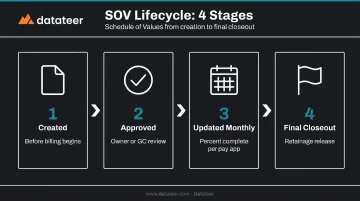
The SOV lifecycle follows a consistent pattern: created before billing begins, approved by the owner or GC, updated monthly as work progresses, and used as the basis for every pay app through final completion and retainage release.
Step 1: Define Project Scope and Break Work Into Line Items
Start with the signed contract — not a generic template from a prior job. Each line item should represent a distinct, measurable piece of work that both field crews and the finance team can verify independently, whether organized by trade, phase, system, or location.
A practical rule: if two scopes can progress at different rates, they need separate line items. Bundling them creates ambiguity at billing time and hands reviewers a reason to reject or reduce the payment request.
Step 2: Assign Realistic Scheduled Values
Each line item needs a dollar value based on actual cost — material estimates, labor hours, subcontractor quotes, or historical project data. Rough percentages and generic allocations don't hold up to scrutiny.
Frontloading — assigning inflated values to early-stage items like mobilization or site prep — is the most common structural mistake. The risks are significant: owner and architect scrutiny, potential rejection, and a depleted SOV at closeout where very little contract value remains against substantial work still to complete. AIA A201 explicitly grants the architect the right to demand substantiating data before approving any SOV.
Step 3: Include Required Columns and Tracking Fields
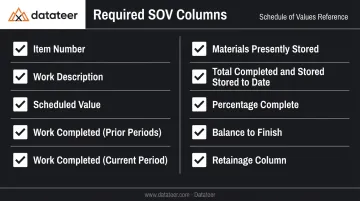
At minimum, every SOV must contain:
- Item number
- Work description
- Scheduled value
- Work completed (prior periods)
- Work completed (current period)
- Materials presently stored
- Total completed and stored to date
- Percentage complete
- Balance to finish
- Retainage column (where applicable)
Change orders belong as separate line items — never merged into existing ones. Keeping them distinct preserves an independent billing history and completion status for each approved change, which matters when disputes arise.
Step 4: Submit, Update, and Reconcile Each Billing Cycle
The SOV is submitted once for approval at project start, then updated monthly with current percent-complete values before each pay app. Those updates must be defensible — tied to verified field progress, not office estimates drafted the day before submission.
Each monthly update feeds directly into the project's Work-in-Progress (WIP) schedule, which tracks over- and underbilling positions across every active job. Finance teams that manage this manually — CSV exports, spreadsheet reconciliation, Procore-to-Sage VLOOKUP work — operate on data that's 10–20 days stale by the time reports reach decision-makers.
Datateer's WIP & Financial Truth dashboard eliminates that lag through direct ERP sync — covering Procore, Sage, Viewpoint Vista, Viewpoint Spectrum, Foundation Software, CMiC, and Acumatica, among others. It calculates percentage complete, earned revenue, billed revenue, and over/under-billing positions at the job level in real time. One Double L Management team member described their first access as: "that one click replaced two weeks worth of prior work."
Contractor SOV vs. Subcontractor SOV: Key Differences
The structure of each SOV reflects the billing relationship it serves.
| Dimension | GC's SOV | Subcontractor's SOV |
|---|---|---|
| Submitted to | Owner / architect | General contractor |
| Scope coverage | Full project (all trades, phases, GC overhead) | Trade-specific contracted scope only |
| Line item structure | By phase, CSI division, or trade | By task, system, or location within trade scope |
| Approval required from | Owner / architect | GC |
| Format | AIA G703 (standard) | AIA G703 (aligned to GC's cost codes) |
The Approval Chain
A subcontractor's SOV must be reviewed and accepted by the GC before the sub can bill against it. The dollar values assigned to each line item must align with how the GC allocated that trade's budget within the master SOV — if they don't reconcile, the billing won't pass through cleanly, and the sub absorbs the delay.
Why Subs Should Take Their SOV Seriously
Subcontractors often treat SOV preparation as paperwork. On straightforward, short-duration jobs, that works fine. On complex multi-phase projects with retainage, scope modifications, and a closeout that stretches months, a weak SOV creates real financial exposure.
The approved SOV establishes the agreed dollar value for every scope item — and that's what either substantiates or undermines a sub's claim if a GC disputes completion percentage or withholds payment.
An ASCE study across 30 projects found late payment in 77% of subcontract projects — and a poorly documented SOV is one of the most avoidable contributing factors.
Common SOV Mistakes to Avoid
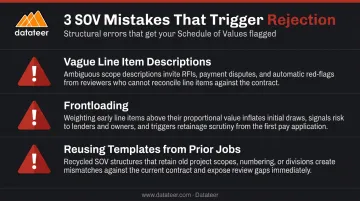
Three Structural Errors That Trigger Rejection
Vague line item descriptions — "Interior work" or "MEP scope" cannot be independently measured. If a reviewer can't verify what percentage is complete by walking the site, the description needs to be more specific.
Frontloading — While frontloading improves short-term cash flow, inflated early-stage values create a mismatch between billing and actual cost, which shows up in WIP reports as overbilling and raises flags with sureties evaluating bonding capacity.
Reusing templates from prior jobs. Every project has a different scope, schedule, and cost structure. A template that worked on a healthcare renovation will misrepresent a parking structure project and invite rejection from a reviewer familiar with the work.
The SOV vs. Pay Application Confusion
Structural errors aside, document confusion is just as common — and equally costly. Many contractors treat these as interchangeable, but they serve distinct functions:
| Document | Purpose | Changes Over Time? |
|---|---|---|
| Schedule of Values | Defines each scope item and its approved value | Only when change orders are added |
| Pay Application | Monthly request asserting % complete per SOV line | Every billing cycle |
The SOV is the approved structure. The pay app is the monthly assertion against it. Conflating the two leads to billing disputes and rejected payment requests.
The Indirect Cost Omission Trap
General conditions, supervision, permits, temporary facilities, and mobilization/demobilization costs must appear as SOV line items. Omitting them doesn't make them go away — it makes them unrecoverable through the billing process.
Adding them in a later pay app signals to reviewers that costs were buried — triggering disputes or outright rejection. The CSI standard calls for overhead and profit to be distributed across trade line items, not carried as a lump sum or deferred to the back end of the project.
Conclusion
The schedule of values converts a lump-sum contract into a transparent, payment-ready structure that gives every party — owner, GC, subcontractor — a shared reference point for what's been built, what's been billed, and what remains.
Its value depends entirely on accuracy. Built from actual contract scope, populated with real cost data, and updated monthly against verified field progress, the SOV functions as a living financial document — not a one-time submission.
When it's rushed, templated, or treated as a formality, the billing friction and payment delays it was designed to prevent show up anyway. Treat it like the financial control it is.
Frequently Asked Questions
What is a subcontractor schedule of values?
A subcontractor's schedule of values is a trade-specific billing document prepared by the subcontractor and submitted to the GC. It breaks their contracted scope into line items with assigned dollar values, used to support monthly pay applications and track progress against the subcontract amount.
What should be included in a subcontractor schedule of values?
Each line item should include: item number, work description, scheduled value, percent complete, amount previously billed, current billing amount, balance to finish, and a retainage column. Approved change orders under the subcontract appear as separate line items with their own billing history.
How do you fill out a subcontractor schedule of values?
Start with the subcontract scope and break it into measurable line items aligned to the GC's cost codes. Assign dollar values based on actual labor and material costs. Each billing cycle, update percent complete based on verified field progress before submitting the pay application.
Who prepares a subcontractor schedule of values?
The subcontractor prepares their own SOV and submits it to the GC for approval. The GC doesn't create it for them, though they may specify the required format, cost code structure, or level of detail needed to reconcile with the master SOV.
How does a subcontractor SOV differ from a contractor's SOV?
The GC's SOV covers the full project scope submitted to the owner, while a subcontractor's SOV covers only their contracted trade scope submitted to the GC. The sub's values must align with how the GC allocated that trade's budget within the master SOV.
How often should a schedule of values be updated?
Monthly, at each billing cycle, to reflect the current percent complete for each line item. Add approved change orders as new line items before submitting the next pay application.