The result? Finance teams spend the last two weeks of every month assembling numbers that are already outdated by the time anyone reads them.
"Centralized data" gets mentioned a lot, but the real case for it isn't theoretical. It shows up in specific moments: catching a labor overrun in week 4 instead of week 14, closing the books without a reconciliation sprint, or spotting a cash crunch before it stalls a job. This article breaks down exactly what centralized financial data does for construction owners—and why firms that act on it consistently outperform those that don't.
Key Takeaways
- Centralized financial data connects your ERP, job costs, WIP, and field activity into one live view, with no manual assembly required
- Poor project data and miscommunication account for 48% of all rework on U.S. jobsites, costing $31.3B annually—a direct consequence of fragmented information
- Finance teams with centralized data spend less time assembling reports and more time advising on decisions that affect margins
- Catching margin fade early requires cost data that flows automatically, not data that arrives weeks after the damage is done
- Firms acting on live data build a compounding advantage: tighter margins, sharper bids, and growth that doesn't require adding headcount to manage reporting
What Is Centralized Financial Data in Construction?
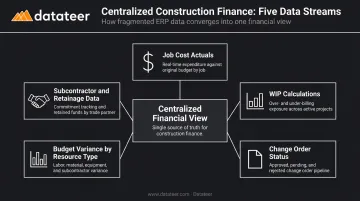
Centralized financial data means one thing in practice: all project financial information—job costs, WIP, change orders, subcontractor payments, budget variances, and payroll—flows automatically from your source systems into a single, always-current view.
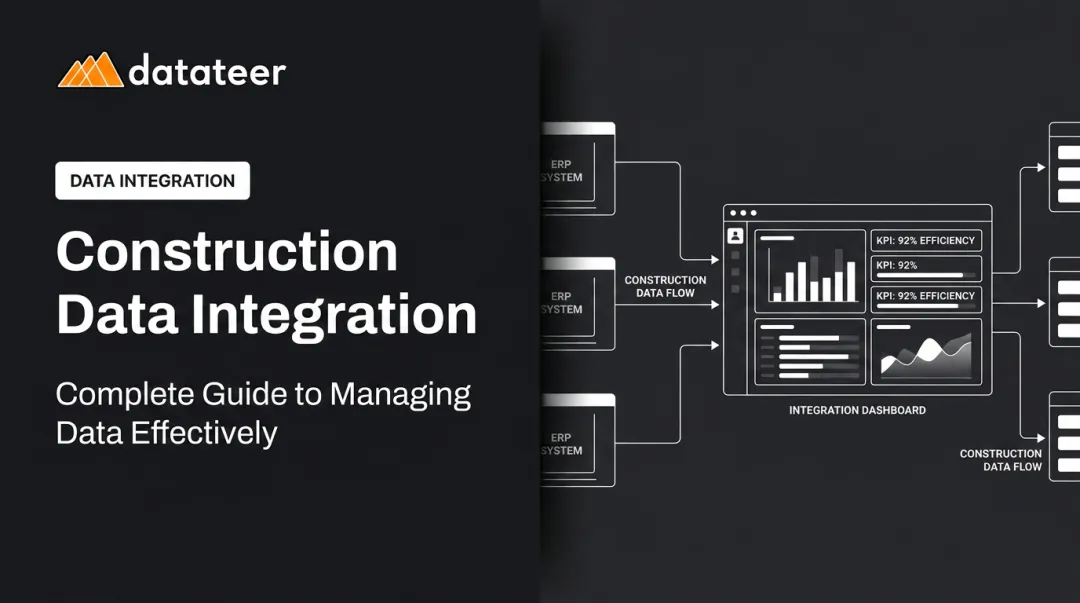
The practical goal is connecting your ERP — Sage, Vista, Procore, Acumatica, Foundation, and others — directly to the dashboards your CFO and finance team use when they need to answer: How are we tracking on margin across all active jobs?
That question should take two minutes, not two weeks. Right now, for most construction firms, it takes two weeks.
What Data Actually Flows
A properly centralized system pulls and unifies:
- Job cost actuals at job, phase, and cost-code level
- WIP calculations: percentage complete, earned revenue, over/under-billings, and projected margin
- Change order status: pending, approved, and denied — with aging and margin impact
- Budget variance by resource type (labor, materials, equipment, subcontractor, overhead)
- Subcontractor and retainage data including payment schedules and cash flow impact
This is not an IT project. It's the infrastructure that lets a CFO or finance manager make decisions from live numbers — not numbers rebuilt after the fact from spreadsheets.
Key Advantages of Centralized Data for Construction Owners
Each advantage below ties directly to decisions construction owners make every month—WIP reviews, cash flow calls, bid decisions, and labor allocation. These aren't theoretical benefits; they're operational outcomes.
Advantage 1: Real-Time Financial Visibility Across All Active Jobs
Real-time visibility means accurate job cost data, budget-vs-actual comparisons, and WIP status available at any moment—not reconstructed from spreadsheets after the fact.
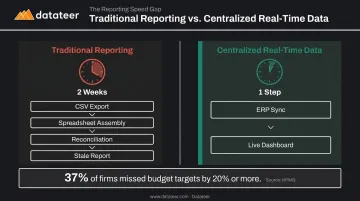
When ERP data syncs automatically to a unified reporting layer, the manual steps of pulling reports, cross-referencing spreadsheets, and reconciling cost codes drop out of the workflow. Finance teams go from assembling data to reading it.
Why this matters operationally:
The typical WIP report cycle in construction requires days of manual work (CSV exports, VLOOKUP formulas, Procore-to-Sage reconciliation). By the time numbers are ready, they reflect decisions that happened weeks ago. Double L Management, a Datateer client, put it plainly: "That one click replaced two weeks worth of prior work."
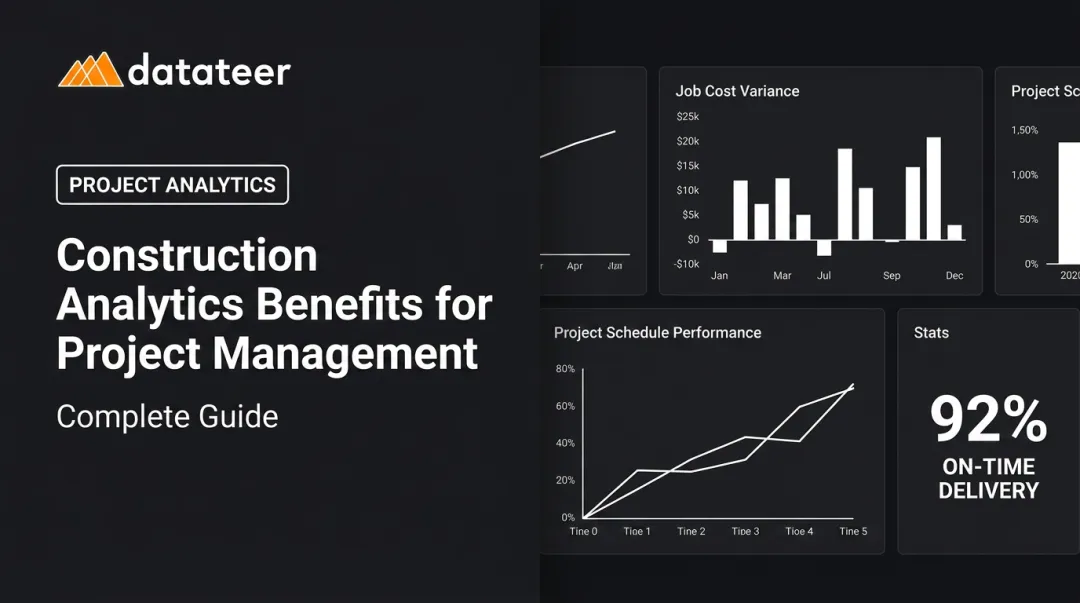
KPMG's 2023 Global Construction Survey found that 37% of E&C respondents missed budget and/or schedule targets by 20% or more over the prior year, up from 32% in 2021. Firms operating on stale WIP data can only do forensic accounting after the damage is done. Firms with live financial views can course-correct mid-project.
KPIs directly impacted:
- WIP report turnaround time
- Budget variance accuracy
- Monthly close duration
- Cost-to-complete forecast reliability
When this advantage matters most: High-volume periods with multiple simultaneous jobs, during change order negotiations, and in owner meetings where stakeholders expect current numbers—not last month's close.
Platforms like Datateer automate this entire flow, connecting 12+ construction ERPs directly to executive-ready dashboards with overnight data syncs (configurable to higher frequency when needed), so finance teams arrive at Monday morning already holding current numbers.
Advantage 2: Proactive Margin Protection and Risk Detection
Margin fade (the gradual erosion of project profit through small, untracked overruns in labor, materials, or subcontractor costs) is one of the most common and costly problems in construction finance. With decentralized data, it's almost always invisible until it's too late.
When all cost data flows into one place automatically, anomalies surface the day they happen. A labor hour spike, a cost code trending over budget, or a subcontractor billing ahead of schedule becomes visible immediately—not on the day the monthly report is finalized.
The timing problem is everything:
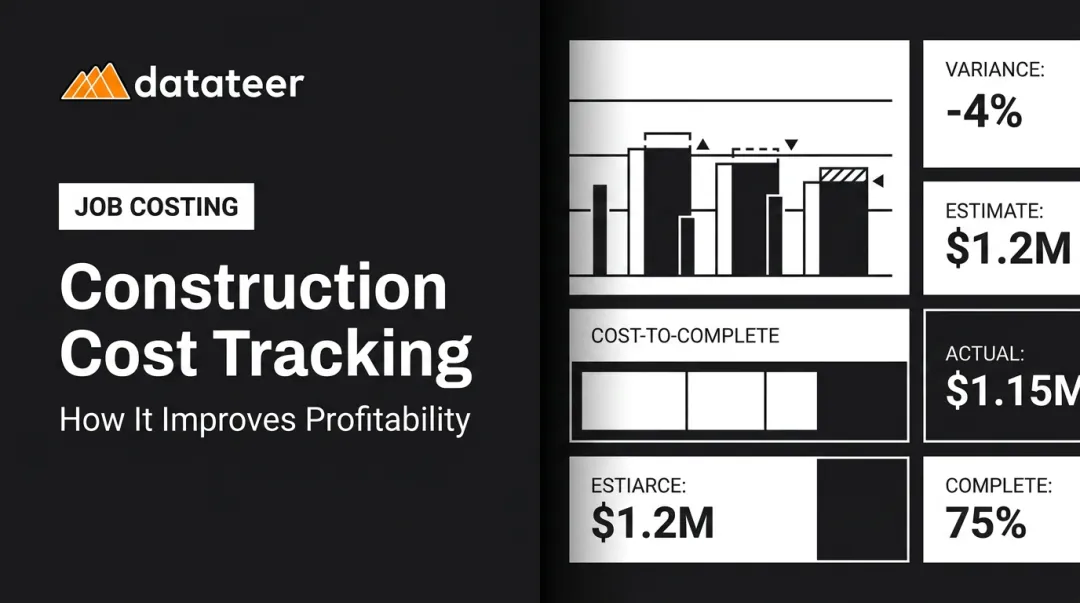
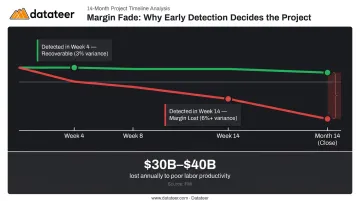
A 3% labor overrun caught in week 4 is recoverable. By week 14, the crew has moved on, the schedule has shifted, and the margin is gone. Centralized data is what makes early detection possible. Datateer's Job Costing & Cost-to-Complete module is built around this premise: finance managers can spot labor budget problems mid-week rather than three weeks after payroll is cut.
FMI's 2023 Labor Productivity Study estimated $30B–$40B lost annually to poor labor productivity, with labor overruns capable of wiping out bottom-line margins entirely. That scale of risk isn't managed with monthly spreadsheet reviews.
KPIs directly impacted:
- Gross margin per project
- Labor cost variance
- Cost-at-completion accuracy
- Change order approval cycle time
When this advantage matters most: Long-duration projects, fixed-price contracts, and labor-intensive jobs where small deviations compound quickly. On a 14-month GMP project, a 2% labor variance in month 3 can become a 6% problem by month 8 if no one catches it.
Advantage 3: Bridging the Field-Office Gap With a Shared Source of Truth
Financial problems in construction often originate in the field (unreported delays, informal scope changes, inaccurate time tracking) but finance teams only learn about them when costs appear in the ERP weeks later. This lag is a structural problem created by decentralized data, not a people problem.
When field data (time entries, daily reports, material usage) and office data (job costs, budgets, invoices) feed into the same system automatically, project managers and finance teams work from identical information. No reconciliation step. No version conflicts. Decisions get made faster and with greater confidence.
The cost of the gap:
PlanGrid and FMI's Construction Disconnected study found that miscommunication and poor project data account for 48% of all rework on U.S. construction jobsites—$31.3B in annual rework cost. The breakdown: $17.0B from poor communication, $14.3B from poor project data. These aren't soft metrics. They represent real margin loss that flows directly from teams operating on different information.
A shared source of truth also changes the dynamic in owner-contractor meetings. Instead of debating whose numbers are right, all parties reference the same live data. That shift—from argument to analysis—is where real decisions happen.
KPIs directly impacted:
- Rework rate
- Change order dispute frequency
- Project status reporting accuracy
- Decision lag time (days from issue identification to resolution)
When this advantage matters most: Multi-site projects, jobs involving multiple subcontractors, and any project where the field team and finance office are geographically separated.
What Happens When Centralized Data Is Missing
The consequences of fragmented financial data are recognizable to any construction finance manager:
- Month-end becomes a data assembly project. Finance teams spend the final two weeks manually stitching WIP reports from spreadsheets—by the time numbers are ready, they're already outdated.
- Cost code inconsistency makes benchmarking impossible. When cost codes vary across projects, there's no reliable way to compare margin performance or flag underperforming job types.
- Margin fade goes undetected until end-of-job. What could have been caught in month 2 shows up as a loss in the final reconciliation.
- Cash flow surprises become routine. Overbilling and underbilling positions aren't visible until the close process surfaces them—too late to act strategically.
- Scaling gets structurally harder. Adding a new project means more spreadsheets, more manual work, and more exposure to errors. Each new job compounds the problem rather than building on what already exists.
Every one of these problems shares the same root cause: finance teams are stuck gathering data instead of acting on it. That's the gap centralized data closes.
How to Get the Most Value From Centralized Construction Data
Centralized data delivers its full value when three conditions are met:
- Data flows automatically — not manually re-entered or exported
- It's reviewed on a consistent cadence — weekly or near-real-time, not monthly
- Insights are acted on — not just reported and filed
The most common mistake construction firms make is centralizing data in a way that still requires human assembly. Moving from 12 spreadsheets to one spreadsheet is not centralization. True centralization means the ERP syncs directly to the dashboard with no manual steps.
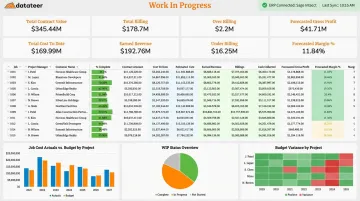
Datateer connects directly to Procore, Sage 100/300/Intacct, Viewpoint Vista, Spectrum, Acumatica, Foundation, CMiC, Jonas, QuickBooks, NetSuite, and others. The platform delivers 12 pre-built construction intelligence dashboards on day one, with implementation completed in 2–4 weeks. Automated data cleaning standardizes cost codes across projects and reconciles system discrepancies without manual intervention.
Firms that extract the most value treat centralized data as an operating cadence:
- Project managers check job cost dashboards as part of their weekly rhythm
- CFOs review portfolio-level WIP without waiting for the monthly close
- Field teams see the financial impact of their decisions in near real time
The difference shows up on the P&L: firms running this cadence catch margin fade and billing gaps weeks earlier than those still waiting on the monthly close.
Conclusion
Construction owners who consistently protect margins, win better bids, and scale without chaos aren't operating on better intuition. They're operating on better data—available faster and without manual effort.
The advantages of centralized financial data—real-time visibility, early margin protection, and a shared source of truth between field and office—build on each other. Firms that establish this foundation early can act on problems while projects are still in progress—not after the month-end close confirms what went wrong.
Treat centralized data as an ongoing financial operating practice, not a one-time technology project. Setup gets you access. What you do with that visibility every week is what actually protects margin.
Frequently Asked Questions
What are the benefits of centralizing data for construction budget management?
Centralized budget data gives owners a live view of spending against approved budgets across all active jobs, reducing the risk of undetected overruns. It eliminates the lag between when costs occur and when finance teams see them, turning budget management from a monthly review into a continuous practice.
How does centralized data help prevent cost overruns in construction?
When cost data flows automatically from the ERP into a unified view, overruns surface as they happen rather than weeks later. That gives project managers and finance teams time to take corrective action while it still matters, before the overrun compounds into permanent margin loss.
What is a "single source of truth" in construction finance?
A single source of truth means all stakeholders—field teams, project managers, and the finance office—are working from the same live financial data. It eliminates conflicting spreadsheet versions, reconciliation disputes, and the awkward meetings where different teams arrive with different numbers.
How does data centralization reduce the time spent on WIP reports?
When ERP data syncs automatically to reporting dashboards, the manual work of pulling, formatting, and reconciling spreadsheet data disappears. What previously took weeks of CSV exports and VLOOKUP formulas becomes a current view available each morning.
Can centralized financial data work with existing construction ERPs?
Yes. Datateer integrates directly with Procore, Sage, Viewpoint Vista, Spectrum, Acumatica, Foundation, CMiC, Jonas, QuickBooks, NetSuite, and more. Firms keep their existing systems and connect a layer that pulls, standardizes, and surfaces the data already flowing through them.
What is the difference between centralizing project data and centralizing financial data in construction?
Project data centralization typically covers documents, schedules, and field communications. Financial data centralization focuses specifically on job costs, WIP, budget variances, and cash flow: the figures that directly impact profitability. CFOs and owners need the latter to protect margins; the former supports coordination but doesn't replace financial visibility.