For construction finance managers, CFOs, and CPAs serving construction firms, this matters operationally. PCM determines how much revenue appears on the books each period, feeds directly into the WIP schedule, and drives project-level P&L. Getting it right isn't optional — it shapes every financial decision made between contract signing and final invoice.
This article covers what PCM is, how the cost-to-cost formula works, a step-by-step worked example, what distorts the method's accuracy, and when a different approach makes more sense.
Key Takeaways
- PCM recognizes revenue in proportion to project progress at the end of each accounting period — not at completion
- The cost-to-cost method measures completion by dividing costs incurred to date by total estimated costs
- Reliable PCM results depend on accurate cost estimates and disciplined job cost tracking
- ASC 606 and IFRS 15 effectively require progress-based recognition for most construction contracts
- Overbilling and underbilling positions flow directly from PCM calculations into the WIP schedule and balance sheet
What Is the Percentage of Completion Method?
PCM is a revenue recognition framework for long-term contracts. Revenue is recorded each period based on how much of the project has been completed — not when the project wraps up, not when cash is collected.
The cost-to-cost method is the most common technique for measuring that completion percentage, though others exist (labor hours, units delivered, milestone attainment).
PCM keeps revenue aligned with economic reality across a project's lifespan. Without it, a contractor reports zero revenue for months — then a massive lump sum at project end. That distorts the income statement and makes financial planning nearly impossible.
PCM vs. the Alternatives
| Method | How Revenue Is Recognized | When It Applies |
|---|---|---|
| Percentage of Completion | Each period, based on progress | Most construction contracts under ASC 606 |
| Completed Contract | All at project finish | Limited circumstances — when over-time criteria aren't met |
| Milestone-Based | When predefined deliverables are achieved | Contracts with distinct, measurable performance milestones |
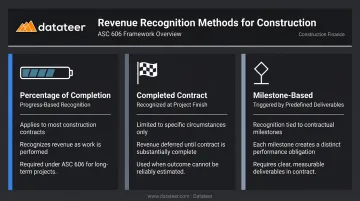
Under ASC 606, completed-contract accounting isn't a free policy election. If a contract meets any of the three over-time recognition criteria in ASC 606-10-25-27, revenue must be recognized over time. The completed-contract approach only applies when those criteria aren't satisfied — at which point, point-in-time recognition applies.
How to Calculate Percentage of Completion Using the Cost-to-Cost Method
The cost-to-cost approach treats the proportion of total costs consumed as a proxy for project progress. It works well in construction because direct labor, materials, and subcontractor costs are large, trackable, and directly tied to work performed.
The Three Core Formulas
Formula 1 — Percentage of Completion:
Costs Incurred to Date ÷ Total Estimated Project Costs
Formula 2 — Cumulative Revenue to Date:
Percentage of Completion × Total Contract Value
Formula 3 — Current Period Revenue:
Cumulative Revenue to Date − Previously Recognized Revenue
Before any calculation can begin, four data inputs are required:
- Total contract value
- Total estimated project costs
- Actual costs incurred to date
- Revenue already recognized in prior periods
Step 1: Estimate Total Project Costs
This is the most judgment-intensive step and the single biggest driver of accuracy. Three common approaches:
- Analogous — use historical data from comparable completed projects
- Bottom-up — build costs task by task from first principles
- Parametric — use data-driven modeling (cost per square foot, cost per unit, etc.)
Estimates aren't static. Any scope change, change order, material price shift, or unforeseen site condition should trigger a revised estimate. An outdated denominator produces a misleading completion percentage — and the downstream revenue figures will be wrong by the same margin.
Step 2: Track and Tally Costs Incurred to Date
This step requires capturing all direct project costs, accurately attributed to the specific job:
- Labor hours and wages
- Materials purchased and consumed
- Subcontractor invoices
- Equipment costs charged to the project
Every dollar must be job-coded correctly in the ERP or accounting system. Misattributed or missing costs directly distort the completion percentage — a cost coded to the wrong job understates progress on one project and overstates it on another. Across a portfolio of active projects, these errors compound quickly.
Step 3: Apply the Formulas to Determine Period Revenue
Chain the three formulas in sequence:
- Calculate the completion percentage using current costs
- Multiply by total contract value to get cumulative revenue-to-date
- Subtract previously recognized revenue to isolate the current period amount
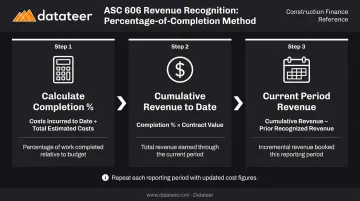
Repeat this process each reporting period with updated cost figures. The method is cumulative: prior period calculations carry forward, so any cost restatement or estimate revision automatically flows into the current period's recognized revenue.
Worked Example: Percentage of Completion in Construction
The Scenario
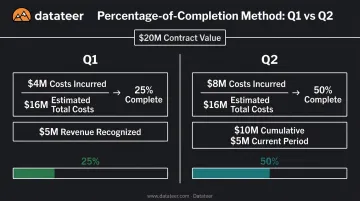
A commercial contractor wins a $20,000,000 contract. Total estimated project costs are $16,000,000. At the end of Q1, the contractor has incurred $4,000,000 in costs and has not previously recognized any revenue.
Q1 Calculation
Step 1 — Completion percentage: $4,000,000 ÷ $16,000,000 = 25%
Step 2 — Cumulative revenue to date: 25% × $20,000,000 = $5,000,000
Step 3 — Current period revenue: $5,000,000 − $0 = $5,000,000
The contractor recognizes $5,000,000 in revenue for Q1.
Q2 Calculation (Extending the Example)
By Q2, cumulative costs have reached $8,000,000.
Step 1 — Completion percentage: $8,000,000 ÷ $16,000,000 = 50%
Step 2 — Cumulative revenue to date: 50% × $20,000,000 = $10,000,000
Step 3 — Current period revenue: $10,000,000 − $5,000,000 = $5,000,000
Q2 recognized revenue is $5,000,000 — isolating only what belongs in that period, not double-counting Q1.
The Overbilling/Underbilling Implication
PCM-calculated revenue and amounts actually billed to the client rarely match exactly. That gap has a name and a balance sheet consequence:
- Overbilling — Contractor billed $6,000,000 by Q1 but only earned $5,000,000 per PCM → the $1,000,000 difference is a liability (Billings in Excess of Costs)
- Underbilling — Contractor billed $4,000,000 but earned $5,000,000 per PCM → the $1,000,000 difference is an asset (Costs in Excess of Billings)
These positions feed directly into the WIP schedule. A persistently underbilled portfolio signals cash flow strain: the firm is completing work faster than it's sending invoices. Overbilling positions that accumulate without corresponding earned revenue signal future revenue reversals.
Datateer surfaces these positions automatically across the entire job portfolio. A single WIP dashboard displays total overbilling and underbilling balances alongside earned revenue, total billing, and forecasted gross profit — no manual assembly required each month.
Key Factors That Affect the Accuracy of the Percentage of Completion Method
The method's reliability rests on two pillars: the quality of cost estimates and the completeness of job cost tracking. If either breaks down, the completion percentage becomes unreliable — and recognized revenue follows.
What Makes Cost Estimates Move Mid-Project
Oxford University research found that 86% of large transportation infrastructure projects experienced cost overruns, averaging 28% in real terms. Construction cost estimates shift for several reasons:
- Scope changes and change orders reset the total cost baseline, sometimes by millions
- Labor rate shifts — union escalations, market rate changes, or productivity shortfalls — erode initial estimates
- Material price spikes, especially when commodity prices surge mid-project, inflate costs without warning
- Unforeseen site conditions — subsurface issues, environmental discoveries, access constraints — surface costs that no estimate anticipated
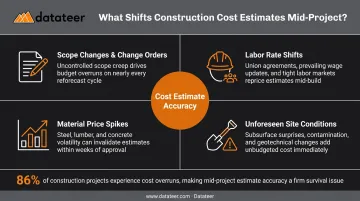
Each of these requires a revised total estimated cost — which, in turn, recalculates the completion percentage and adjusts cumulative recognized revenue.
The Data Latency Problem
Accurate estimates only get you halfway there. Stale cost data is a separate problem that undermines even the best projections.
When job costs are exported from the ERP manually, formatted in spreadsheets, and reconciled at month-end, the completion percentage used for revenue recognition may already reflect a snapshot two to three weeks old by the time it reaches the CFO's desk.
Datateer addresses this directly — the platform syncs with construction ERPs (Procore, Sage, Vista, Acumatica, Foundation, and 12+ others) overnight by default, with more frequent updates available. Datateer compresses what typically takes 10–20 days of manual work into an automated daily refresh, so the cost figures feeding PCM calculations reflect the project's current state rather than its state three weeks ago.
Common Mistakes When Applying the Cost-to-Cost Method
Including Costs That Don't Reflect Actual Progress
The most common misuse: recording purchased materials as incurred costs before any installation work begins. If $500,000 of materials are delivered to the site on Day 1 and immediately entered as project costs, the completion percentage spikes — before a single task has been performed.
Under ASC 606-10-55-21, inputs that are disproportionate to actual progress must be excluded from the margin-bearing cost-to-cost ratio. Revenue equal to cost may be recognized for qualifying uninstalled goods, but only when all three criteria are met:
- Customer controls the goods before installation
- Goods are procured from third parties
- Goods are not significantly designed or manufactured by the contractor
Recognizing margin on stockpiled materials before installation-related work is underway is not supported.
Failing to Update the Cost Estimate
If total estimated costs climb from $16M to $19M due to scope changes, but the formula denominator stays at $16M, the completion percentage is overstated. Revenue gets recognized ahead of actual progress.
Re-estimating total costs is not an optional refinement — it's part of the method's ongoing mechanics. Anchoring on the original estimate while the project evolves directly causes material revenue misstatement.
Manipulation Risk and Internal Controls
Because management controls both the estimated total costs and which actual costs are included, there is real opportunity to influence recognized revenue through selective adjustments. The SEC's 2022 enforcement action against Granite Construction illustrates the consequences — manipulated cost forecasts across seven projects led to restated financials covering 2017–2019 and a $12 million penalty.
Strong controls are essential:
- Supervisory review of completion calculations
- Formal change order approval processes
- Independent review of cost-to-complete estimate revisions
- Documented audit trail for significant assumption changes
Cost-to-Cost as a Lagging Indicator of Physical Progress
Even with airtight controls, the cost curve and physical reality can diverge. Two common scenarios:
- Front-loaded spending: A project is 40% through its budget but only 25% physically complete — foundations and pre-mobilization costs hit early
- Front-loaded work: Physical progress outpaces cost recording, understating completion percentage
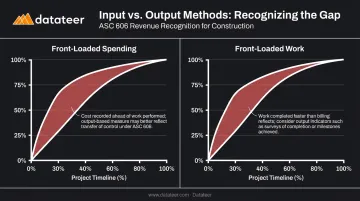
When the cost curve diverges from physical reality, the method may trigger early or late revenue recognition. Output-based measures — site surveys, milestone completion, units delivered — can be more accurate in these situations, and ASC 606 permits them when they more faithfully depict performance.
When to Consider an Alternative to PCM
When Point-in-Time Recognition Applies
ASC 606 does not let contractors choose between PCM and completed-contract accounting. If a contract doesn't satisfy any of the three over-time criteria in ASC 606-10-25-27, point-in-time recognition is required. The timing may resemble legacy completed-contract accounting, but it's a conclusion reached through the criteria assessment, not a policy election.
Circumstances where over-time recognition may not apply:
- Short-duration contracts likely to be completed within a single accounting period
- Projects where total costs cannot be reliably estimated
- Contracts where the contractor lacks an enforceable right to payment for performance completed to date and the asset has alternative use
Even when a contract does qualify for over-time recognition, the cost-to-cost method isn't always the right measure. Two project-level patterns can undermine its reliability.
Operational Signals That Cost-to-Cost Is a Poor Fit
Two situations suggest cost-to-cost may produce misleading results even when over-time recognition is appropriate:
Highly irregular cost curves — projects where most costs are concentrated in the final phase. Early-stage completion percentages calculated from cost spend will be largely meaningless as indicators of value delivered.
Severe scope uncertainty — projects with frequent change orders or highly volatile estimated total costs. When the denominator shifts materially multiple times per period, any completion percentage calculated between updates is likely to require significant revision.
In both cases, an output-based measure (milestone completion, verified physical progress, engineer certifications) may produce a more defensible recognition schedule.
Frequently Asked Questions
How do you calculate the cost-to-cost method?
Divide total costs incurred to date by total estimated project costs to get the completion percentage. Multiply that percentage by the contract value to get cumulative revenue to date. Subtract any previously recognized revenue to isolate the current period amount.
What is the difference between the percentage of completion method and the cost-to-cost method?
PCM is the revenue recognition framework: it defines when revenue is recognized based on project progress. Cost-to-cost is one specific technique for measuring that progress, alongside alternatives like labor hours expended, units delivered, or milestone achievement.
Is the percentage of completion method required under GAAP?
ASC 606 requires over-time recognition when specific criteria are met, such as when the customer controls the asset as it's created. For most construction contracts, those criteria are satisfied, which effectively requires a progress-based method. The outcome follows the facts of the contract, not an accounting policy choice.
How does the percentage of completion method connect to the WIP schedule?
PCM-calculated earned revenue feeds directly into the WIP report, which compares earned revenue against billed amounts. The gap produces either an underbilling (asset) or overbilling (liability) position on the balance sheet, both of which are critical indicators of cash flow health and billing efficiency.
What happens when cost estimates change mid-project?
The completion percentage must be recalculated with the revised total estimated costs. This adjusts cumulative recognized revenue and produces a catch-up or reversal entry in the current period. Timely re-estimation matters because delayed recognition of cost overruns creates revenue volatility when corrections finally hit.
When should a construction company use the completed contract method instead?
When the contract fails ASC 606's over-time criteria: costs can't be reliably estimated, the project falls within a single accounting period, or no enforceable payment right exists for work completed to date. It should never be chosen simply to defer revenue or smooth timing.