Most resources cover construction contracts from a legal angle — liability, indemnification, dispute rights. This post takes a different approach. It connects contract structure directly to financial reporting obligations, WIP mechanics, and the margin risks that keep CFOs up at night.
Key Takeaways
- Contract type determines whether you recognize revenue over time or at completion under ASC 606
- The Schedule of Values drives pay applications, WIP calculations, and earned value tracking
- Untracked change orders silently inflate underbillings and distort project profitability
- Retainage held across a 10–30 project portfolio can lock up 5–10% of contract value for 12 months or longer
- Manual WIP reporting creates a 10–20 day lag — by the time the numbers arrive, cost issues have already compounded
What Is a Construction Contract?
A construction contract is a legally binding agreement between a project owner and contractor that establishes scope of work, payment terms, project timeline, responsibilities, and risk allocation. Risk allocation, in particular, is where financial reporting begins.
Beyond scope and schedule, the contract defines how costs and revenues flow through your job cost ledger, when billing is permitted, and how performance is measured against budget.
Who are the parties? On most commercial projects:
- Owner (or developer)
- General contractor
- Subcontractors (often holding their own separate contract with the GC)
- Design professionals, consultants, and suppliers
On complex projects, the "contract" is rarely a single document. Per AIA Contract Documents, a complete contract suite includes the agreement, general conditions, scope of work, drawings, specifications, and schedule of values.
Each component carries financial implications. Gaps between them create the ambiguity that drives change orders, disputes, and budget overruns.
The 4 Main Types of Construction Contracts and Their Financial Risk Profiles
The 5 Main Types of Construction Contracts and Their Financial Risk Profiles
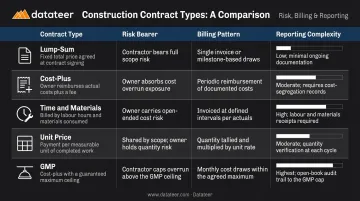
Contract type is the single biggest driver of how financial risk is distributed between owner and contractor. Here's how each structure plays out in practice — and what it demands from your financial reporting.
| Contract Type | Risk Bearer | Billing Pattern | Reporting Complexity |
|---|---|---|---|
| Lump-Sum | Contractor | Schedule of values | Margin tracking, WIP |
| Cost-Plus | Owner | Actual cost reimbursement | Cost documentation |
| Time & Materials | Shared | High-frequency billing | Forecasting |
| Unit Price | Shared | Per-unit measurement | Quantity tracking |
| GMP | Contractor (above cap) | Cost-plus with ceiling | Contingency + savings |
Lump-Sum (Fixed-Price)
The contractor agrees to complete all work for a predetermined total. Budget certainty for the owner; cost overrun risk absorbed by the contractor.
This structure simplifies billing — one contract value, one schedule of values — but complicates margin tracking. If material costs spike or productivity underperforms, the contract price doesn't move. Margin shrinks with each untracked cost overrun, and the damage only surfaces at month-end WIP review.
Cost-Plus
The owner reimburses actual costs (labor, materials, overhead) plus a fixed fee or percentage. Financial risk shifts to the owner, but this structure demands rigorous cost documentation. Every invoice, labor charge, and overhead allocation must be tracked and supported. Accurate job costing is the entire basis of billing — without it, you can't invoice, defend costs, or close the books.
Time and Materials (T&M)
The contractor bills an hourly labor rate plus materials consumed. Transparent, but difficult to budget. Without strict monitoring, T&M contracts are prone to cost escalation. From a reporting standpoint, they generate high billing frequency — which benefits cash flow — but create forecasting challenges since the final contract value is never fixed until work is complete.
Unit Price
Payment is set per measurable unit of work: cubic yards excavated, linear feet of pipe installed, square yards of paving. Common in civil and infrastructure work. Errors in quantity tracking translate directly to billing shortfalls — and forecasting breaks down when field quantities diverge from original estimates without timely reconciliation.
Guaranteed Maximum Price (GMP)
A hybrid built on cost-plus mechanics with a hard cap on the owner's exposure. Costs above the GMP fall to the contractor. AIA notes that many GMP contracts include savings-sharing provisions when actual costs finish below the cap — creating complex accounting requirements. Construction finance managers (CFMs) must track contingency budgets, savings calculations, and cost-to-complete updates continuously throughout the project.
Key Contract Components That Drive Financial Reporting
Scope of Work
Ambiguous scope is the leading cause of change orders. AIA's analysis of 18,229 completed projects found that average cost changes ran 4–5% across most projects — with larger projects generating over 11 change orders on average. Every unresolved scope gap becomes a potential cost and billing discrepancy that complicates financial statements.
Schedule of Values (SOV)
The SOV breaks total contract value into line items tied to completion milestones. Per AIA's payment process guidance, the SOV is the foundation of every pay application. It directly drives earned value calculations. Errors at contract execution cascade into billing discrepancies you'll be reconciling for the entire project lifecycle.
Change Order Procedures
Change orders formally document scope modifications and their cost and time impact. AGC defines a change order as a written agreement signed by owner, contractor, and designer stating the change in work, contract sum adjustment, and timeline adjustment. Without that formal process, costs hit the job cost ledger without a corresponding contract value update, which artificially inflates underbilled positions.
Retainage
Retainage is typically 5–10% of each progress payment, withheld until substantial completion. ConsensusDocs confirms this as the prevailing statutory range. For firms running 15–30 active projects simultaneously, the implications compound fast:
- Cumulative held retainage can tie up months of working capital
- It must appear as a discrete balance sheet item, not buried in accounts receivable
Dispute Resolution Terms
Mediation, arbitration, and litigation clauses define what happens when obligations break down. The financial stakes are real: Arcadis reported that average North American construction dispute values reached $60.1M in 2024, up from $43M the prior year. Contract termination creates unapplied costs and unrealized revenue that must be unwound in the financial statements.
How Contract Type Shapes Financial Reporting
Revenue Recognition Under ASC 606
Under ASC 606 (FASB's revenue recognition standard), construction contractors must analyze whether performance obligations are satisfied over time or at a point in time. For most long-term construction contracts, the over-time criteria are met — meaning revenue is recognized progressively as work is performed, using an input method such as cost-to-cost.
Shorter, highly uncertain contracts where the over-time criteria aren't met require point-in-time recognition — the closest analogue to the old completed-contract method. The AICPA's construction-specific ASC 606 guidance identifies additional complexity around contract modifications, variable consideration, and change order accounting — all of which tie directly back to contract structure.
WIP Schedule Mechanics
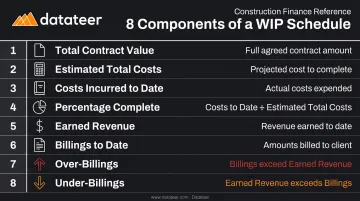
The WIP schedule is the financial report that ties everything together: contract value, costs incurred, estimated costs to complete, and billings — producing an over/underbilled position for each project.
A standard WIP schedule includes:
- Total contract value
- Estimated total costs
- Costs incurred to date
- Percentage complete (costs to date ÷ estimated total costs)
- Earned revenue (% complete × contract value)
- Billings to date
- Over-billings (billings exceed earned revenue — a liability)
- Under-billings (earned revenue exceeds billings — an asset)
AICPA describes the WIP schedule as enabling revenue recognition and providing a precise indicator of financial performance. It's also the primary document sureties and lenders scrutinize when assessing bonding capacity and credit availability. UFG Surety notes that a poorly documented WIP schedule can directly limit bonding capacity.
Margin Fade by Contract Type
Margin fade — the gradual erosion of projected profit as a project progresses — presents differently depending on contract structure:
- Cost-plus and T&M contracts surface cost overruns quickly because billing tracks actual costs
- Lump-sum and GMP contracts can mask overruns until late in the job, when costs have already been absorbed
FMI research found that firms with the highest forecasting rigor achieve budgeted profit objectives 92% of the time — compared to significantly lower rates among firms with weak cost-to-complete discipline. Contract type sets the exposure; reporting cadence determines whether you catch it in time.
Real-Time Visibility as a Financial Control
Construction firms relying on manual spreadsheet WIP reporting typically face a 10–20 day lag between field activity and financial insight. That gap means costs are moving, billings may be stale, and margin could be fading — while the CFM is still looking at last month's numbers.
Datateer eliminates this by automating data flow from 12+ construction ERPs directly into pre-built WIP dashboards. The platform pulls contract values, costs incurred, billings, and estimated costs to complete from systems including:
- Procore, Sage, and Viewpoint Vista
- Acumatica Construction, Foundation Software, and CMiC
- Jonas Construction, QuickBooks, NetSuite, and others
Data refreshes overnight as standard, with more frequent cycles available.
A Business Analyst at Double L Management put it plainly: "The very first time we accessed our data through a Datateer analytics dashboard, that one click replaced two weeks worth of prior work."
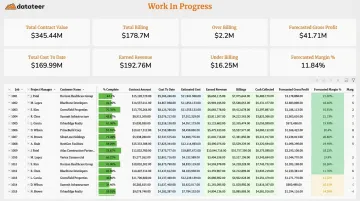
The WIP dashboard surfaces portfolio-level overbillings, underbillings, forecasted gross profit, and margin percentage as summary KPIs — giving CFMs the insight they need to act while there's still time to correct a project's trajectory.
Common Contract Mistakes That Create Financial Exposure
Vague Scope and Unrealistic Allowances
Contracts with poorly defined scopes or low allowances for finishes and materials generate automatic change order pressure. The financial result: costs accumulate without a corresponding contract value adjustment, SOV line items drift out of alignment, and billing disputes follow. Arcadis identified errors and omissions in contract documents as a top North American dispute cause in 2024 — reinforcing how upstream ambiguity creates downstream financial exposure.
Missing Change Order Documentation
Verbal approvals and undocumented scope changes are a direct path to financial misrepresentation. When costs are posted to the job cost ledger without a formal change order, the contract value remains static while costs grow — artificially inflating the underbilled position and overstating profitability risk on paper.
Datateer's Change Order Impact & Aging module addresses this by:
- Flagging stalled change orders where work has been performed but approvals are pending
- Tracking aging by days since submission and tying exposure to specific cost codes
- Surfacing WIP schedule distortions before they escalate into claims
Ignoring Retainage Accumulation Across the Portfolio
Individual retainage amounts look manageable on a single contract. Across a portfolio of 15–25 active jobs, cumulative held retainage can represent millions in tied-up working capital. Most firms discover the full exposure only at year-end — by which point managing it proactively is no longer an option.
Datateer's retainage tracking turns that end-of-year surprise into a managed cash flow variable:
- Separates A/R retainage (owner-held) from A/P retainage (held from subs) with release schedules
- Flags overdue releases before they compound into larger cash flow gaps
- Feeds expected retainage timing directly into the 13-week cash flow forecast
Frequently Asked Questions
What is in a construction contract?
A construction contract typically includes scope of work, contract sum, payment terms, schedule of values, project timeline, change order procedures, warranty requirements, insurance obligations, and dispute resolution clauses. On complex projects, it's a suite of documents — not a single agreement.
What are the 4 types of construction contracts?
The four core types are lump-sum (fixed-price), cost-plus, time and materials, and unit price. Lump-sum transfers cost overrun risk to the contractor; cost-plus shifts it to the owner. GMP contracts are a common hybrid — cost-plus with a ceiling.
What are the 3 C's of a contract?
It's not a formal legal standard, but construction finance professionals use it as a practical checklist: clarity (unambiguous terms), completeness (all provisions included), and compliance (adherence to applicable law). A contract that passes all three is far less likely to generate disputes or audit exceptions.
What is a WIP report in construction?
A WIP report summarizes each active project's contract value, costs incurred, percentage of completion, earned revenue, and billed amounts — revealing whether the firm is overbilled or underbilled on each job. Construction CFOs use it to assess project health, recognize revenue, and support surety and lender relationships.
How does contract type affect revenue recognition?
Under ASC 606, most long-term construction contracts (lump-sum, GMP, cost-plus) qualify for over-time revenue recognition using the cost-to-cost input method. Shorter or highly uncertain contracts may require point-in-time recognition instead. How performance obligations are defined in the contract determines how costs and revenues are matched on the financial statements.
What is retainage in a construction contract?
Retainage is a percentage (typically 5–10%) of each progress payment withheld by the owner as security against defective or incomplete work, released upon project completion. For contractors managing multiple active contracts, accumulated retainage across the portfolio represents real working capital that must be tracked on the balance sheet and incorporated into cash flow forecasting.