Introduction
Every construction project moves forward in stages — and so does the money. But without a documented breakdown of who gets paid what and when, billing disputes, cash flow gaps, and budget overruns follow predictably.
The Schedule of Values (SOV) is the document that prevents this. It allocates the entire contract amount across individual work components, drives every pay application, and serves as the shared financial reference point for owners, architects, and contractors throughout the project lifecycle.
The problem is that many construction finance teams manage SOVs manually in spreadsheets. That approach produces stale data, version-control headaches, and billing that drifts out of alignment with actual work. Owner relationships erode, and margin problems stay hidden until they're nearly impossible to reverse.
This guide covers everything you need: what an SOV is, its required components, how to build one correctly, common mistakes to avoid, and how modern finance teams are moving beyond spreadsheet-based SOV management entirely.
Key Takeaways
- An SOV allocates the full contract amount across individual work items and drives every pay application
- AIA A201-2017 §9.2 requires SOV submission before the first payment application on stipulated sum and GMP contracts
- Frontloading, vague descriptions, and stale change order data are the most damaging SOV mistakes
- The SOV feeds directly into WIP schedules — so inaccurate SOVs distort your entire financial picture
- Modern construction analytics platforms like Datateer connect SOV data directly to live executive dashboards, replacing manual reporting with automated workflows
What Is a Schedule of Values in Construction?
An SOV is a document that allocates the entire contract sum to each specific portion of the contractor's work. Each line item carries a dollar value, and when all line items are totaled, they must equal the full contract amount — exactly.
It serves two distinct roles simultaneously:
- Billing control document: The SOV drives pay applications. Contractors report completion percentages per line item each billing cycle, which translates directly into the dollar amount billed.
- Financial management tool: The SOV tracks progress, cost, and cash flow across the project lifecycle, providing a running record of what's been earned, what's been billed, and what remains.
When Is an SOV Contractually Required?
Under AIA Document A201-2017 §9.2, the contractor must submit a Schedule of Values to the Architect before the first Application for Payment on stipulated sum or Guaranteed Maximum Price (GMP) contracts. The exact language: "the schedule of values...shall be used as a basis for reviewing the Contractor's Applications for Payment."
In practice, this means GCs on stipulated sum or GMP contracts cannot submit their first pay application without an approved SOV on file.
SOV vs. Related Documents
Contractors often conflate the SOV with three related documents:
| Document | What It Is |
|---|---|
| Project Budget | Internal cost estimate — not shared with the owner |
| Construction Schedule | Timeline of activities — not a financial document |
| Pay Application | Periodic billing request that uses the SOV as its foundation |
The SOV is the bridge between the contract and the billing cycle. Without an approved SOV, a pay application has no verifiable basis — the SOV is what gives each billing request its contractual backing.
Key Components of a Schedule of Values
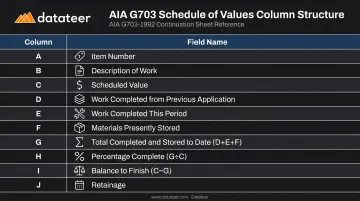
A well-formed SOV follows the column structure codified in the AIA G703-1992 Continuation Sheet:
| Column | Field |
|---|---|
| A | Item Number |
| B | Description of Work |
| C | Scheduled Value |
| D | Work Completed (Previous Periods) |
| E | Work Completed (This Period) |
| F | Materials Presently Stored |
| G | Total Completed + Stored to Date |
| H | Percentage Complete |
| I | Balance to Finish |
| J | Retainage |
Scheduled Value
Each line item's dollar amount must reflect the realistic cost of that scope — both direct costs (labor, materials, equipment) and indirect costs (project management, permits, temporary facilities, supervision). The sum of all scheduled values must tie exactly to the total contract amount. Any mismatch creates compliance and billing problems before the project has even started.
Stored Materials
Column F allows contractors to bill for purchased materials not yet installed on-site. This is critical for trades with large upfront procurement needs — mechanical, electrical, and structural steel subcontractors routinely purchase significant material inventories before installation begins. Without stored materials billing, those contractors absorb substantial cash outflows with no offsetting revenue.
Retainage
A percentage of each progress payment — typically 5% to 10% depending on the contract and applicable state law — is withheld by the owner until project completion. The SOV tracks retainage withheld per line item and the cumulative retainage balance, giving both parties a clear picture of the cash being held back.
Standard Industry Forms
Two forms dominate the industry:
- AIA G703-1992 Continuation Sheet — Used with the G702 Payment Application. The default standard for most commercial construction projects.
- ConsensusDocs 293 — An alternative schedule of values form used on ConsensusDocs-based contracts.
When a contract doesn't specify a form, the AIA G703 structure serves as the default starting point.
How to Create a Schedule of Values: Step-by-Step
Step 1: Start With the Signed Contract
The SOV cannot be built accurately without a complete understanding of scope and contract amount. Confirm what's included, what's excluded, and the total contract sum before breaking anything down.
Step 2: Break the Work Into Logical Components
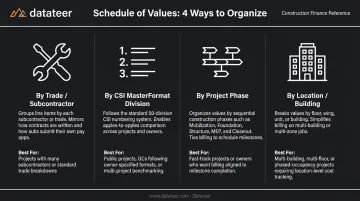
With the contract scope confirmed, choose a breakdown method that mirrors how progress will actually be tracked. Common organizational approaches include:
- By trade or subcontractor
- By CSI MasterFormat division (the industry standard for organizing construction work)
- By project phase (demolition, foundation, structure, envelope, MEP, finishes)
- By location or building for multi-building projects
If your site super reports by phase, organize the SOV by phase. The structure you choose here drives every billing conversation for the life of the project.
Step 3: Assign Realistic, Defensible Values
Values should be based on confirmed subcontractor quotes, internal cost estimates, or historical data. They must include both direct and indirect costs. Two things to avoid:
- Frontloading early-phase line items to accelerate cash collection (more on this below)
- Omitting general conditions — permits, supervision, temporary facilities, and similar overhead must appear somewhere in the SOV or the contractor absorbs them
The total must match the contract sum exactly — any gap signals a scoping error before the project starts.
Step 4: Submit a Preliminary SOV for Review
Before finalizing, submit a preliminary SOV to the owner and architect. As Smith Currie notes, the SOV is often presented for approval before periodic pay applications begin. The owner examines cost allocations, requests clarifications, and proposes adjustments. Both parties must reach agreement before submitting the first pay application — this alignment step is what prevents disputes later.
Step 5: Update Consistently Throughout the Project
Every billing cycle requires updating percent-complete and billed amounts for each line item. Every approved change order must be incorporated promptly. A stale SOV — one that lags behind approved change orders — creates billing mismatches that slow payments and strain owner relationships. Treat each update as a contract management task, not an accounting afterthought.
How the Schedule of Values Is Used in Construction Finance
Progress Billing and Pay Applications
The SOV is the foundation of every monthly pay application. Contractors report the percentage of each line item completed in the current period, which translates to the dollar amount being billed. Owners and architects use this data to verify that payments correspond to actual work performed — not estimates or projections.
According to Levelset's 2021 Construction Cash Flow & Payment Report, only 9% of contractors are always paid on time and 47% say cash flow problems directly reduce their profits. An accurate, complete SOV is one of the most effective tools a contractor has to minimize payment friction.
Cash Flow Forecasting and WIP Reporting
The percent-complete data captured in the SOV feeds directly into Work-in-Progress (WIP) schedules — the primary tool construction CFOs and finance managers use to assess whether a project is over-billed or under-billed relative to costs incurred.
Two key positions emerge from WIP analysis:
- Costs in Excess of Billings (Under-billings): Work performed but not yet invoiced — earned revenue tied up without corresponding cash
- Billings in Excess of Costs (Over-billings): Invoiced ahead of work performed — a liability on the balance sheet
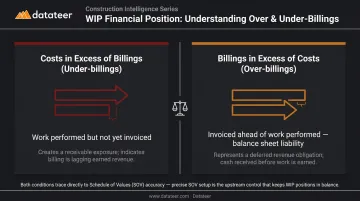
An accurate, current SOV is essential for WIP accuracy. When SOV data is stale or front-loaded, WIP calculations break down — and the resulting financial statements can hide margin fade until it's too late to recover.
Change Order and Dispute Management
The SOV acts as a shared reference point when disputes arise over scope, billing, or payment. Because it documents the agreed-upon value of each work component, parties can trace exactly what was contracted and what has been completed — without relying on memory or side correspondence.
A well-structured SOV also supports several downstream financial functions:
- Simplifies audit trails for lenders reviewing draw requests
- Gives surety companies a clear picture on bonded projects
- Provides a defensible paper trail if billing disputes escalate to claims
Common SOV Mistakes and How to Avoid Them
Frontloading and Misallocated Costs
Frontloading means assigning inflated values to early-phase line items — foundation work, mobilization, site prep — to collect more cash upfront than the actual cost distribution justifies.
The risks:
- Erodes owner trust when they recognize the pattern
- Creates tension with lenders during draw reviews
- Leaves inadequate remaining SOV value in later phases when actual costs are still occurring
Assign values that genuinely reflect cost and effort distribution. If concrete accounts for 12% of the project budget, it gets 12% of the SOV, not 20%.
Vague Descriptions and Missing Indirect Costs
Two compounding mistakes that often appear together:
Vague line items: using descriptions like "Electrical Work" instead of "Electrical Rough-In, Floors 1-3" creates ambiguity during billing reviews. Architects slow down approvals when they can't verify what specifically was completed. Disputes follow.
Omitted indirect costs: permits, supervision, temporary facilities, and general conditions must be included in the SOV. If they're not, the contractor either absorbs those expenses or submits late change orders that damage relationships.
Failing to Update the SOV After Change Orders
When an approved change order isn't incorporated into the SOV, the billing document no longer matches the contract. The downstream effects:
- Payment approvals are delayed as discrepancies surface
- Accounting reconciliation becomes confused
- Legal exposure accumulates as the billing record diverges from the contract record
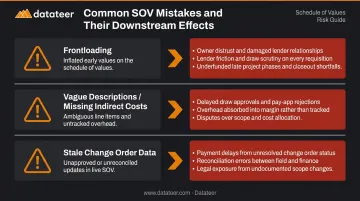
The solution is a standing internal process: change order approval automatically triggers an SOV update before the next billing cycle.
From Spreadsheets to Real-Time Dashboards: Managing SOV Data in Modern Construction Finance
The Spreadsheet Problem
According to JBKnowledge's 9th Annual Construction Technology Report, 51% of construction accounting and ERP workflows still rely on spreadsheets, with 49% of data transfers between systems done manually.
When SOV data lives in a static spreadsheet, updating it for each billing cycle means manual exports, copy-paste routines, VLOOKUP reconciliations, and formula maintenance. By the time a WIP report is assembled from that data, it can be 10 to 20 days old. Field conditions have changed. Margin problems have compounded. The report is already a historical document before anyone reads it.
How Modern ERPs Changed the Equation
Platforms like Procore, Sage 100/300/Intacct, Viewpoint Vista, Viewpoint Spectrum, and Acumatica Construction now capture SOV data directly within the project billing module. The link between progress reporting and pay applications is automated — no duplicate data entry, no version-control gaps, and a reliable audit trail that updates with each billing cycle.
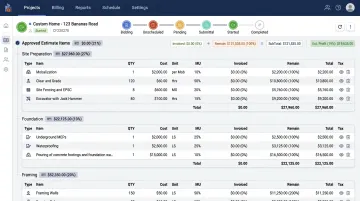
This ERP integration eliminates the manual handoff that caused most SOV errors in the first place. When a change order is approved in Procore, it flows into the billing record. When a subcontractor updates their percent-complete in Vista, it populates the pay application automatically.
Real-Time Financial Intelligence
ERP integration solves the data entry problem. Finance teams still need a way to view SOV-driven billing and cost data across an entire portfolio, not just job by job.
Datateer integrates directly with 20+ construction ERPs — including Procore, Sage, Vista, Spectrum, Acumatica, Foundation Software, CMiC, and Jonas — pulling live data into executive dashboards without CSV exports or manual reconciliation. Data refreshes overnight as standard, with faster cadences available.
The WIP dashboard surfaces portfolio-wide numbers at a glance:
- Earned revenue, total billings, and projected margin per job
- Overbilling and underbilling exposure across all active projects
- Change order lifecycle status, including stalled COs where work has been performed but billing hasn't been authorized
One client, Double L Management, described the result directly: "That one click replaced two weeks worth of prior work."
For construction CFOs, this shifts the role from forensic accounting (reviewing what already happened) to strategic financial management, where margin fade is caught while there's still time to correct course. Implementation takes 2 to 4 weeks. Pricing starts at $10,000/year per data source, with unlimited users and no per-seat fees.
Frequently Asked Questions
What is a schedule of values?
A Schedule of Values is a document that allocates the total construction contract amount across individual work components. It serves as the foundation for progress billing and financial tracking throughout the project, ensuring every dollar billed ties to a specific, agreed-upon scope of work.
Who prepares the schedule of values?
The general contractor is primarily responsible for preparing the SOV, typically in collaboration with key subcontractors. Under AIA A201-2017 §9.2, it must be submitted to the architect before the first pay application.
What does a schedule of values look like?
The SOV is a table with columns for item number, work description, scheduled value, percent complete, work completed from previous periods, current billing amount, stored materials, retainage, and balance to finish. The AIA G703-1992 Continuation Sheet is the most widely used format.
What is the difference between a schedule of values and a pay application?
The SOV is the foundational document that breaks the contract into valued line items. The pay application is the periodic billing request submitted each billing cycle — it uses the SOV's completion percentages to calculate the amount currently owed to the contractor.
How often should a schedule of values be updated?
The SOV should be updated every billing cycle (typically monthly) to reflect completed work and remaining balances. It must also be revised whenever a change order is approved, to keep the billing document aligned with the current contract.
What is frontloading in a schedule of values?
Frontloading is the practice of assigning inflated values to early-phase line items to collect payment faster than the actual cost distribution justifies. This erodes owner trust and can leave too little remaining contract value to fund later project phases — a problem that becomes visible during lender draw reviews.