Get the timing wrong and the consequences are real: cash flow crises for contractors running payroll on delayed funds, legal disputes between owners and GCs, stalled subcontractor relationships, and prompt payment violations that carry steep monthly penalties. The challenge is that "the right time" is rarely a single answer — it varies by contract, project type, state, and circumstance.
This article breaks down exactly when retainage is typically paid, what triggers its release, when holdbacks are legally justified, and how construction finance teams can manage timing proactively.
Key Takeaways
- Retainage is typically released upon substantial completion or another milestone defined in the contract
- Public and private projects follow different rules; state prompt payment laws set specific release deadlines for each
- For many contractors, retainage represents their entire profit margin on a job, making timing a business-critical issue
- Bad-faith delays beyond documented defects or disputes can trigger statutory penalties of 1–2% per month
- Subcontractors face compounded delays because their release depends on the GC receiving payment from the owner first
Why Retainage Payment Timing Matters
Retainage isn't just an administrative formality. For most contractors, it's where the money is.
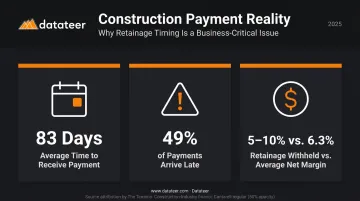
According to CFMA's 2024 Construction Financial Benchmarker, the average construction firm earns a 6.3% net margin before tax. Standard retainage runs 5–10% of each progress payment. Do the math: the retained percentage frequently exceeds the contractor's entire profit on a given job. Miss the retainage release, and the job is effectively done at a loss.
The downstream effects compound quickly. When an owner withholds retainage from a GC, that GC withholds from subcontractors, who may be funding payroll, materials, and overhead out of pocket for months. Levelset's 2019 National Construction Payments Report found that contractors wait an average of 83 days to receive payment — the longest of any industry — and 49% of payments arrive late. Retainage ranks among contractors' top payment challenges.
Legal exposure runs in both directions:
- Owners who hold retainage too long risk violating state prompt payment statutes, triggering monthly penalty interest ranging from 1% to 2% depending on jurisdiction
- Contractors who release retainage prematurely expose themselves to liability if defects emerge after final payment
- Surety and bonding relationships can also be strained when retainage disputes surface during closeout, affecting future bonding capacity
Getting retainage timing right requires tracking release schedules by project, jurisdiction, and contract type — not waiting for payment to show up.
When Is Retainage Typically Paid?
The fundamental rule: retainage is paid when the conditions specified in the construction contract are met. In practice, that most commonly means substantial completion, final completion, or a defined project milestone — but the specifics vary by contract, project type, and jurisdiction.
Based on Contract Terms
The contract is the governing document. It defines:
- The retainage percentage (commonly 5% or 10%)
- The triggering event for release (e.g., "substantial completion," "final acceptance," "punch list clearance")
- Any stepped or phased reduction provisions (e.g., reducing from 10% to 5% at 50% project completion)
One critical point contractors often overlook: if retainage terms are not explicitly stated in the contract, there is no retainage. Contract review before project start isn't optional — it's where retainage disputes are either prevented or created.
Based on Project Type: Public vs. Private
Public and private projects follow different rules.
Federal contracts are governed by FAR 52.232-5. Under the current rule (FAC 2026-01, effective March 13, 2026), if the Contracting Officer finds satisfactory progress was achieved during any period, payment is made in full — no retainage withheld. If progress is unsatisfactory, the officer may retain up to 10% until performance improves. Upon substantial completion, all remaining withheld funds must be released except amounts "adequate for protection of the Government."
Private projects are more loosely governed by contract negotiation, though states are increasingly imposing caps and statutory release timelines. California's SB 61 caps retention at 5% on private nonresidential projects effective January 1, 2026. New York's General Business Law already imposes a 5% cap.
Based on State-Specific Release Timelines
State law adds another layer, and the differences are significant.
| State | Owner Release Deadline | GC-to-Sub Payment | Penalty |
|---|---|---|---|
| California | 45 days after completion | 10 days after receipt | 2%/month + attorney fees |
| New York | 30 days after final approval | 7 days after receipt | 1%/month |
| Texas (Private) | 30 days after final completion | 7 days after receipt | 1.5%/month + attorney fees |
| Florida (Public) | 30 days after substantial completion | 10 days after receipt | 1%/month |
| Washington | 60 days after notice of completion | Per contract | 1%/month |
| Connecticut | 30 days after complete application | 30 days after receipt | Attorney fees |
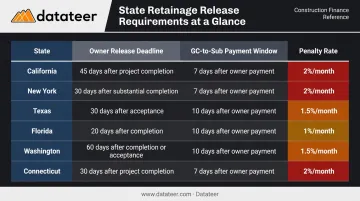
Note the language differences: California triggers the clock on the "date of completion," while New York uses "final approval of the work." These aren't interchangeable terms.
"Final approval" typically requires formal sign-off from the owner or design professional — which can extend the timeline well beyond physical completion of the work.
What Triggers the Release of Retainage?
Retainage doesn't release automatically on a calendar date. Something specific has to happen first.
Substantial Completion
This is the most common trigger. Under AIA A201-2017 (Section 9.8.1), substantial completion is "the stage in the progress of the Work when the Work or designated portion thereof is sufficiently complete in accordance with the Contract Documents so that the Owner can occupy or utilize the Work for its intended use."
The critical point: substantial completion does not mean 100% complete. Minor punch list items can remain. But disputes over whether the threshold has actually been met are one of the leading causes of retainage delays because the contract's language, the architect's judgment, and the owner's position don't always align.
Final Completion and Punch List Clearance
Some contracts tie the full retainage (or a portion of it) to punch list resolution and the owner's issuance of final acceptance. A single unresolved item (even a minor one) can delay release for every party in the payment chain.
ConsensusDocs 200 addresses this more precisely, requiring the owner to pay remaining retainage "less a sum equal to the Contractor's reasonable cost to complete any remaining incomplete Work" at substantial completion. This limits the owner's ability to hold the full retainage over minor outstanding items.
Notice of Completion and Formal Certificates
Seven states require a formal Notice of Completion filing to start the retainage release clock:
- Alaska, Arizona, California, Massachusetts, Nevada, Tennessee, and Utah
In California, the owner may record this notice within 15 days of the actual completion date, triggering both the retainage payment deadline and the mechanics lien filing windows.
If the notice isn't filed, lien deadlines are typically extended (from 30–60 days to 90+ days for subcontractors in California), but the retainage clock may remain ambiguous and creates uncertainty for everyone downstream.
Milestone-Based or Phased Release
Less common on standard contracts, but negotiated more often on longer projects: partial retainage release tied to specific milestones. A subcontractor who finishes their scope while the overall project continues might negotiate release of their retainage independent of the project's final completion. AIA A201 Section 9.8.5 permits retainage release for substantially complete portions before the entire project is finished.
Owner Approval and Dispute Resolution
Even when physical work triggers are met, owner approval is often still required. The California Supreme Court addressed the limits of this in United Riggers & Erectors, Inc. v. Coast Iron & Steel Co. (4 Cal.5th 542, 2018), holding that a "good faith dispute" excusing payment must relate to a statutory or contractual precondition rather than a general quality dispute over work already accepted. An owner can't broadly invoke quality concerns to delay payment indefinitely.
When Holding Retainage Longer May Be Justified
There are legitimate reasons to extend a retainage holdback beyond the typical release trigger:
- Documented defects — work that visibly fails to meet contract specifications and has not been corrected
- Open liens or claims — unresolved subcontractor liens or supplier claims against the project
- Good-faith scope disputes — a genuine, documented disagreement about whether work meets contractual requirements
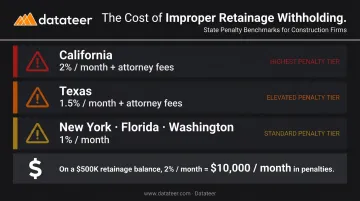
Withholding retainage without a valid, documented reason — particularly after the contractor has fulfilled observable contract requirements — can constitute bad faith. The penalty rates from the table above make this expensive:
- California: 2% per month plus attorney fees
- Texas: 1.5% per month plus attorney fees if litigation is required
- New York, Florida (public), Washington: 1% per month
What contractors should do when retainage is improperly withheld:
- Document completion — photos, inspection reports, certificates, correspondence
- Send a formal written demand letter citing the applicable contract provision and state prompt payment statute
- Evaluate the mechanics lien option carefully — lien deadlines run from the last date of work or Notice of Completion filing, which can expire before retainage becomes contractually due
Step 3 is the timing trap that catches subcontractors off guard. Texas addresses it explicitly with a separate retainage lien deadline — the 15th day of the 3rd or 4th month after the original contractor's work is complete. Most other states don't, meaning lien rights can expire silently before retainage is even contractually due. By the time a firm realizes the deadline has passed, the leverage is gone.
Best Practices for Managing Retainage Timing
Retainage timing should be managed from contract execution, not treated as a final-step formality.
Negotiate specific release triggers upfront. Vague contract language — "completion," "final acceptance," "satisfactory" — is the single most common source of retainage disputes. Define the triggering event precisely. Specify whether it's the issuance of a Certificate of Substantial Completion, punch list clearance, or Notice of Completion filing. Push for milestone-based reduction provisions if the project timeline warrants it.
For subcontractors: mirror or improve on the prime contract terms. Your retainage release depends on the GC receiving payment from the owner first. Review any "pay-when-paid" provisions carefully and negotiate subcontract language that includes its own milestone-based release schedule where possible — don't assume the prime contract protects you automatically.
Track retainage aging continuously, not just at month-end. Retainage disputes affect approximately 62% of construction firms, and most are discovered late — during the monthly close cycle, after weeks of delay have already accumulated. Finance teams need visibility between close cycles to catch overdue balances before they become disputes.
Construction-specific analytics close that gap directly. Datateer's Construction Retainage Tracking & Schedule Analytics — part of the Financial Operations & Cash Management suite — surfaces both A/R retainage (amounts owners owe your firm) and A/P retainage (amounts your firm holds on subs) in a unified view.
The module flags overdue retainage releases, tracks release schedules by project, owner, and subcontractor, and feeds directly into the 13-week cash flow forecast so upcoming releases are factored into working capital projections.
Rather than waiting for the monthly spreadsheet reconciliation to surface a problem, the platform pulls data overnight from your existing ERP — Sage, Viewpoint Vista, Acumatica, Foundation, CMiC, or any of 12+ supported systems. The current retainage position is available the following morning, with no manual assembly required.
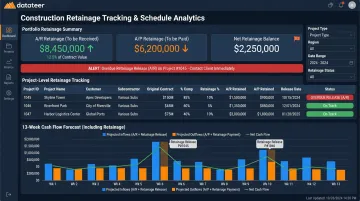
For CFOs and controllers running retainage across a portfolio of active projects, that daily visibility means overdue releases get resolved weeks earlier — before they create a cash flow gap.
Frequently Asked Questions
When should retainage be paid?
Retainage should be paid when the conditions defined in the construction contract are met — most commonly upon substantial completion or final completion. State prompt payment laws typically set specific deadlines after that trigger: 30 days in New York and Texas, 45 days in California, 60 days in Washington.
What triggers the release of retainage in construction?
The most common triggers are substantial completion of the project, clearance of the punch list, issuance of a Certificate of Substantial Completion, or filing of a formal Notice of Completion. The exact trigger depends on the contract language and the applicable state law.
What is substantial completion and how does it affect retainage release?
Substantial completion is the point at which the work is complete enough for the owner to use it for its intended purpose, even if minor items remain. It typically starts the retainage release clock, though disputes over whether this threshold has been met are one of the most common causes of retainage delays.
How long can a contractor hold retainage from subcontractors?
A GC can generally hold retainage from subcontractors until the owner releases retainage to the GC, but state prompt payment laws impose their own downstream timelines. California requires GCs to pay subs within 10 days of receiving owner payment; New York requires 7 days; Texas requires 7 days.
Can retainage be released early or in phases before project completion?
Yes — contracts can include provisions for phased release tied to specific milestones, such as reducing retention from 10% to 5% after 50% project completion, or releasing a subcontractor's retainage once their scope is complete. These terms are worth negotiating upfront, particularly on longer projects where cash flow pressure compounds over time.
Is it normal to pay a contractor 50% upfront?
No — a 50% upfront payment is not standard in commercial construction. Typical mobilization advances run 2–10% of total contract value, with the balance paid through progress payments tied to completed work, net of retainage.