Key Takeaways
- The AIA G703 is the standardized Continuation Sheet that breaks the contract sum into billable line items for progress payment applications
- Required under AIA A201-2017 §9.2 on stipulated sum and GMP contracts; architect approval is required before first use
- Tracks ten columns across each line item, from scheduled value and work-in-place to percent complete, balance to finish, and retainage
- Front-loading and vague line items are the fastest ways to trigger architect rejection and delay payment
- The G703 attaches to the G702 cover sheet; together they form the complete pay application package
What Is the AIA G703 Schedule of Values?
The AIA G703-1992 Continuation Sheet is a standardized document published by the American Institute of Architects. It serves two purposes: recording the contractor's Schedule of Values and tracking cumulative progress billing across each payment application period.
A Schedule of Values allocates the entire contract sum to individual portions of work. Each line item represents a specific scope, phase, or cost category — and the sum of all line items must equal the total contract amount exactly.
G703 vs. the Schedule of Values Concept
These two terms are related but not the same:
The Schedule of Values is the underlying data — how the contract price is allocated across work items. The G703 is the standardized AIA form used to present and submit that data.
Other forms exist (ConsensusDocs publishes its own Schedule of Values form, ConsensusDocs 293), but the G703 is the industry default on AIA-governed projects.
G703 vs. the Project Estimate
Contractors sometimes conflate the G703 with the original bid or estimate. Both documents share similar line items but serve entirely different purposes:
- The estimate reflects what the contractor expects the work to cost
- The G703 reflects how the agreed contract price will be billed
- Updates to the estimate don't automatically change the G703 — the G703 ties to the contract, not the budget
G703 vs. the G702
The G702 (Application and Certificate for Payment) is the cover sheet the architect certifies. The G703 is the detailed attachment that justifies that certification, line item by line item. Both are submitted together; the G702 is incomplete without the G703 line-item backup.
Why the AIA G703 Is Required on Construction Projects
The contractual basis is direct. AIA A201-2017 §9.2 states:
"Where the Contract is based on a stipulated sum or Guaranteed Maximum Price, the Contractor shall submit a schedule of values to the Architect before the first Application for Payment, allocating the entire Contract Sum to the various portions of the Work. The schedule of values shall be prepared in the form, and supported by the data to substantiate its accuracy, required by the Architect. This schedule, unless objected to by the Architect, shall be used as a basis for reviewing the Contractor's Applications for Payment."
This applies to both stipulated sum and GMP contracts — and since A201-2017 is incorporated into AIA A102-2017 and A133-2019, the requirement extends across both contract structures.
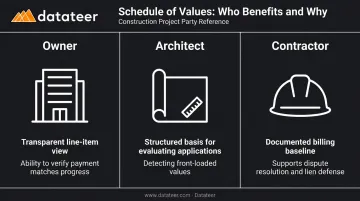
What the G703 Enables for Each Party
| Party | What the G703 Provides |
|---|---|
| Owner | Transparent, line-item view of how the contract price is allocated — making it possible to verify that payment requests match actual progress |
| Architect | A structured basis for evaluating Applications for Payment and detecting overvalued early-phase work |
| Contractor | A documented billing baseline that supports payment dispute resolution and lien claim defense |
What Happens Without an Approved G703
No approved G703 means no agreed-upon basis for reviewing payment applications. This blocks the entire payment cycle. The architect cannot certify what they cannot evaluate — which makes early submission and approval a cash flow priority, not an administrative formality.
What the AIA G703 Includes: Column-by-Column Breakdown
The G703 is structured as a table with a project header (project name, application number, period to date, contract date, contractor/owner/architect information) followed by ten standardized columns per line item.
Columns A and B: Item Number and Description of Work
Each row represents one scope component. Descriptions must be specific enough for the architect to assess progress independently. The difference matters:
- ❌ "Electrical Work" — too vague to evaluate
- ✅ "Electrical Rough-In," "Panel Installation," "Fixtures" — each assessable on its own
Column C: Scheduled Value
The dollar amount assigned to each line item at initial submission. All scheduled values must sum to the total contract amount. Once the architect approves the G703, these values become the fixed basis for all future billing and only change if the contract amount changes.
Columns D and E: Work Completed (Previous Applications and This Period)
Two sub-columns track the running billing history:
- Column D — cumulative amount billed in all prior periods
- Column E — amount being added in the current application
These two columns feed directly into Column G, building the complete billing history that underpins every progress payment.
Column F: Materials Presently Stored
Contractors can bill for materials purchased and delivered (on-site or in approved off-site storage) before installation. AIA A201-2017 §9.3.2 conditions this on procedures satisfactory to the Owner to establish title and protect their interest — including applicable insurance, storage, and transportation costs for off-site materials.
Columns G, H, and I: Totals, Percent Complete, and Balance to Finish
These are derived columns — calculated from the values above. They give the architect and owner a project-wide progress snapshot in a single view:
- G: Total Completed and Stored to Date
- H: Percent Complete
- I: Balance to Finish
Column J: Retainage
Many contracts allow the owner to withhold a percentage from each progress payment until project completion. According to CFMA, retainage typically sits at 5% or 10% of total project cost.
CFMA notes that a 10% retention rate can exceed a contractor's profit margin — making retainage tracking a direct factor in working capital management and WIP accuracy.
How the AIA G703 Is Completed and Submitted
The G703 is typically prepared by the general contractor before the first payment application, working from the contract sum and the detailed scope of work in the contract documents. Many contractors start from their estimate or CSI cost code breakdown to develop logical, defensible line items.
Step 1: Prepare the Initial Schedule of Values
Draft the G703 by dividing the contract sum into individual line items — by trade, CSI division, project phase, or subcontractor — and assign a scheduled value to each. The total must equal the contract sum exactly.
A few things to confirm before submitting:
- Check Division 01 specifications (specifically MasterFormat 01 29 73 – Schedule of Values) for any project-specific formatting or substantiation requirements
- Some project specs require submission 14 days before the initial Application for Payment (University of Houston master specifications, for example, use this timeline)
- Submit an informal preliminary draft to the architect early when possible — not an AIA-defined term, but a common practice that surfaces objections before the formal submission
Step 2: Obtain Architect Review and Approval
Under A201-2017 §9.2, the architect can object to the G703 if values appear unreasonable or front-loaded. A clear, well-substantiated G703 moves through this step faster. Vague entries and suspect value allocations invite scrutiny and resubmission delays.
Common triggers for architect objections include:
- Line items with disproportionately high values relative to scope (front-loading signals)
- Vague descriptions that can't be tied to specific work or trade
- Totals that don't reconcile to the contract sum
- Missing or unexplained stored materials entries
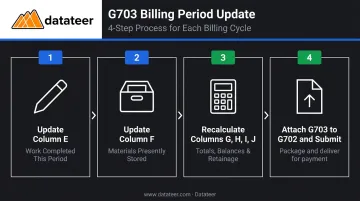
Step 3: Update the G703 with Each Pay Application
Every billing period requires updating:
- Column E (Work Completed This Period) for each relevant line item
- Column F (Materials Presently Stored) where applicable
- Recalculate Columns G, H, I, and J
- Attach the updated G703 to the G702 and submit
Change orders require a parallel update. AIA contract guidance confirms they can be entered directly in the G703 workflow, but whether they're incorporated into existing line items or added as new ones depends on the contract documents and architect preference. Either way, the G703 must reconcile to the current contract amount after every change.
Common Mistakes When Using the AIA G703
Front-Loading the Schedule of Values
Front-loading means assigning disproportionately high scheduled values to early-phase line items (mobilization, site prep, demolition) while compressing the value of later work. It improves short-term cash flow but carries real risk:
- Architects are trained to detect it and can object before the G703 is approved
- Owners may reject the G703 entirely and require resubmission
- If the contractor defaults before completing back-end work, the overvalued early billings create a direct financial exposure for the owner
Vague or Overly Broad Line Items
Grouping too much scope under one entry — a single "MEP" line for a complex building, for instance — makes it nearly impossible for the architect to verify accurate percent completion. The result is slow approvals, conservative certifications, or outright rejection of the line item. Line item specificity and payment speed are directly correlated.
Missing or Outdated Change Order Entries
Every approved change order that modifies the contract sum needs to be reflected in the G703 before the next pay application. When it isn't, the G703 totals diverge from the actual contract amount — creating reconciliation problems, payment disputes, and inaccurate financial reporting.
Levelset identifies billing for unapproved change orders as one of the most common pay application mistakes that leads to rejection. The inverse problem — failing to add approved change orders — is equally disruptive, just less obvious until month-end reconciliation.
Construction finance teams managing G703 updates in manual spreadsheets are most exposed to this problem. When contract data lives in the ERP and billing data lives in a spreadsheet, the two can fall out of sync the moment a change order is processed.

Platforms like Datateer address this by pulling change order data (pending, approved, denied, and executed) directly from connected ERPs like Procore, Sage, Vista, and Acumatica, so the financial picture stays current without manual re-entry.
Billing for Stored Materials Without Proper Documentation
The stored materials column is frequently flagged during architect review. Billing for materials off-site without a prior written agreement, or without documentation satisfying the owner's title-protection requirements, often results in those amounts being disallowed. Check the contract and project specs before billing Column F — the requirements vary by project.
Frequently Asked Questions
What is an AIA Schedule of Values (AIA G703)?
The AIA G703 is the standardized Continuation Sheet used on AIA-governed construction projects to document the Schedule of Values. It breaks the contract sum into individual line items that form the basis for requesting and certifying progress payments throughout the project lifecycle.
What does a typical AIA Schedule of Values include?
Each line item on the G703 tracks ten columns:
- Item number
- Description of work
- Scheduled value
- Work completed in previous periods
- Work completed this period
- Materials presently stored
- Total completed and stored to date
- Percent complete
- Balance to finish
- Retainage
What is the difference between the AIA G702 and G703?
The G702 is the cover Application and Certificate for Payment: the summary document the architect signs to certify the payment amount. The G703 is the detailed Continuation Sheet that itemizes each line item's progress. Both are submitted together as the complete pay application package.
Is the AIA G703 required on all construction projects?
No — the G703 is required specifically on projects using AIA contract documents where the contract is based on a stipulated sum or Guaranteed Maximum Price, per A201-2017 §9.2. Projects governed by other contract frameworks may use different forms.
Who prepares the AIA G703?
The general contractor typically prepares the G703, working with the project manager and estimating team, then submits it to the architect for review and approval before the first payment application.
Can the G703 be revised after submission?
Yes. Under A201-2017 §9.2, the G703 can be revised as the project progresses — particularly to reflect approved change orders. Revisions require supporting data and are subject to the same architect review process as the original submission.