The problem compounds. Retainage delays don't arrive alone. They stack on top of slow billing cycles, change order disputes, and approval bottlenecks, quietly eroding liquidity and limiting a firm's capacity to pursue new work. According to Billd's 2024 National Subcontractor Market Report, subcontractors wait an average of 57 days to get paid after submitting a pay application — and retainage sits on top of that delay.
This guide covers how retainage works, how it flows through the payment chain, how to account for it correctly, what triggers disputes, and what construction finance managers can do to protect cash flow.
Key Takeaways
- Retainage (5–10%) is withheld from every progress payment and held until substantial or final completion
- Subcontractors carry a disproportionate share of the retainage burden and wait the longest to collect
- Both retainage receivable (asset) and retainage payable (liability) must be tracked separately for accurate WIP reporting
- Contract terms negotiated upfront — step-down clauses, defined completion milestones — are the highest-leverage tool for faster release
- Real-time retainage tracking eliminates the 10–20 day data lag that prevents CFMs from acting on overdue balances
What Is Construction Retainage?
Retainage (also called retention or holdback) is a predetermined percentage of each progress payment withheld by the project owner until the work reaches substantial or final completion.
It serves two purposes:
- Incentivizes quality completion — contractors have a financial stake in resolving every punch list item
- Protects the owner — provides a security buffer against liens, defects, or contractor default
Standard Rates and Step-Down Clauses
The industry commonly uses 5% or 10% retainage. Step-down clauses — provisions that reduce the rate once a project hits 50% completion (for example, from 10% to 5%) — are a key negotiating tool and are codified in states like Illinois, where private construction law requires retainage reduction at the halfway point.
Retainage is not a penalty or a disputed deduction. It's a contractually agreed security deposit applied to approved work already performed — which is exactly why prolonged withholding creates real cash flow pressure: the contractor has completed the work, submitted the invoice, and still can't access those funds.
How Retainage Flows Through the Payment Chain
Retainage doesn't stop at the GC. The owner withholds from the GC, and the GC typically mirrors that same withholding percentage from each subcontractor. This cascade hits subcontractors hardest: they operate on thinner margins and routinely wait the longest to collect.
Billing Mechanics Across the Project Life
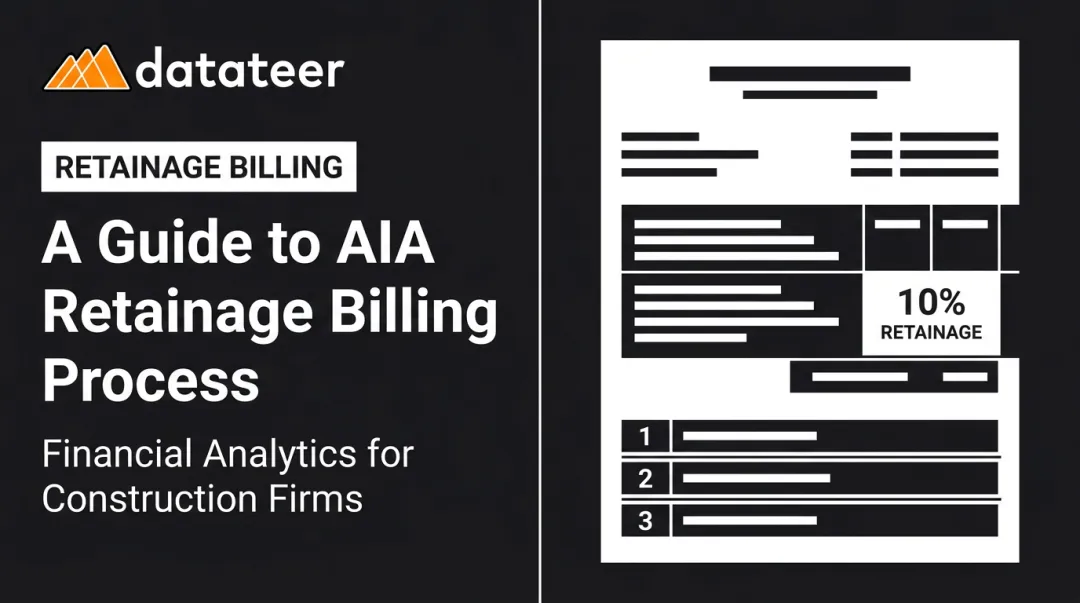
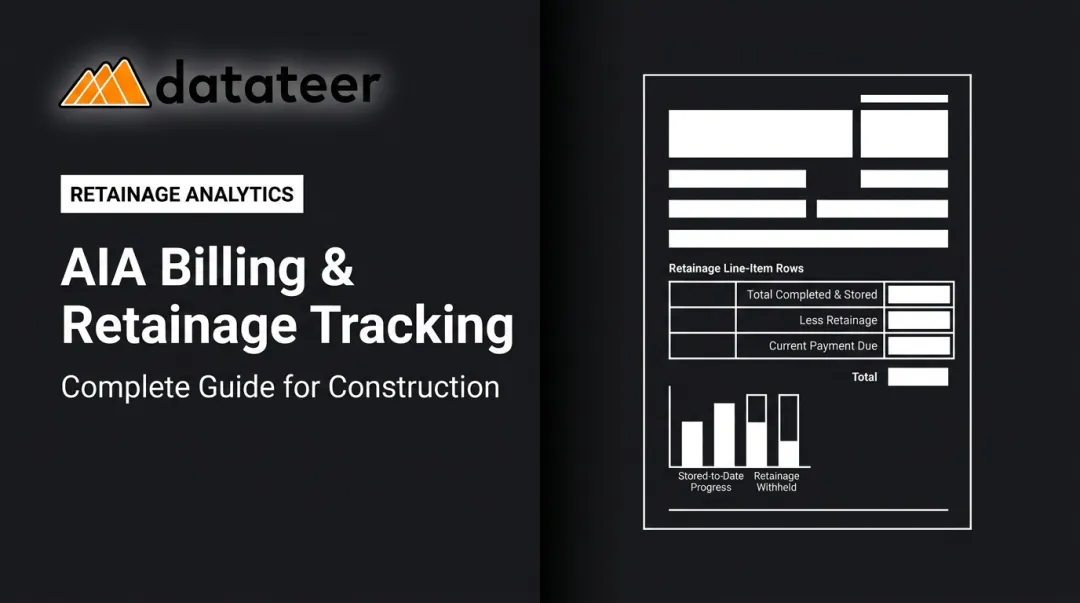
With each pay application, the retainage percentage is deducted from the gross amount billed. Over a 12-month project, that accumulating balance can grow to equal or exceed the contractor's total profit margin. At that point, retainage collection is as critical to profitability as any billing milestone — and just as worth tracking.
Public vs. Private Project Rules
Retainage rules differ sharply by project type and jurisdiction:
| Project Type | Federal/State Rules | Typical Cap |
|---|---|---|
| Federal construction | FAR 32.103 / 52.232-5 — retainage allowed when progress is unsatisfactory | 10% max |
| California public works | Public Contract Code § 7201 | 5% |
| Florida public construction | FS 255.078 | 5% |
| Washington public/private | RCW 60.28.011 / 60.30.010 | 5% |
| New York private | GBS 756-C | 5% |
| Illinois private | 815 ILCS 603 — step-down required at 50% completion | 10% → 5% |
| Massachusetts private (≥$3M) | MGL Ch. 149, § 29F | 5% |
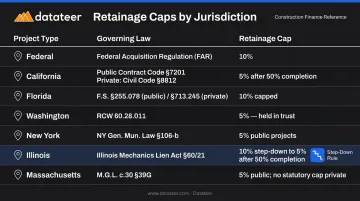
Private projects allow more negotiation flexibility; public projects follow stricter statutes. For finance teams managing multi-state portfolios, missing a jurisdiction-specific cap — like Illinois's mandatory step-down at 50% completion — can mean holding or releasing retainage incorrectly, which creates both cash flow and compliance exposure.
Substantial vs. Final Completion
This distinction matters more than most contracts make clear:
- Substantial completion — the owner can occupy and use the building; work is functionally complete
- Final completion — every punch list item is resolved, all documentation is submitted
Retainage tied to final completion can be held months or years longer. Pushing for release tied to substantial completion is one of the highest-value moves a contractor can make at the contract negotiation stage.
Pay-When-Paid and Pay-If-Paid Clauses
These provisions further delay subcontractor retainage. Under pay-if-paid clauses, subcontractors only receive payment — including retainage — if and when the GC is paid by the owner, shifting non-payment risk downstream entirely.
The 2025 FASA/ASA 50-State Contingent Payment Survey identifies state-by-state limits, including states like California, New York, North Carolina, Wisconsin, and Virginia that have restricted or prohibited pay-if-paid enforceability.
The Cash Flow Reality: How Retainage Creates Payment Delays
When a contractor operates on a 5% net profit margin and the owner withholds 10% retainage, the contractor is effectively cash-flow negative on the profit portion of every invoice for the entire project duration.
A 2019 Levelset survey of 503 construction professionals found that 66% waited more than 30 days to collect retainage after project completion. That's a significant working capital drain layered on top of the standard payment cycle.
The Compounding Delay Effect
Retainage risk accumulates alongside other payment friction:
- Slow pay applications and approval backlogs
- Change order disputes that pause billing
- Administrative errors that give owners procedural grounds to delay
- Crew demobilization that slows punch list resolution
CFMs managing 10, 20, or 50+ active projects face this compounding exposure simultaneously across their entire portfolio — not on one job at a time.
The "Last Mile" Problem at Project Closeout
The final 5–10% of a project is disproportionately where retainage disputes concentrate. As crews demobilize and attention shifts to new work, incomplete documentation and unresolved defect claims give owners legal grounds to withhold funds indefinitely. At this stage, the owner holds the most leverage: the contractor's incentive to return is low, and the cost of prolonged dispute often exceeds the withheld amount.
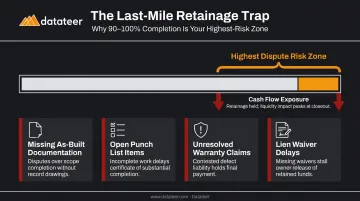
Common closeout triggers that stall retainage release:
- Missing or incomplete as-built documentation
- Open punch list items with disputed responsibility
- Unresolved warranty or defect claims
- Lien waiver or final release paperwork delays
Strategic Business Risk
Capital trapped in aging retainage receivables creates downstream consequences that compound quickly:
- Reduced working capital and compressed bonding capacity
- Limited ability to bid new work
- Forced reliance on credit lines for operating costs
- Inaccurate WIP reports that overstate profitability until cash arrives
These risks don't stay isolated to individual projects. Late payments cost the construction industry $208 billion in 2022, with nearly half of subcontractors waiting 30+ days for payment, according to Construction Dive — a number that reflects the systemic nature of retainage exposure across the industry.
Retainage on the Books: How CFMs Should Track It
Retainage Receivable vs. Retainage Payable
These are two distinct balance sheet items that must be tracked separately:
- Retainage receivable — funds the owner withholds from the GC; recorded as an asset but not yet cash
- Retainage payable — funds the GC withholds from subcontractors; recorded as a liability
Confusing or combining them produces unreliable financial reporting and distorted WIP calculations.
WIP and Revenue Recognition Impact
Firms generally don't recognize retainage as revenue until it's earned and released. This directly affects over/underbilling calculations in WIP reports. Misclassifying retainage makes a project appear more profitable than it is. When the cash finally arrives and the gap becomes visible, corrective action is often already too late.
What Proper Retainage Tracking Looks Like
Operationally, effective retainage management requires:
- Aging retainage receivables by project, flagged when approaching or past contractual release dates
- Mapping expected release dates to project milestones (substantial completion, final lien waivers)
- Reconciling retainage payable against what each subcontractor is owed
- Cross-checking retainage balances against ERP data to catch discrepancies before they become disputes
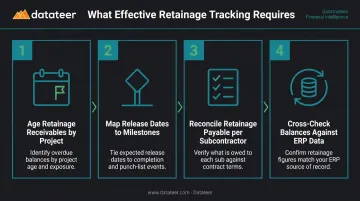
Many firms still manage this in spreadsheets, creating reconciliation errors, version control issues, and visibility gaps that delay corrective action. When retainage tracking lives in Excel, a data error doesn't surface until month-end close — and by then, overdue balances have already gone uncollected for weeks.
The Bonding Capacity Connection
Those same tracking gaps that distort WIP reports also catch the attention of surety underwriters. Underwriters evaluate working capital ratios when setting bonding limits, and large retainage receivable balances that are poorly aged, miscategorized, or unmonitored signal weak liquidity — reducing bonding capacity and limiting the firm's ability to bid on new work. Accurate, current retainage data is both a financial reporting requirement and a direct input to how much work the firm can pursue.
Common Causes of Retainage Payment Disputes
Contract Ambiguity
Vague definitions of "substantial completion," missing step-down provisions, and imprecise scope language create conditions for disagreement. Without a clear contractual trigger forcing the owner's hand, retainage release becomes discretionary — and discretion rarely favors the contractor.
Punch List and Work Quality Disputes
Owners frequently use retainage as leverage to compel defect corrections. Without documented, progressively signed-off records of completed work, contractors are vulnerable to subjective disputes that can extend withholding indefinitely. A well-documented acceptance trail is one of the most effective dispute prevention tools available.
Administrative and Documentation Failures
Even without a substantive dispute, procedural gaps give owners and GCs grounds to delay payment. Common triggers include:
- Incomplete or incorrectly formatted pay applications
- Missing lien waivers at the wrong billing stage
- Retainage calculation errors or improperly tracked balances
- Discrepancies between what the ERP shows and what was submitted
Manual tracking compounds the problem. Errors in spreadsheets or ERP systems create discrepancies that trigger delays where none should exist — converting a process failure into a real cash flow problem.
How to Reduce Payment Delays and Speed Up Retainage Release
Negotiate Better Contract Terms Upfront
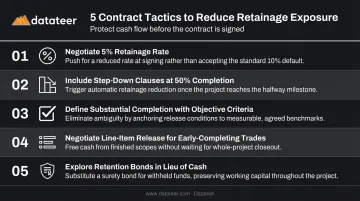
This is the highest-leverage point. Terms locked at contract signing are far harder to change mid-project:
- Push for 5% retainage over 10%
- Include step-down clauses reducing the rate at 50% completion
- Define "substantial completion" using objective, measurable criteria (not subjective owner judgment)
- Negotiate line-item release for trades that complete early
- Explore retention bonds as an alternative to cash withholding — Washington state law (RCW 60.28.011) expressly allows a bond in lieu of public retainage
Maintain Billing and Documentation Discipline
Throughout the project:
- Submit clean, complete, timely pay applications — errors reset the clock
- Document all completed work with progressive sign-offs
- Send formal written demand letters referencing applicable state Prompt Payment Act deadlines when retainage is not released on schedule
- Know your state's penalties: California imposes 2% per month on wrongfully withheld retention, Texas 1.5% per month, Washington and New York 1% per month — these are meaningful numbers worth invoking
Eliminate Financial Blind Spots with Real-Time Retainage Tracking
Construction finance managers overseeing multiple active projects cannot effectively manage retainage exposure through spreadsheets or reports that are 10–20 days stale. By the time a month-end WIP report surfaces an overdue balance, weeks of collection time have already been lost.
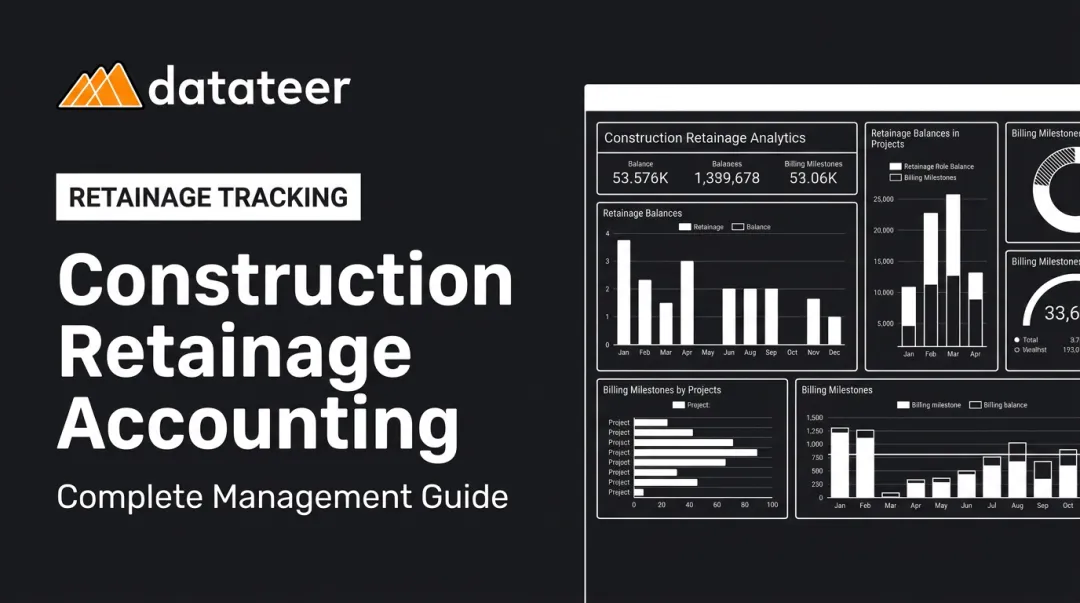
Datateer's retainage analytics platform addresses this directly. The Construction Retainage Tracking & Schedule Analytics module tracks:
- A/R retainage — retainage held by owners on your firm, aged by project and flagged when past due
- A/P retainage — retainage your firm holds on subcontractors, tracked per project and per sub
- Overdue retainage flags — identifies balances tying up working capital without triggering formal collection action before they become collection problems
- 13-week cash flow integration — retainage release schedules feed directly into forward-looking liquidity projections
Data syncs overnight from your connected ERP (Procore, Sage, Viewpoint Vista, Acumatica, Foundation, CMiC, Jonas, QuickBooks, NetSuite, and others) with no manual exports required. Both A/R and A/P retainage are pulled from a single ERP connection, eliminating the reconciliation gymnastics that manual processes require.
The entire platform, including retainage tracking, is bundled into flat annual pricing starting at $10,000/year per data source with unlimited users — no per-seat fees, no module add-ons. Implementation takes 2–4 weeks, and all dashboards go live simultaneously on day one.
For CFMs who want to see the retainage dashboard populated with their own ERP data, Datateer offers a free 15-Minute Workflow Audit: no slides, just your data and a direct conversation about what's possible.
Frequently Asked Questions
How is retainage used in construction billing and payments?
Retainage is a percentage — typically 5–10% — deducted from each progress payment and held by the owner until the project reaches substantial or final completion. It serves as a financial incentive for contractors to complete quality work and as a security buffer protecting the owner against defects or default.
How long should a contractor wait to get paid?
Under most state Prompt Payment Acts, retainage is due within 30–60 days of substantial or final completion. Subcontractors wait even longer: the Billd 2024 report found an average 57-day delay just for standard progress payments, on top of any retainage holdback.
How to reduce payment delays in construction?
Four levers make the biggest difference:
- Negotiate clear payment terms and step-down clauses before signing
- Submit accurate, timely pay applications every billing cycle
- Document completed work with progressive owner sign-offs
- Track retainage in real time so overdue balances surface before they become a cash flow problem
What are my rights if construction payment is delayed?
Most states have Prompt Payment Acts entitling contractors and subcontractors to interest on late payments — ranging from 1% to 2% per month depending on the state. You can also pursue mechanics liens, demand letters, and dispute resolution (mediation or arbitration). Consult applicable state statutes and legal counsel for your specific situation.
What is the difference between retainage receivable and retainage payable?
Retainage receivable is money the owner owes to the GC: an asset on the balance sheet. Retainage payable is money the GC owes to subcontractors: a liability. Tracking both accurately across every active project is essential for correct WIP reporting and reliable cash flow management.
What is a typical retainage percentage in construction?
5% and 10% are the most common rates. Many states have passed laws capping retainage at 5% for public and/or private projects — California, Florida, Washington, New York, and Massachusetts among them. Illinois requires a step-down from 10% to 5% at the 50% completion threshold on private projects.