Introduction
Most commercial construction teams have filled out a G702 dozens of times. Far fewer can explain why the architect returned the last one — or how a retainage miscalculation from billing period three is still affecting cash flow in month eleven.
AIA progress billing is the construction industry's standardized method for requesting payment incrementally as work is completed, using specific AIA forms to document, verify, and certify each payment application against the contract value. It governs how cash moves through a project from start to substantial completion.
This matters most to construction finance managers, CFOs, project accountants, and CPA advisors serving construction clients. According to Levelset's 2019 National Construction Payments Report, 49% of construction payments are not made on time and the average payment takes 83 days.
At that pace, every step of the pay application process is a cash flow decision, not just a paperwork exercise.
Those delays rarely start with the owner. The teams that struggle most with AIA billing aren't unfamiliar with the forms — they treat them as templates to complete rather than financial controls to enforce. Rejected applications, accumulated retainage errors, and compounding cash shortfalls follow directly from that distinction.
Key Takeaways
- AIA progress billing uses two core forms: the G702 (payment application summary) and the G703 (line-item continuation sheet tied to the Schedule of Values)
- Progress payments are incremental releases tied to verified work — not full disbursements
- Retainage (typically 5–10% per billing period) accumulates and releases only at or near substantial completion
- Architect certification of the G702 is required before the owner releases payment, making it the most common cash flow bottleneck
- AIA billing is only contractually required when the project agreement specifies it — a simpler format used correctly outperforms a misapplied G702 every time
What Is AIA Progress Billing — and Why Construction Uses It
What AIA Progress Billing Actually Is
AIA progress billing is a formal payment application process created by the American Institute of Architects. Contractors document work completed during a billing period and request payment against the total contract value using standardized forms tied to a pre-approved Schedule of Values.
It's meaningfully different from a standard invoice. A typical invoice states an amount due. An AIA pay application requires:
- Line-item documentation of percentage complete per scope item
- Architect certification before payment is authorized
- Supporting documentation (lien waivers, stored material records, change order logs)
- Mathematical reconciliation between the summary form and the line-item detail
That documentation trail makes it an auditable financial record — not just a payment request.
Why AIA Billing Became the Commercial Standard
Multi-phase construction projects can't rely on simple invoicing. Work happens across months or years, materials get stored before installation, and multiple subcontractors need payment simultaneously. Lenders and auditors require documented evidence of progress at every stage — a level of detail a standard invoice can't provide.
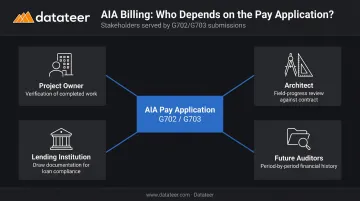
AIA describes G702/G703 as the industry standard for monthly payment releases — a consistent format that all four parties in a commercial project depend on. AIA billing satisfies each party's documentation requirements from a single submission:
- The project owner — verification that payment corresponds to real, completed work
- The architect — a structured format for field-progress review against the contract record
- The lending institution — auditable draw documentation for construction loan compliance
- Future auditors — a clear, period-by-period financial history of the project
AIA billing is not a legal mandate by default. It becomes contractually required when a project specifies AIA A201 General Conditions or when the owner's contract explicitly demands G702/G703 format submissions. If neither condition applies, simpler invoicing may be sufficient.
How AIA Progress Billing Works Step by Step
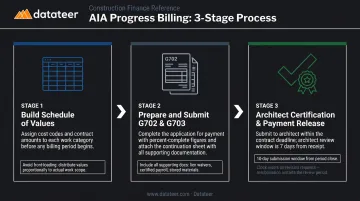
The process follows a consistent sequence on every project. The contractor establishes a Schedule of Values before work begins. At the close of each billing period, completed percentages are documented per line item. The G702 and G703 are prepared and submitted with supporting documents. The architect certifies — or returns for revision. The owner releases payment minus the retainage holdback.
Here's each step in practice.
Step 1: Build the Schedule of Values
The Schedule of Values (SOV) is the billing roadmap for the entire project. It breaks the total contract amount into individual line items — site prep, concrete, MEP, finishes — with assigned dollar values. Every future pay application measures progress against it.
The most common SOV mistake is front-loading: assigning inflated values to early-phase line items to collect more cash upfront. Owners and architects identify this quickly. The result is rejected submissions, forced revisions, and a strained relationship before the project gains momentum.
AIA explicitly states that architects review the SOV to verify it isn't front-loaded — and that front-loading creates serious overpayment risk if a contractor defaults mid-project.
Build the SOV to reflect realistic cost distribution. A well-structured SOV moves through architect review faster and avoids forced revisions down the line.
Step 2: Prepare the G702 and G703 Forms
The G702 is the summary and formal payment request. It captures:
- Original contract value
- Approved change orders to date
- Total work completed (current period and cumulative)
- Retainage withheld
- Previous payments received
- Net amount currently being requested
This is the document the architect signs. Without that signature, the owner has no authorization to release payment.
The G703 is the evidentiary backup. Structured around the SOV, it shows for each line item:
- Scheduled value
- Work completed this period
- Cumulative work completed to date
- Stored materials on site
- Percent complete
- Retainage (where variable retainage applies)
If the G703 figures don't reconcile with the G702 summary, reviewers flag the entire package. The two forms work as a unit: the G702 is only as credible as the G703 data supporting it.
Step 3: Submit, Get Certified, and Receive Payment
A complete submission package includes:
- G702 + G703
- Lien waivers from subcontractors
- Stored material invoices with delivery verification
- Updated change order log
- Insurance certificates (if required by contract)
Incomplete packages are the single most common reason for delayed certification. Confirm what each owner requires before the first billing period — requirements vary by contract and project type.
Under AIA A201-2017, the contractor submits the application at least 10 days before the progress payment date. The architect then has 7 days to issue a Certificate for Payment or notify both parties of reasons for withholding. Once the architect signs the G702's "Certificate for Payment" section, it authorizes the owner to release payment. If the architect returns it with revisions requested, the clock resets.
Key Documents and Terms in AIA Billing
| Term | What It Is | Why It Matters |
|---|---|---|
| G702 | Application and Certificate for Payment — the summary form and formal payment request | Requires architect's certification signature; no signature, no payment |
| G703 | Continuation Sheet — line-by-line breakdown tied to the SOV | Provides the evidentiary detail that justifies every dollar on the G702 |
| Schedule of Values | Pre-project billing framework dividing the contract into scope categories with assigned values | The single reference document for all progress measurement — errors here cascade through every billing period |
| Retainage | Percentage withheld from each progress payment (typically 5–10%) | Accumulates across all billing periods; released at substantial completion — a significant cash flow constraint on longer projects |
| Change Orders | Approved modifications adjusting contract scope and value | Only formally approved change orders may be billed; pending or verbal agreements cannot appear in a G702 |
Levelset notes that contractors and subcontractors whose work is concentrated early in a project can wait months or years to collect all retainage owed. On a 24-month project with a 10% holdback, that's a substantial float that the contractor is effectively financing for the owner. State laws vary considerably — New York's private-project rules now cap retainage at 5%, for example — so contract terms and jurisdiction always govern.
Common Errors That Stall AIA Pay Applications
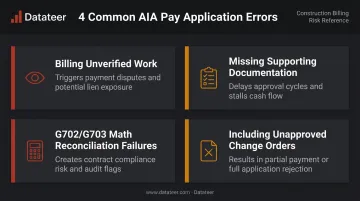
Most pay application rejections trace back to four recurring mistakes.
1. Billing work before it's field-verified
Listing a line item at 100% complete before the architect or owner has confirmed it in the field is the fastest path to rejection. Percentages must reflect observable, verifiable progress — not internal schedule assumptions or optimistic projections.
2. Missing or mismatched supporting documentation
Lien waivers from lower-tier subcontractors, stored material invoices with delivery confirmation, and an updated change order log are standard attachments on most commercial projects. One missing document can hold up the entire application.
3. Math errors and reconciliation failures between G702 and G703
If G703 line-item totals don't reconcile with the G702 summary — or if retainage percentages are applied inconsistently across line items — the entire package gets flagged. For finance teams managing AIA billing across multiple concurrent projects, this is where parallel spreadsheets create the most damage.
Platforms like Datateer that sync directly with construction ERPs (Procore, Sage, Viewpoint Vista, Acumatica, and 12+ others) eliminate the manual re-entry step where most reconciliation discrepancies originate. Datateer's WIP dashboard calculates percentage complete, earned revenue, over-billings, and under-billings automatically from live ERP data, so the figures going into a billing period's G702 reflect what the accounting system actually shows.
The Retainage Tracking module extends this further, tracking retainage per project and per owner, flagging overdue releases, and integrating retainage schedules into 13-week cash flow forecasting.
4. Including unapproved change orders
Change orders awaiting owner or architect approval cannot legally be billed. Submitting them signals poor document control and erodes owner trust — slowing future approvals even after those change orders are formally signed. Datateer's Change Order Impact & Aging module tracks status across pending, approved, denied, and executed stages, giving finance teams a clear view of what's billable before the G702 is prepared.
When AIA Billing May Not Be Required
AIA billing is contractually required only when the project agreement references AIA A201 General Conditions or explicitly mandates G702/G703 submissions. Smaller private projects, residential builds, and direct-owner commercial contracts without those references are not obligated to use AIA format.
Simpler alternatives may be more appropriate when:
- The approval chain is short (owner and contractor dealing directly, no lender oversight)
- The project scope is narrow and easily documented in milestone-based invoices
- The documentation burden of full AIA compliance outweighs its benefit for that project size
The disciplines AIA billing enforces — SOV structure, work verification before billing, consistent retainage tracking — remain the disciplines that prevent disputed payments and WIP distortion. Teams that abandon those disciplines along with the forms often discover the real cost later.
Treating G702 and G703 as forms to fill in without understanding retainage terms, SOV structure, or change order requirements produces mechanical compliance without financial control. Adopt AIA billing deliberately — with full understanding of what each field means, not as an inherited administrative habit.
Frequently Asked Questions
What is AIA progress billing?
AIA progress billing is the standardized construction payment application process using G702 and G703 forms to document completed work by line item against the Schedule of Values and formally request payment at defined billing intervals. It requires architect certification before the owner releases any payment.
What is the difference between a progress payment and a final payment?
Progress payments are incremental releases tied to verified work completed during each billing period, with retainage withheld from each one. The final payment releases the remaining contract balance — including all accumulated retainage — once the project reaches substantial completion and all close-out obligations are met.
What forms are used in AIA progress billing?
The G702 (Application and Certificate for Payment) is the summary and formal payment request; the G703 (Continuation Sheet) is the line-item detail form tied to the Schedule of Values. Both are submitted together as a single billing package — neither is valid without the other.
What is retainage and when is it released in AIA billing?
Retainage is a percentage withheld from each progress payment — typically 5–10% — as a performance guarantee. It accumulates throughout the project and is released based on terms defined in the contract, typically at substantial completion or final project acceptance. State law may cap the retainage percentage.
Can subcontractors use AIA billing forms?
Yes. Subcontractors frequently use AIA forms when the subcontract requires it. Consistent subcontractor documentation gives the general contractor accurate, verifiable line-item detail to compile its own pay application against the master Schedule of Values.
What causes AIA pay applications to be rejected or delayed?
The most common causes include:
- Billing for work not yet field-verified
- Missing supporting documentation (lien waivers, stored material invoices)
- Including unapproved change orders
- Math errors or retainage miscalculations between G702 and G703
Incomplete packages are rejected outright; errors reset the architect's review timeline.