
The gap isn't in knowing that you should charge for changes. It's in knowing exactly what to include, which markup to apply, and how to adjust your pricing based on who caused the change. Get those three things right, and change orders stop being a margin drain.
Key Takeaways
- Change order pricing covers three layers: direct costs, overhead, and consequential impact costs — all three must be captured.
- Know your actual overhead rate before accepting any markup cap a contract tries to impose on you.
- Owner-directed changes warrant full premium pricing; unforeseen conditions call for fair cost-recovery rates.
- Never start change order work without written approval. Verbal authorization disappears the moment the work is done.
- Without real-time cost tracking, impact cost claims are nearly impossible to prove after the fact.
How to Price a Construction Change Order Step by Step
Step 1: Calculate Direct Costs
Start with every cost that exists only because of this change. Most contractors get the obvious ones. It's the second tier that gets missed.
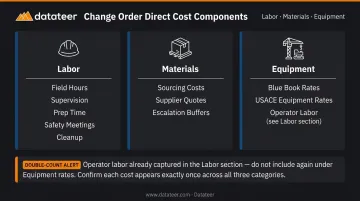
Labor — include more than field hours:
- Field labor hours for the changed scope
- Estimating and change order preparation time
- Supervision hours directly attributable to the change
- Safety meetings and toolbox talks tied to the new scope
- Cleanup labor
Materials — use actual quotes where possible. For materials not yet sourced, apply a documented escalation buffer and state your basis for the estimate. Vague estimates get challenged; documented assumptions hold up.
Equipment — price using recognized rate references such as the Rental Rate Blue Book or USACE EP 1110-1-8 rates, or whatever your contract specifies. Confirm that operator labor is captured separately — it's a common double-count error in reverse, where neither rate includes the operator.
Step 2: Add Indirect and Overhead Costs
Indirect costs are project-linked expenses that don't belong to a single line item: workers' comp insurance, payroll taxes and fees, small tools and consumables, OSHA compliance time, and warranty exposure. Each needs a defensible percentage backed by your actual cost data, not a guess.
Overhead — rent, admin salaries, office utilities, management time — must be recovered on change order work just like base contract work.
The problem is that many institutional contracts cap markup at 10% total for overhead and profit combined. According to CFMA's 2024 Construction Financial Benchmarker, SG&A alone runs 11.8% of revenue for the average construction firm. If your overhead runs above what a 10% cap recovers, you're working at a loss on that change.
Know your actual overhead rate before you sign a contract with a markup cap. Negotiate caps at contract execution — not after a change order surfaces.
That validation requires real numbers, not estimates. Datateer's Overhead & Burden Rate Analytics module calculates actual fully-burdened labor rates by craft and division, compares budgeted burden rates against actuals, and surfaces under-allocated overhead by project — giving a CFM the data to defend a markup rate before submitting, not rationalize it afterward.
Step 3: Account for Consequential Impact Costs
Impact costs are often the largest component of a change order — and the hardest to collect without documentation.
Impact costs are the ripple effects a change creates on work you were already doing:
- Crew demobilization and remobilization
- Overtime to recover schedule
- Stacking of trades (multiple subs competing for the same space)
- Supervision dilution across more simultaneous scopes
- Rework in completed areas disturbed by the change
MCAA research shows overtime productivity losses compound quickly: at 60 hours per week, crews lose 10% productivity in week one and 17% by week four. At 70 hours, week-four losses reach 22%. These aren't opinion — they're measurable, citable numbers.
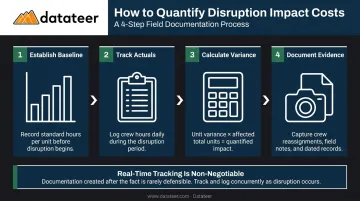
How to quantify impact costs:
- Establish a baseline productivity rate (hours per unit installed) from the pre-disruption period
- Track actual hours per unit during the disruption window using daily logs
- Calculate the variance and multiply by total affected units
- Document crew reassignments and schedule compression with same-day field records
The catch: firms still running monthly spreadsheet close cycles often discover these costs three to four weeks after they occurred — long after the documentation window closes. Catching the variance the next morning is what separates a defensible claim from a theoretical one. Datateer's Change Order Impact & Aging module pulls overnight from Procore, Sage, Vista, Spectrum, and Acumatica, surfacing labor slippage and cost variances by cost code before the morning standup.
Step 4: Apply Profit Markup and Finalize the Price
Apply markup to your full cost base — direct costs plus indirect costs plus impact costs. Applying markup only to direct labor is one of the most common underpricing errors in the industry. It understates the true cost base and permanently compresses margin on every change you sign.
A few pricing principles worth keeping:
- Enter at the high end of a defensible range. Change orders get negotiated down. If you start at your target margin, you exit below it. On a change order, you're the only contractor available — use that leverage.
- Bond costs are recoverable under AIA A201-2017 Section 7.3.4. Bond and insurance premiums are expressly includable when pricing a Construction Change Directive. If the change increases bonded contract value, itemize the additional premium separately rather than absorbing it into overhead.
- Lump sum vs. Not-to-Exceed: if the scope is clear, lump sum pricing is fine. If scope is vague, push for a Not-to-Exceed change order with documented cost tracking — it protects you from absorbing undefined risk.
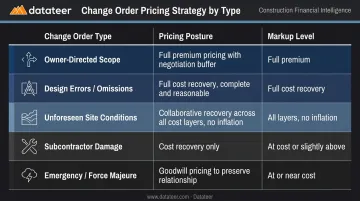
How to Adjust Markup Strategy Based on the Type of Change
Not every change carries the same pricing leverage. Treating them identically leaves money on the table — or damages the relationship you need to finish the job.
Owner-Directed Changes
The owner voluntarily decided to modify scope mid-project. You're already mobilized. There is no competitive pressure. This is the clearest case for premium pricing and full markup on all three cost layers. These changes are optional — price them accordingly, with room to negotiate without giving up margin.
Design Errors and Omissions
When changes stem from errors or omissions in the original construction documents, the cost traces back to the design professional. Price these fully — all direct, indirect, and consequential costs — but not opportunistically. Optional late-stage design refinements can carry a premium; necessary corrections to design errors should be priced completely and reasonably.
AIA A201-2017 Section 3.2.2 requires prompt reporting via RFI. Identifying an error doesn't automatically entitle you to additional cost, so document carefully from the moment you spot it.
Unforeseen Site Conditions
Hidden subsurface conditions, inspector-required code upgrades, renovation surprises — these are outside anyone's control. The right posture is collaborative: price at cost recovery, not cost recovery plus a premium. Being reasonable doesn't mean absorbing costs — capture all three layers, just don't inflate them.
Under AIA A201-2017, notice for concealed or unknown conditions must be provided before disturbing the condition and no later than 14 days after first observation. Miss that window and the claim weakens significantly.
Damage by Other Subcontractors
The pricing objective here is full cost recovery, not profit generation. Document the damage immediately with photos and daily logs, and issue a back-charge at cost or slightly above, depending on the working relationship. Exception: if the responsible party's general liability insurance is covering the claim, standard or premium markup becomes more defensible — you're pricing against a policy, not a relationship.
Emergencies
Genuine job emergencies — burst pipes, fire remediation, roof failures — call for a different calculus than scope changes. Price at or near cost. That posture preserves goodwill and reflects the reality that neither party caused the event. If insurance covers the loss, standard markup applies.
Quick reference by change type:
| Change Type | Pricing Posture | Markup Level |
|---|---|---|
| Owner-directed scope | Premium justified | Full + negotiation buffer |
| Design errors/omissions | Full cost recovery | Complete, reasonable |
| Unforeseen site conditions | Collaborative recovery | All three layers, no inflation |
| Subcontractor damage | Cost recovery | At cost or slightly above |
| Emergency / force majeure | Goodwill pricing | At or near cost; standard if insured |
Key Variables That Affect Your Change Order Markup Rate
Markup rates aren't universal. Each change order carries its own risk profile, and your pricing should reflect that before you submit.
| Variable | Why It Matters | Pricing Impact |
|---|---|---|
| Contract Markup Caps | Many institutional contracts (colleges, hospitals, municipal work) cap total markup at 10% | Negotiate caps at contract execution, not mid-project |
| True Overhead Rate | CFMA 2024 reports SG&A at 11.8% of revenue industry-wide | Stale figures cause underbilling across every single change |
| Scope Clarity | Vague scope carries more execution risk | Build a risk premium in, or use Not-to-Exceed with cost tracking |
| Payment Risk | GCs can lose owner approval after work is done; owners can exhaust contingency | Price slightly above target to buffer against occasional denials |
Scope clarity deserves special attention. Lump sum pricing on a poorly defined change is high-risk territory. Either require a clear scope definition before pricing, or build in a meaningful contingency. That premium isn't padding; it's protection against scope creep that would otherwise erode your margin directly.
What You Need Before Pricing a Change Order
Accurate pricing starts with the right inputs. Rushing an estimate without complete documentation is how legitimate change orders end up underpaid.
Documentation you need:
- Clear scope description (or the RFI/CCD that triggered the change)
- Photos of existing field conditions before any change work begins
- Original contract cost codes to baseline your direct cost estimate
- Any prior daily logs covering the affected work area
Contract terms to review before submitting:
- Markup percentage caps
- Notice deadlines — AIA A201-2017 uses 21 days for Claims and 14 days for concealed conditions; your contract may differ
- Required cost breakdown format
- Approval workflow and signature authority chain
Missing a contractual notice deadline can invalidate a legitimate claim entirely — check your contract before the change work begins.
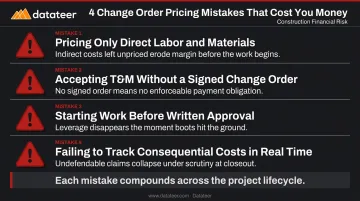
Common Mistakes That Erode Change Order Margins
Each of these mistakes is common, preventable, and expensive once it takes hold across a project.
- Pricing only direct labor and materials. Indirect costs, supervision, warranty exposure, consumables, and administrative prep time all compound across a project — and together they erode margin on change order work.
- Accepting T&M billing without a formal change order. A T&M ticket isn't a signed change order. GCs routinely revisit T&M costs after the fact to negotiate them down. Always offer a Not-to-Exceed change order as an alternative.
- Starting work before written approval. Once the work is complete, your leverage disappears with it. Verbal authorization won't hold up, discount requests follow, and your payment rights are effectively gone — this is the most reliable way to give away margin.
- Failing to track consequential costs in real time. Impact costs are nearly impossible to prove retroactively without contemporaneous documentation. Without daily logs and productivity data captured as costs occur, these claims get rejected.
Frequently Asked Questions
What is a typical change order fee?
No universal standard exists in AIA, AGC, or ConsensusDocs primary documents. Contract-specific examples range from 10% at Case Western Reserve's institutional specs to up to 20% under University of Hawaii guidance. CFMA data shows SG&A alone averages 11.8% of revenue, which means a 10% total cap may not cover overhead before profit.
Why are change orders so expensive?
Change orders include not just direct labor and materials but also indirect costs, administrative burden, and consequential impact costs — crew remobilization, productivity disruption, and overtime to recover schedule. Those hidden layers are what drive the total price above the base scope estimate.
What markup percentage should I charge on a construction change order?
It depends on the type of change, contract terms, and your actual overhead rate. Owner-directed changes often support 15% or higher; unforeseen condition changes may warrant 10–12%. Benchmark against your real overhead data — not an assumed standard.
Should I ever agree to T&M billing on a change order?
T&M billing without a formal change order creates significant payment risk. If a client insists on T&M, offer a Not-to-Exceed change order instead: this establishes a signed maximum price while still tracking actual costs through field tickets.
What costs are most commonly missed when pricing change orders?
Consequential impact costs are the most frequently overlooked category: demobilization, productivity loss, supervision dilution, and overtime all add up fast. Also commonly missed are small tools, consumables, safety meeting time, warranty exposure, and change order preparation hours.
What happens if I start work before the change order is signed?
Performing work without a signed change order weakens your legal position significantly. It removes schedule leverage for approval, opens the work to after-the-fact price disputes, and in some jurisdictions may affect lien rights for that specific scope. Document everything and push for written authorization before mobilizing.